No Good Reason

Standard

I woke up early the other day thinking about my blog and tried to come up with one good reason why I haven’t posted anything lately. (Can you believe I wrote my last post about this survey of American alcohol consumption habits six weeks ago?) It turns out there isn’t a good reason. All the things that might have caused me to put it aside—like being so close to the end of my resolution that it just seems too boring to acknowledge again; or that winter meant the end of my running season and also the need for training updates; or even the fact I just started a new job, but still had to finish up a few things for my old one—just add up to pure and simple procrastination.

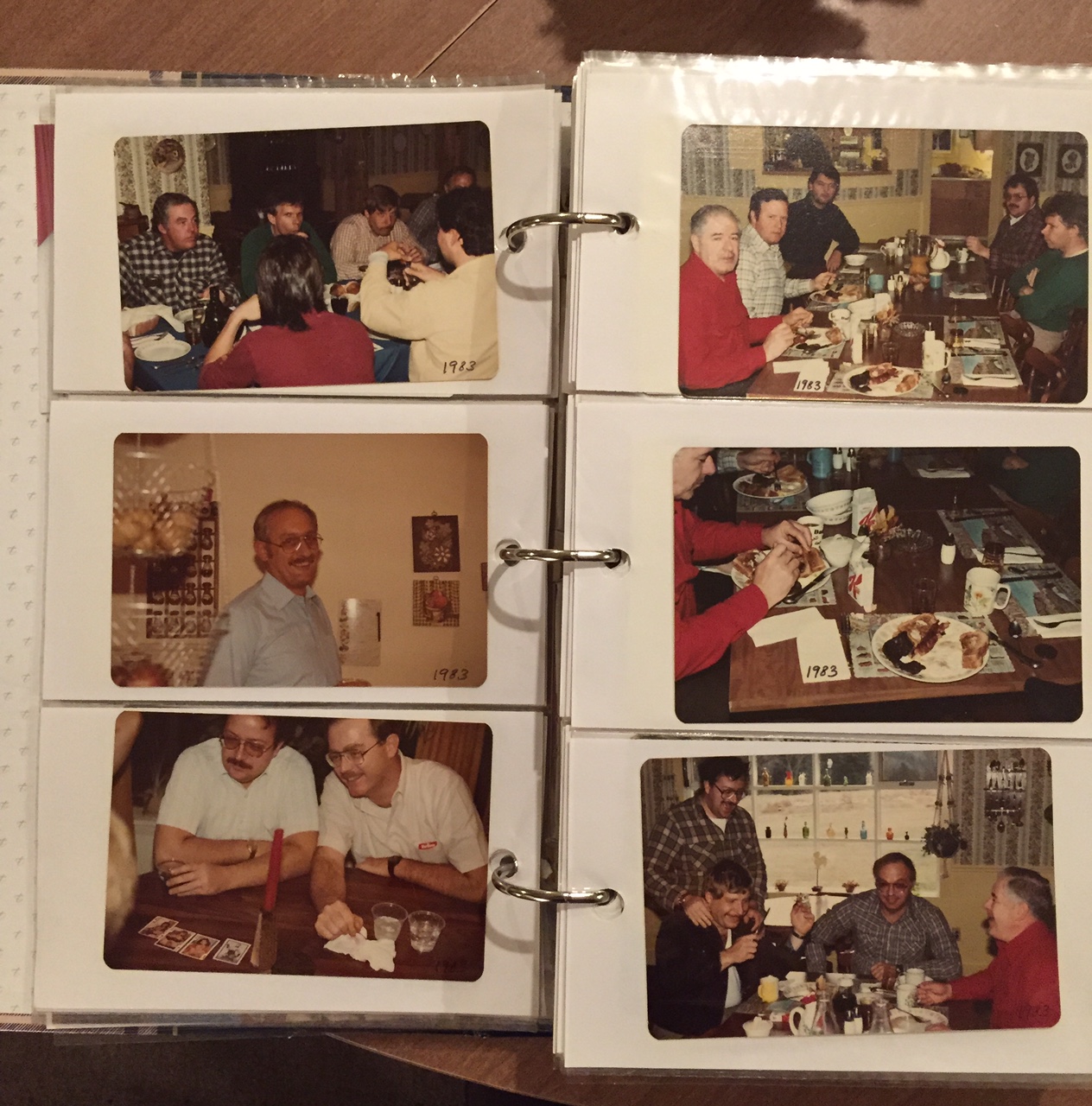
It certainly wasn’t due to a lack of material. Believe it or not, the blog folder on my computer has a file for each of the five weeks I missed. The week of November 16th, I conducted several interviews and started and re-started a piece for the “Vermont Inn-trigue” thread of this blog about the inn’s most loyal guests, a group of hunters who’ve stayed at the inn each and every hunting season for the past 37 years. I interviewed the leader of this group, Tony, multiple times, heard many of his jokes and stories, and took a look at the scrapbook of his group’s many memorable times at the inn.

Tony has stayed at the Combes Family Inn each and every year over its 37 years of operation.

Tony has stayed at the Combes Family Inn each and every year during its 37 years of operation.

Just a few of the snapshot from decades of visits to Vermont and the Combes Family Inn.

Just a few snapshots from the mementos complied over decades of visits to Vermont and the Combes Family Inn.

Tony saw this flyer in 1968 and decided it would be fun to scare up a group to go hunting in Vermont. The farm became the Combes Family Inn in 1978.

Tony saw this flyer in 1968 and decided it would be fun to scare up a group to go hunting in Vermont. The farm became the Combes Family Inn in 1978.

My first interview with the group was over dinner. When one of them asked “What’s for dinner?” my dad replied, “We’re not changing the menu unless you guys change your jokes.”

“You have a better chance of getting hit by lightning,” Tony replied. That evening, with the barbs and jibes getting lobbied back and forth, was not all that different from my first such dinner with them, when I was just 10 years old.

The night before the hunters left, we all watched the Patriots game and I had a chance to ask Tony if it surprised him that he’s been coming to the inn for 37 years in a row. “No it doesn’t,” he answered. “We’re comfortable coming here. When we leave, we’re already looking forward to coming again the next year. God willing, we’ll be coming for many more years.”

Before I knew it, the hunters were gone and I never turned that great material into a coherent article. The following week, I wondered if I should be concerned about my high levels of caffeine consumption. I vowed to research the pros and cons of caffeine and explain why people who stop drinking alcohol often become chronic coffee drinkers. This post would have been like my article about Crystal Light back in January. I found several articles about caffeine consumption, including this general overview, this one about the role coffee may play in helping people abstain from drinking alcohol, and this one citing 10 reasons to quit drinking coffee. I didn’t get very far in my research. However, I did resolve to figure out eventually which was worse, alcohol consumption or caffeine consumption. I’ll let you know when I figure that out.

Several other blog topics presented themselves in late November and early December. I briefly considered breaking with my usual M.O. by writing a political piece about the disheartening state of race relations in our country. Although I quickly ruled that out, I will share one comment that I left on Facebook that sums up my feelings about what transpired in Ferguson: “Mike Brown’s fate was sealed the moment Officer Wilson saw him him as a crazed demon that needed to be killed, rather than a troubled teen who needed to be saved.”

Two weeks ago, I almost opted to write about the end of the federal grant that I was directing and my thoughts about how that experience was personally fulfilling and even life-changing. If you get a chance, flip through “Vermont’s Digital Stories,” the final report for the project. I’m proud of the team’s work to improve lives in Vermont’s flood-damaged communities and remain very grateful to have had a meaningful opportunity to give back to others, after my own speedy recovery from Tropical Storm Irene.

Finally, last week, a friend of mine told me that she had heard an interesting radio segment about the different norms and perceptions for alcohol consumption in various countries. The point was that Americans have the lowest national tolerance (so to speak) for alcohol consumption and consume far less alcohol than most other nations. The differences are particularly acute between the U.S. and Europe, especially Italy and France. With such an interesting and relevant topic, I was certain my blog drought was going to be over. Alas, I couldn’t locate the radio piece my friend had heard. And, although I found a lot of articles about similar topics—such as this one, this one, and this one—the weekend came and went without a post.

So, now you’re all caught up on what I’ve been thinking about the past six weeks. Have a very happy holiday season—I promise to write again very soon. There’s no good reason not to.

Take It or Leave It

Standard

Now that I’m within striking distance of the end of my self-imposed year-long ban on drinking alcohol, I want to share my new appreciation for the surprisingly bifurcated nature of alcohol. A few weeks ago, I had quoted that 30% of American adults do not drink at all and another 30% drink less than one alcoholic beverage a week. Given how much time, energy, money, and everything else that the other 40% spend on alcohol (not to mention the negative consequences that result from drinking too much of it), am I the only one who is surprised to learn that for 60% of adult Americans alcohol is essentially a non-factor?

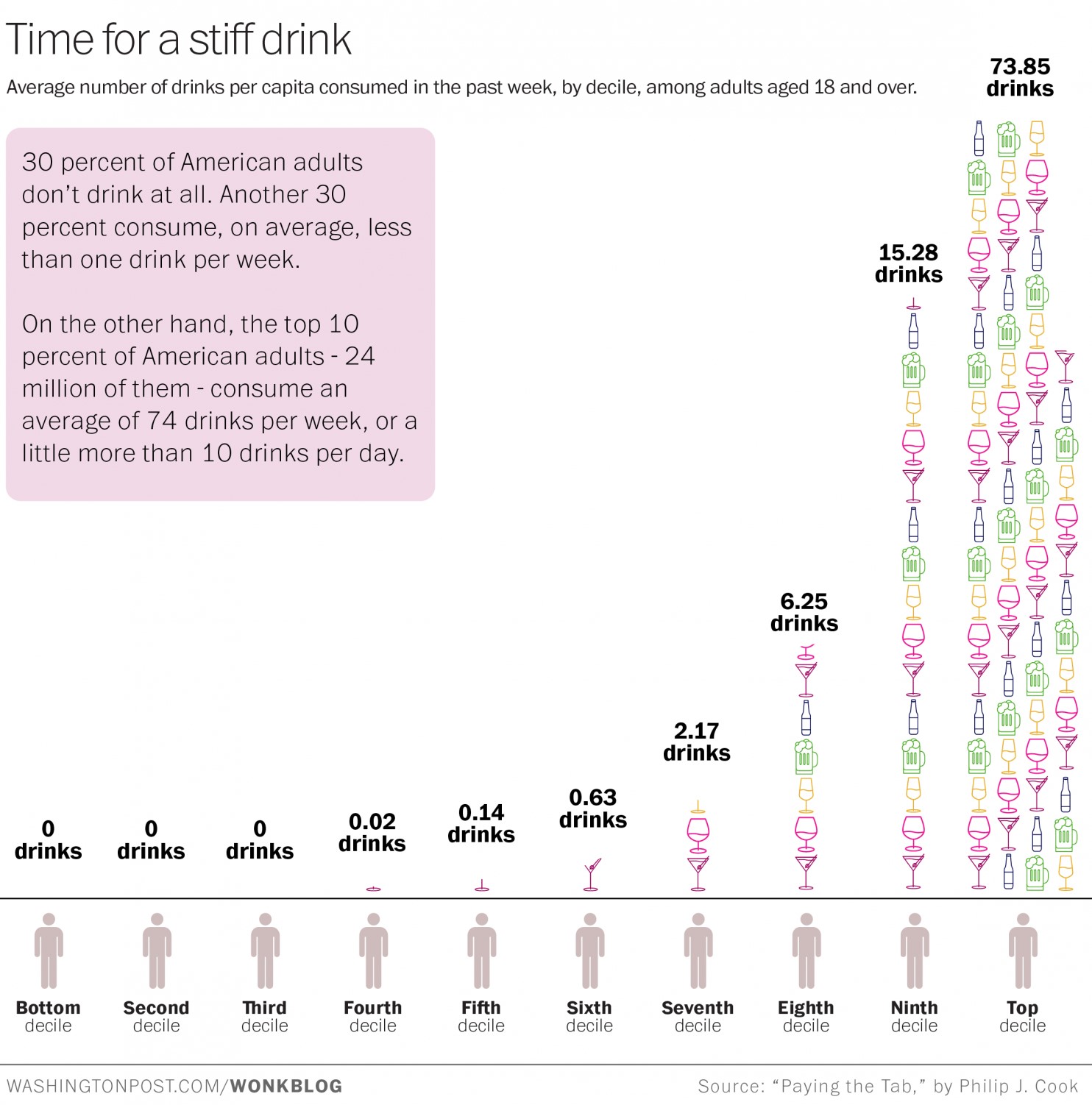
The info-graphic below does an amazing job of presenting the data on weekly alcohol consumption by breaking it into deciles or 10 equal sized groups of survey participants:

Drinking Info-graphic

This is how you read the graph: each group represents 10% of survey respondents, and, by extrapolation, 10% of all adult Americans. Starting on the left side, you have the folks who don’t drink at all – so you see “0 drinks,” meaning that these 10% chunks of Americans have no drinks in a typical week.  As you move to the right of the graph, you see the results for the next 10% of adult Americans, and so on, and so on. Since the first three deciles each report 0 drinks, this means that it is estimated by this survey that a full 30% of adult Americans do not drink at all.

The survey, just like all of the other stats I’ve seen about alcohol, refers to “drinks” according to the suggested serving size or the “standard drink.” That’s 12 ounces of regular beer (usually about 5% alcohol), 5 ounces of wine (typically about 12% alcohol), and 1.5 ounces of distilled spirits (about 40% alcohol).

With that in mind, continue moving to the right of the graph to see the results for Americans who drink, starting with those who drink the least. This reveals that another 30% drink less than one drink per week — 0.02 drinks per week on average, 0.14 drinks per week, and 0.63 drinks. Keep moving right on the graph to discover that people in the 7th decile report drinking only 2 drinks per week and those in the 8th decile a little less than one drink per day.

Now we’ve reached the part where the graph gets very, very interesting. The 9th decile reports drinking slightly more than 15 drinks per week on average. As I reported in January, before my New Year’s resolution, I typically drank two glasses of wine a night with dinner. This means that I certainly fell in the 9th decile of respondents to this survey. To put that another way, 90% of the American adult population drinks less than I used to!

Now look at the results for the last decile on the graph. On average, this group reports drinking 73.85 drinks per week or more than 10 standard drinks per day. That’s more than the equivalent of 2 bottles of wine a day. And, if you do the math, the people in this top decile consume much more than half of all alcohol consumed by everyone. Although that’s extremely scary, I don’t doubt the veracity of the data.  Do you?

If this interests you, take a look at the post from the Washington Post Wonkblog where I found the information, the official results from the National Institute of Alcohol Abuse and Alcoholism study from which the data originates, the Amazon page for “Paying the Tab,” the 2007 book that shed light on the study, and a review of that book in the New England Journal of Medicine.

And, for the 40% of Americans who have a few drinks (or more) per week and may, like me, have concerns about how that can lead to weight gain, the WP Wokblog also put together this helpful “Guide to Efficient Drinking” that ranks various alcoholic drinks by calories per ounce and calories per serving.

Breakfast with the Vermudgeon (cont.)

Standard

IMG_5926

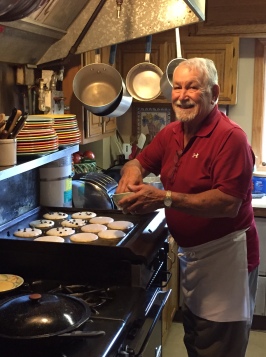
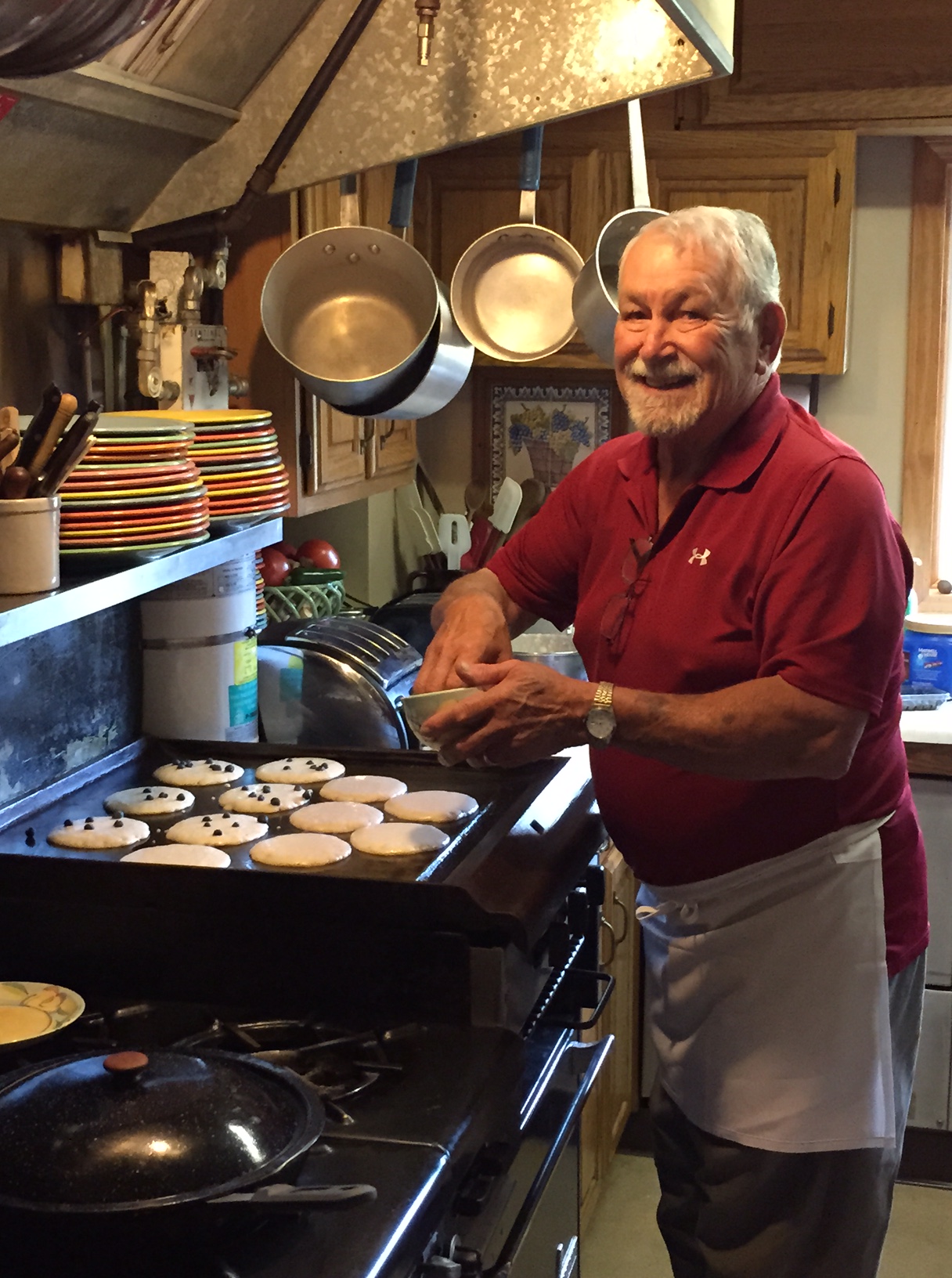
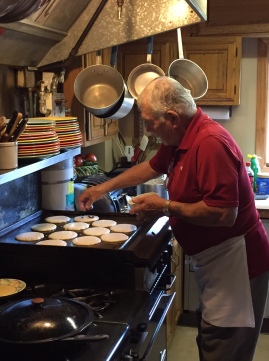
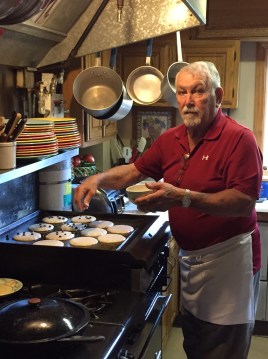
Above: If you see this man in the Combes Family Inn’s kitchen, enter at your own risk!

Last month, I caught my father in such a rare moment of weakness that I not only managed to get a number of great photos of him cooking breakfast, but I also learned several of his breakfast tips and secret recipes. I weaved all of that great material into a blog post that closed with a promise to later explain why I call him “the Vermudgeon.” Now, a month later, let me fulfill that promise.

Facebook guest comment

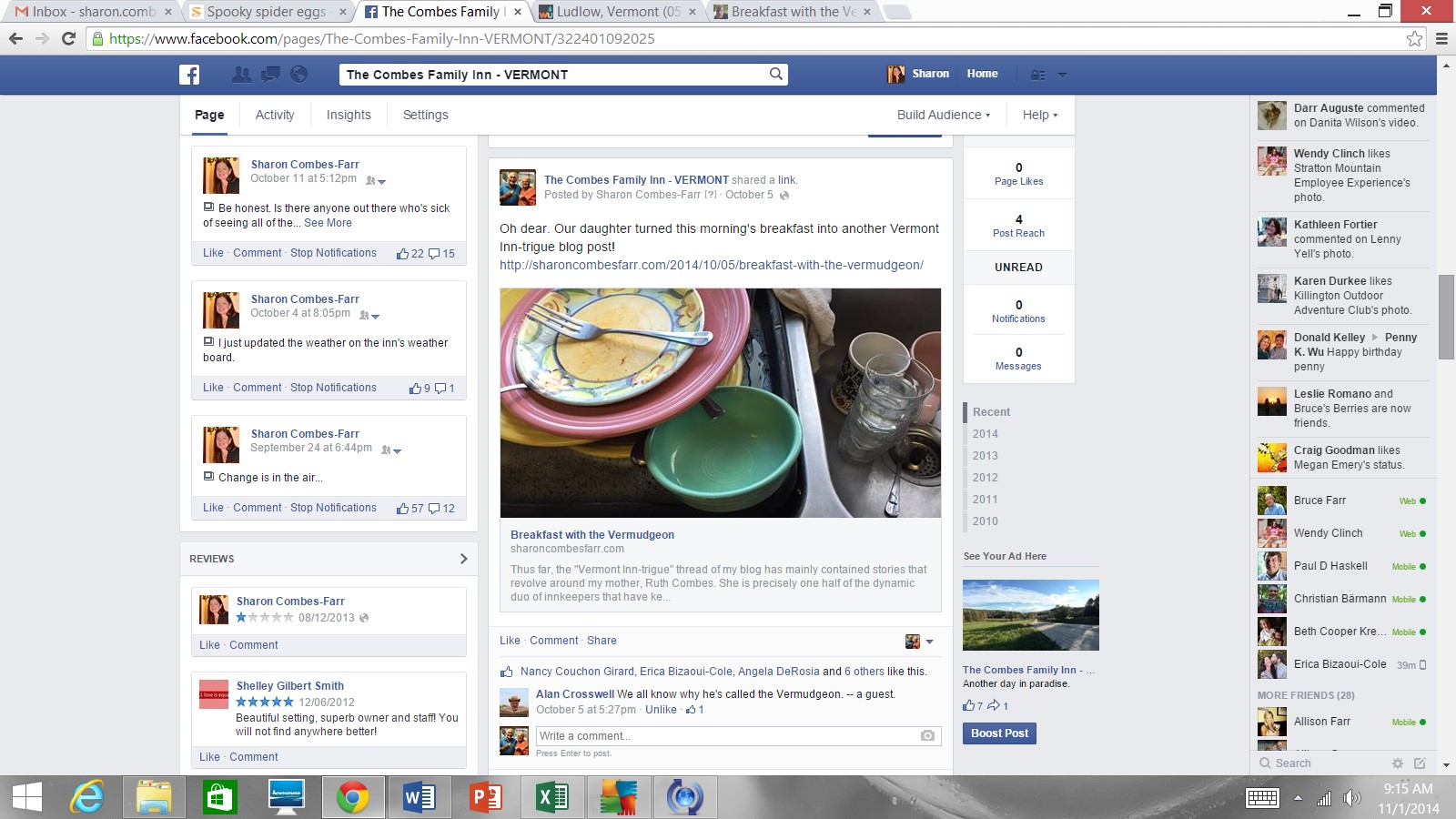
Above: A classic response from “a guest” to the original “Breakfast with the Vermudgeon” blog post.

In response to the original blog post, one loyal guest commented on the inn’s Facebook page with these simple words: “We all know why he’s called the Vermudgeon – a guest.”

For those of you not familiar with the inn, here’s the deal.

I coined the phrase “Vermudgeon” shortly after I moved back to Vermont in 2007, after more than a 20 year absence. At the time, my husband Bruce and I were staying at the inn for four months, while our house nearby was in the final stages of construction. During that time, we both got a close-up view of my parents’ lives as Vermont innkeepers. I can’t say whether my dad’s humor has gotten more dry and his general demeanor more cantankerous over the years or whether I just didn’t pay that much attention when I was growing up at the inn.  But I can say that some of his comments to guests, especially when they venture into “his kitchen” during breakfast service, are bona fide sit-com material.

As you probably guessed by now, “Vermudgeon” is merely a mash-up of the two words “Vermont” and “curmudgeon.” Vermont has more than its fair share of curmudgeons – I’ll bet they have the most per capita – and, I have referred to several of them as “Vermudgeons” these last several years. My dad earned his stripes with comments like, “You’re in my kitchen,” to a guest who wandered in looking for more half and half for her coffee, not to mention the countless times he’s declared the grill retired for the day on the dot at 9 a.m. in the winter and at 9:30 a.m. in other seasons.

Mom insists that not much has changed since I left home at 18, as far as my dad is concerned. “He’s always had a dry – even acerbic – sense of humor,” she explained. Rather than providing me her own examples to illustrate her point, she encouraged me to call one of her employees to get a few classics. When I say “encouraged” what I really mean is that she dialed the woman’s number and handed me the phone when she answered.

Here are the three short stories she told me.

There was a large ski group staying at the inn that included several teenagers. My mother had set all of the tables in the dining room with a large table in the middle and a bunch of smaller tables for the teens along the periphery. When it came time for dinner, all the kids came in first and immediately sat at the big table, leaving the adults to scurry around to sit in small groups at the other tables. Evidently one of the adults wanted to sit with a specific group but there weren’t enough chairs at that table. He popped his head into the kitchen and asked my dad where he could find a chair. Deadpan, Dad replied, “There’s plenty of room on the front porch.”

In addition to not liking to be disturbed when he’s busy in the kitchen, Dad is also infamous for not wanting to answer the phone. When I call and he answers, I don’t even ask for my mother, because it’s obvious she’s not home. As you might imagine, his phone manner is also Vermudgeonly.

One guy called to book the walking tour from inn to inn of which my parents are founding members. The gentleman was confused about whether or not he could bring his car to the inn, if he and his wife were to be walking.  My dad’s response, “Oh, you can certainly feel free to bring your car and we’ll just sell it on eBay.”

Strangely, that guy didn’t make a reservation. Then there’s this other guy who called for a room and took a bit too much time to debate whether he would book it B&B or the Modern American Plan, which includes dinner. He seemed concerned about the quality of the food and asked my father, “Do you eat there?”

Dad’s reply: “Not if I can help it.”

A Year’s A Long Time

Standard

I’ve learned a lot these past 10 months as I embraced, resisted, and—all the while—kept my New Year’s resolution not to drink alcohol for one year. If I learned only one thing it’s that a year can seem like a very long time. Sure, it’s 12 months, 52 weeks, 365 days, 8,760 hours, 525,600 minutes, and 31,536,000 seconds. More than that, though, it offers a heck of a lot of time in which to change one’s mind. It’s no wonder that, according to one survey, only 8% of people succeed in keeping their resolutions.

No, I’m not thinking of stopping now! I know that, with two months still to go, it might seem a bit premature to have this conversation. It’s just that I’ve been thinking a lot this week about how long a year is and I decided it would be a good blog topic. Besides, (knock on wood) there’s zero chance that I’m going to take a sip of alcohol between now and midnight on New Year’s Eve. So I might as well write about it, while my thoughts are fresh.

The best part about a year being such a long time is that it gives plenty of time to make great personal progress, which in my case included losing 23 pounds and cutting 23 minutes off of my fastest marathon time. It’s also more than long enough to change not only your habits, but also to evolve your personal thinking and perceptions. Even though I have decided that I will drink alcohol again, I’ll never think about it the same way again. Before my dry year, I never fully appreciated how pervasive alcohol is in our society or how damaging it can be. Many of our conventions revolve around alcohol, despite 30% of American adults not drinking at all and another 30% only drinking one alcoholic beverage a week.

Now that I proved I could do it, reached my goal weight, stepped up my running game, and developed this new appreciation for life, I’m basically ready for the year to be over. That’s one of the reasons why I started to think that a year is a long time. The other is that I’ve been giving a lot of thought to whether or not I will commit to another difficult and/or life-changing resolution for next year.

The one I’ve been tossing around all year has been a resolution not to purchase any material objects. With all the time I’ve spent thinking about it and floating it by other people, today was the first time that I Googled it to see if someone else has done it. Of course someone has.  I found this guy, who had a life-altering experience not buying any consumer durables or clothes for several months and made it about six months, before he broke down and bought a new computer (after spilling coffee all over his old one). I also found this family with two young children that stuck to their resolution not to buy anything new for a whole year (they allowed themselves to buy used clothes and other items). There’s even a Wiki article on “How to buy nothing.”

I have two more months to mull it over. I’m just not sure I have it in me to go from one extreme resolution right into another. Maybe 2015 will be a year of just savoring what I achieved in 2014 and enjoying the wonderful life that I have. Or maybe it will be the year that I qualify for the Boston marathon, publish a memoir, and reconnect with a dozen old friends from college. I’m interested to know your thoughts as we approach 2015.

Leaf-Peeping Season

Standard

Five months ago, I wrote about “Fiddlehead Season,” a time that epitomizes the fleeting nature of early spring and reminds me of the vulnerabilities of childhood. How different that time of year is compared to leaf-peeping season, which, I should note, is lingering particularly long this year. A gloriously bright foliage is nature at its most beautiful. And, if spring is like childhood, then the colors of fall reflect the confidence that only comes with age and experience.

This autumn, more than any other, I found myself inexplicably stopping to take photos of the changing trees. On my way to work, on my way home from work, en route to the grocery story — you name it, I stopped my car, jumped out with my iPhone, and tried (sometimes in vain) to capture the sunlight shimmering in the trees. I even varied my thrice weekly drive to Montpelier, in hopes that a different route might yield more trees, more mountains, and, most importantly, more color.

About a week ago, I took an abrupt U-turn in the middle of the road, just a mile from home, in order to snap a photo of the evening light dancing across Buswell Pond. After snapping the pic and jumping back in the car, I quite literally laughed out loud and asked myself, “When did you become a leaf-peeper?”

I’m not sure exactly when it happened. But, clearly, it did. I’ve come a long way since childhood, when I vividly recall thinking that the “flat-landers” were crazy to pay nearly a hundred bucks a night to stay at my parents’ inn, just to watch the leaves change colors.

I thought then that leaf-peeping flat-landers were nothing short of a danger on Vermont’s roadways, driving so terribly slowly and often stopping suddenly, usually right in the middle of the road. “What’s wrong with these people?” I often asked myself.

The drivers from Connecticut and New York were bad enough. But the ones with unrecognizable license plates from presumably more far-flung locations took even greater risks to get just the right view of the bright foliage. It was just absurd.

My Aunt Nancy tried to explain to me that the leaves on the trees back where the guests came from didn’t change the same way ours did. I just couldn’t wrap my head around it. Although I could see the trees with their bright colors, I didn’t appreciate them and, I took them for granted.

Over the twenty years that I lived elsewhere, I missed my home in Vermont more in autumn than at any other time of year. It didn’t take long for me to discover that Aunt Nancy had been right. None of the other places I lived, Washington, D.C., Beijing, and Arizona, just to name a few, had a notable fall season. Maybe the answer to the question “When did you become a leaf-peeper?” is the fall of 2007, the first fall after I moved back home.

That may be, but my own leaf-peeping shenanigans really went to a whole new level last week, when I pulled an abrupt U-turn while heading north on route 103 out of Chester. The early evening sun was illuminating the mountainside behind a dairy farm and I felt an uncontrollable urge to both admire and preserve the scene. I knew I would drive by that same farm again hundreds of times, but may never catch it again with that perfect light that gave the appearance of setting the foliage on fire.

Here’s a small sampling of photos taken in the past few weeks:

Breakfast with the Vermudgeon

Standard

Thus far, the “Vermont Inn-trigue” thread of my blog has mainly contained stories that revolve around my mother, Ruth Combes. She is precisely one half of the dynamic duo of innkeepers that have kept this business going for more than 36 years. I am overdue in writing specifically about the other half, my father, Bill Combes.

Since the beginning of this long adventure, Dad has been the inn’s handy man, head purchaser, waste manager, and, most famously, breakfast chef. It’s for this last role that he is beloved by guests, and it’s the sole subject of this post. Also of note is the fact that my mother is not a morning person, so my father’s contribution as the breakfast chef is fundamental to inn guests getting the second B in B&B. Given the amount of rich material on the topic, it will certainly lead to at least two additional blog posts.

Before observing and interviewing the breakfast chef this morning, I did a quick check in with my mom, asking her to describe my dad’s charm as a breakfast chef. Her response? “I haven’t seen his charm at breakfast,” she replied matter-of-factly. “His style is to be grouchy.”
IMG_5922IMG_5926IMG_5927

You wouldn’t know it this morning. First of all, today is Sunday, signaling that, as tradition dictates, pancakes are on the menu. On other days of the week, various breakfast meats in combination with eggs, and sometimes French toast, appear on the breakfast menu. But every single Sunday morning it’s pancakes and sausage. And Dad’s pancakes are as legendary as they are delicious.

Many times through the years, guests have asked my mother for Dad’s pancake recipe. And she has consistently handed out a recipe that is not my father’s. She doesn’t do this to be deceptive. She does it because she doesn’t know the recipe. This morning, Dad was happy to walk me through the bona fide recipe, as well as some of his other breakfast secrets, eliciting this response from Mom: “I did not know that.”

Well, now you do.

Bill’s Famous Pancakes

Ingredients:

One box of Jiffy Corn Muffin Mix.
8 cups of your favorite Buttermilk Complete Pancake Mix (Dad prefers
Krusteaz, although any brand will do).
2 teaspoons of cinnamon.
Approximately 7 cups of water (see “method” below for more information).
Yield: 20 or more servings of 3 medium-sized pancakes.

Method:

Use an electric mixer to beat together all ingredients. When adding the water, make sure to pay attention to the texture of your pancake batter to get the right amount of water. “You want the batter to run off the spoon, with a little imprint left on it. The batter should not be resistant to come off the spoon, nor should it be runny,” Dad explains. Your griddle has to be hot, but not too hot so that you avoid burning the pancakes.  To grease the surface of the griddle, use a good quality margarine, not fluffy tub of margarine or butter. Regardless what others say about using real butter, Dad’s experience is that margarine is not only less expensive than real butter, it also melts more easily and doesn’t burn as readily. Do not try to flip the pancakes, until after the air bubbles that form on the surface of the pancake has burst. “You will be tempted to flip them before the bubbles burst. But do not do it,” Dad warns.

Dad’s advice about prepping and greasing the grill is universal, whatever’s on the breakfast menu. I personally don’t often eat pancakes anymore. Seeing dad was in a good mood today and I didn’t want to push it with an outlandish breakfast order (something I usually do), I requested scrambled eggs. His scrambled eggs are among the fluffiest I’ve ever had and I have to admit I have not been able to replicate his method myself. I asked him to walk me through his method for achieving fluffy and perfect scrambled eggs, so I could explain it to all of you.

Bill’s Fluffy & Perfect Scrambled Eggs

Method:

Add tablespoon of water and beat the eggs very quickly to capture air. Since you are working with a hot grill, the other secret is to spread the eggs with a fork all over the griddle and cook them for less than one minute. Scrambled eggs cook much more quickly than any other style, so keep that in mind if you have a mixed order from the same table, the eggs aren’t on the griddle for more than a minute.

It was a real treat to find Dad in such a cooperative and chatty mood this morning so that I could quiz him about so many of breakfast secrets. He even revealed that he has been experimenting with his scrambled egg methodology and looked up Martha Stewart’s techniques on his iPad.

If you have the luxury of only having scrambled eggs on the menu so that you don’t have to keep your griddle very hot, he suggests that you try Martha’s low-temperature method. Two videos of this method are available here and here.
FullSizeRender

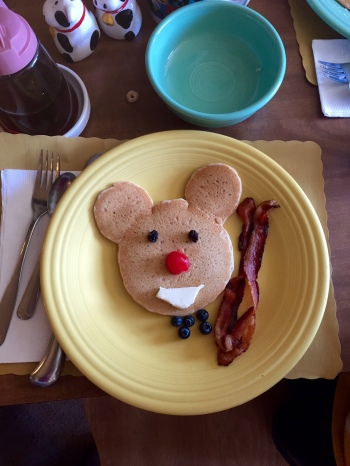
(Above: Although Dad doesn’t encourage adults to place special orders at breakfast, he’s known to produce some really special breakfast treats for the many children that stay at the inn.)

Special breakfast orders aren’t encouraged at the Combes Family Inn, and, frankly, guests issue them at their own risk (refer back to “grumpy” above). Despite this, Dad also revealed some excellent tips on how to make poached eggs. (Disclaimer: If you read this post and then stay at the Inn, please do not mention my name if you dare to order poached eggs.)

Poached eggs

Ingredients:

A pinch of salt.
A tablespoon of vinegar.
2 eggs.

Method:

Use a frying pan with water. Add a little salt and vinegar to the water. Dad says, “The salt is not important, but it helps the water get to a higher temperature. The vinegar, however, is important. It keeps the egg together.” And, he continued, “in terms of timing, I don’t have the time to screw around with a kitchen timer. When I drop the eggs in the softly boiling water, I put the toast down on the toaster. When the toast pops, the poached eggs are done.”

Speaking of the appropriate timing of the different components that go into an egg dish at breakfast, my dad’s number one advice about cooking breakfast is something that I learned in high school and have lived by ever since. With the one exception of poached eggs (as you just learned above), “you always put the toast down first, before putting the eggs on the grill – always,” my father advises, even warns.

Bottom line:  my mom suggests that you listen to the master, because, she proudly claims, “In the winter he can serve breakfast to more than 30 people and get them all on the ski slopes by 8 o’clock.”

We’ve come to the end of this blog post and I haven’t had a chance to explain why we call him the “Vermudgeon.” For that, you’ll have to tune in next week.
IMG_5931

My Dry Year: Third Quarter Report

Standard

Now that I’m three-quarters of the way through my New Year’s resolution to not drink alcohol in 2014, it’s time for a quick update to the “Dry Year” thread of this blog.

SCF last drink

First of all, I’m very proud to report that I am still dry and I don’t miss drinking.  It’s true that I missed it early on, had mild withdrawal symptoms the first few weeks, and even had a nightmare in which I broke my resolution by inadvertently drinking a glass of wine. It also took longer than I had expected to develop the new habit of not drinking.

By the end of May, I had already achieved my goal weight and lost a total of 30 pounds (when you include the 7 pounds I lost last year). I explained exactly how I did it in this blog post.Although I had a few challenges along the way, I’m pleased to report that four months later, I am holding steady at 135 pounds, which is a few pounds below the goal weight I had set for myself.

June 2014 (after) CROPPED

In the first half of the year, I had also already achieved my personal record (or “PR”) marathon time. How I did that is explained here. It should be no surprise that, just as I had predicted early on, losing so much weight was the biggest contributor.

SCF with pace group

After achieving these two main goals so early in the year, I wrestled with the question of whether or not I want to start drinking again when 2015 rolls around. In the end, I decided that I want to have a glass of very nice champagne at midnight this coming New Year’s Eve and then play it by ear after that.

I also decided to add a stretch goal into the mix for the second half of 2014: qualifying for the Boston Marathon.  My first “BQ” attempt — as qualifying for the Boston Marathon is known to avid runners — on my 46th birthday in July was a real disaster. Despite that, it was an unforgettable experience to cross the finish line with a very close friend, no matter how long it took us.

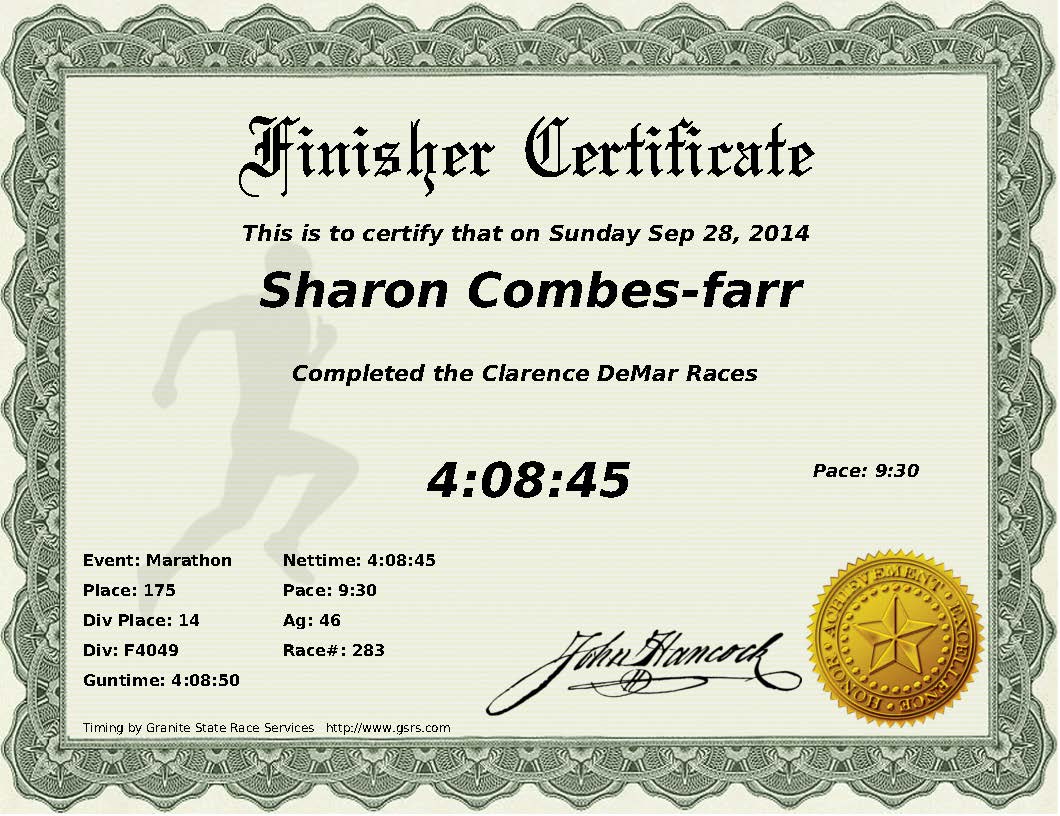
This brings us to today.  This morning, I completed my last race of the season by trying one more time to BQ. I was very happy with my training plan, picked a course that had a nice sloping downhill, went to the race properly hydrated and fueled, and even wore a temporary tattoo with my mile-by-mile race plan on my forearm. All signs pointed to a great day on the course.

What was the result? I really killed the first half of the race, achieving a PR half-marathon time of 01:51:55 and stayed on my planned pace through 20 miles. Then, it got very hot and I started to slow and I worried that I might over-heat. Although I didn’t qualify for Boston, I am extremely proud of myself for pushing through the last several miles to the finish line and cutting another 19 minutes off my best marathon time.

887_Marathon_283 (Clarence Demar - Keene - 09-28-14)

As far as qualifying for Boston is concerned, that’s a goal I will happily carry with me into 2015. If you have any other ideas for New Year’s resolutions for 2015 for me, please leave those as comments to today’s blog post.

LET THEM EAT CAKE (AGAIN)

Standard

A few weeks ago, we were visiting some of my husband’s family in Maine. For brunch, my sister-in-law made an amazing lobster eggs Benedict. She had made way too much hollandaise sauce than we needed and mused out loud about what could be done with it. I immediately suggested that we call my mother and reached for the phone.

Why call her? You might ask. Because, after serving to dinner guests for over 35 years, my mom knows her way around the kitchen and has many useful tips for saving and re-purposing leftovers. If there’s anyone who knows if hollandaise sauce can be frozen and re-served or repurposed in some other way, it’s my mom. And, the answer? “Hollandaise freezes very well. When you heat it on the stove, stir constantly and add a bit of lemon juice and warm water to help re-constitute it,” Mom advised my sister-in-law.

Lobster Eggs Bennedict

In last week’s blog post, I alluded to two of mom’s other secrets:  which cheeses freeze well and what to do with leftover cake.  As promised, here are all the details, as well as my mom’s recipes to make the most of them.

Just like you might not expect that hollandaise sauce can be successfully frozen and reused, many people shy away from freezing cheese. It is true that the texture changes when you bring it back up to room temperature. For that reason, my mom exclusively uses leftover and frozen cheeses to make her legendary macaroni and cheese recipe. A favorite of kids and adult guests alike, mom is continually asked for this recipe. However, it is truly never the same dish twice! The only type of cheese that my mother won’t freeze is fresh goat cheese. As for the others, she reckons that she’s frozen them all: American, Swiss, Cheddar, and even Brie.

Macaroni & Cheese

Ingredients:
7 ounces elbow macaroni (about 2 cups uncooked)
3 tablespoon butter
3 tablespoon flour
3/4 teaspoon salt
dash pepper
2 cups milk
2 cups shredded cheddar, American or both (or whatever other types of cheese you froze!)
1/4 cup bread crumbs
1 tablespoon melted butter

Method:
Cook macaroni, following directions on package. Rinse in cold water and drain. Melt butter in saucepan, blend in flour, salt, and pepper. Add milk, cook on stovetop, stirring frequently until mixture is thick. Combine 1/2 of cheese mixture and macaroni. Then fold in remaining shredded cheese. Pour into a greased 2-quart casserole dish. Sprinkle the top with crumbs and melted butter. Bake 350 degrees for 30 to 40 minutes, until bubbly and lightly browned on top.

Saving leftover cake to make the dessert called “trifle” is another one of my mom’s guilty secrets.  You can save pretty much any cake and freeze it. Once, she even drove over to another inn to take home the leftovers of an entire wedding cake, when she heard the bride wasn’t keeping it.

According to my mom, “The key is to remove all of the frosting. I think vanilla cake makes the best trifle, but I’ve also done it with chocolate and other flavors.” After removing the frosting, just freeze the chunks or slices or whole pieces of cake in gallon sized freezer bags. You can keep it this way for up to one year.

The recipe for my mom’s cake trifle has never been written down before. That makes this the world premiere of the written record for this most excellent dessert.

Ruth’s Leftover Cake Trifle

Ingredients:
1 pound leftover cake
1 cup fruit-based liquor (mom suggests this cassis from the Putney Mountain Winery)
1 cup jam (mom uses her homemade peach or strawberry jam)
1 package vanilla pudding mix
2 cups fresh berries
Fresh whipped cream

Method:
The day you plan to make the trifle, take the bags of frozen cake pieces out of the freezer and let them come to room temperature. Be sure to wash your hands well and use them to break the cake into approximately one inch cubes and set aside in a large bowl.

Use a large square or rectangular cake pan to assemble two layers of the dessert. Cover the bottom of the pan with cake pieces (only using half of the cake). Add half of the liquor. A fruit-based liquor like cassis, which is made from blackberries, is what mother usually uses. Then layer in the jam. Mix up a package of instant vanilla pudding with one cup of milk or half-and-half, making a custard. Put half over the layer of jam. Repeat all steps so that you have two layers, substituting the fresh fruit on the top, instead of jam. Use whatever fresh berries are in season. Refrigerate until ready to serve.

Just before serving, top each serving with freshly made whip cream (1 cup of heavy cream whipped with a table spoon of powdered confectioner’s sugar and a teaspoon of vanilla). If you don’t use up all of the whipped cream, remember that it also freezes very well!

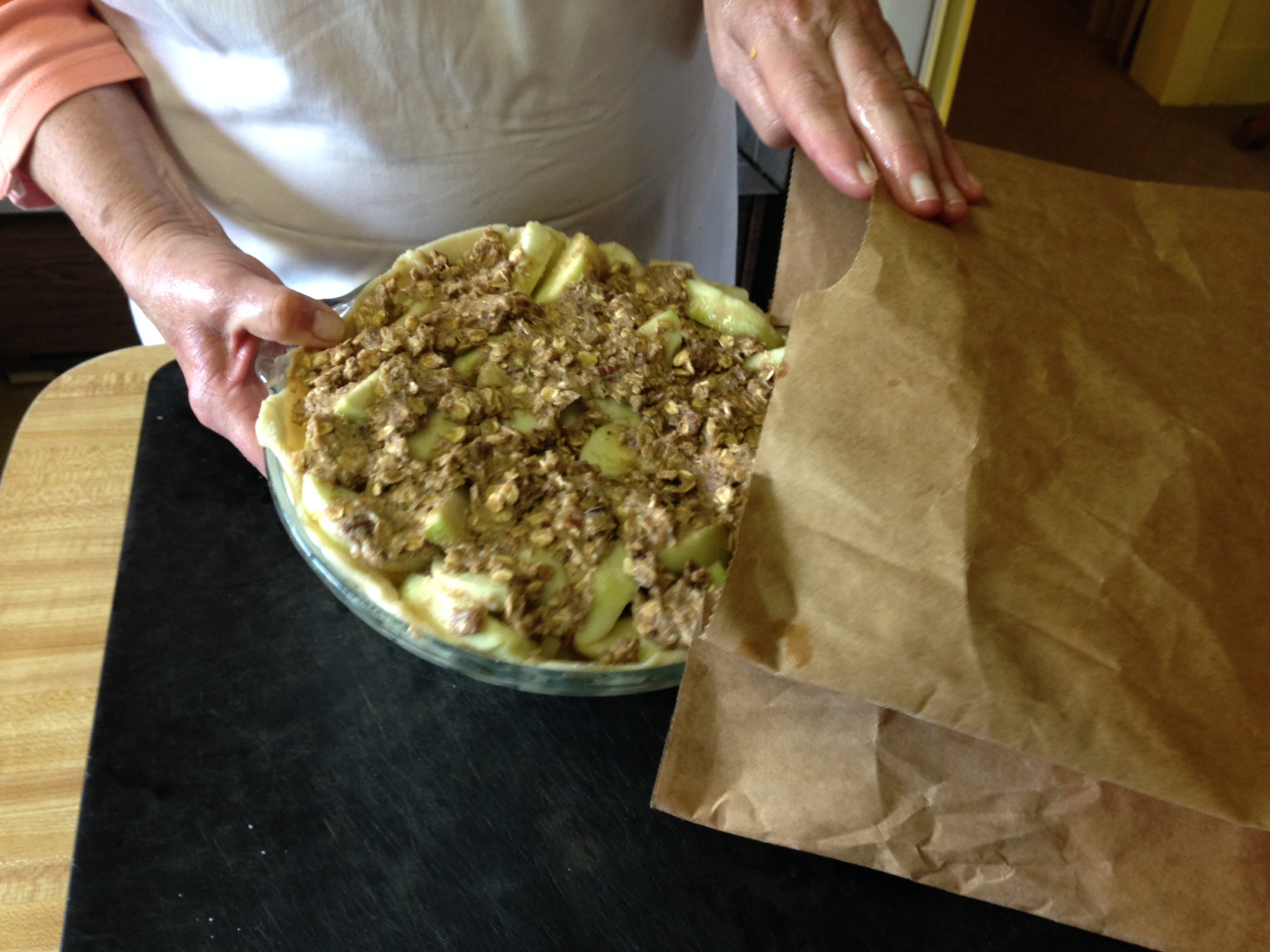
Although it doesn’t involve previously frozen ingredients, another of Mom’s extremely popular time-saving dessert recipes is her “paper bag apple pie.” She’s been making this for over 25 years. During my interview with Mom this morning, I was so captivated by this recipe, that I goaded her into making it with me today during half-time of the Patriot’s game. I’m not exaggerating when I say that the prep time for this delicious rendition of apple pie is less than 10 minutes.

Paper Bag Apple Pie

Ingredients:
4-5 apples, cored, peeled, and sliced
1 pie shell
1 cup sugar
1/8 teaspoon salt
½ teaspoon cinnamon
5 tablespoon flour
3 tablespoon water, apple cider, or apple juice

Topping:
½ cup brown sugar
½ quick oats
1 stick of margarine or butter
¼ cup chopped nuts (optional)

Method:
Place apples in pie shell. Sprinkle with remaining ingredients. Combine topping ingredients to make a crumbly mixture. Spread on top of apples in pie. Place shell with all ingredients in large brown paper bag. Use either paper clips or stapler to bind airtight. Bake 1 hour at 375°. Serve with vanilla ice cream or whipped cream. Serves 8-10.

Mom making bag apple pie

  Into the bagSeal the bagFinished pie

You can find several of the inn’s other recipes on their website here. If you have any questions about these recipes or the inn’s other kitchen secrets or cooking tips, please post them as comments and we promise to get back to you.

Tante Evelyn’s Treats

Standard

My mother is a very good cook. It’s hard to replicate her cooking, because she’s one part Alice Waters, with her emphasis on fresh, local ingredients; one part Rachael Ray, with her mantra that “easy-to-do” is almost always best; one part Martha Stewart, thanks to her kitchen cleverness; and one part MacGyver, no explanation necessary. Another time, I’ll post some of her time-honored cooking and meal planning tips, such as her advice on which types of cheeses can be successfully frozen and re-served and what to do with leftover cake. This post, however, isn’t directly about Mom’s cooking. It’s about a recipe and, as it turns out, human nature.

Tante Evelyn

“Tante Evelyn”

The most requested recipe in my mother’s large repertoire, bar none, is a cookie recipe that we call “Tante Evelyn’s Treats,” which was named after my mother’s French-Canadian aunt. Like many immigrant women of her generation, it seemed that the only way Tante Evelyn knew how to show love was through her cooking. Visiting her was always popular when we were children, because she never failed to have multiple homemade sweets freshly baked in her kitchen, that she insisted we eat to our little hearts’ content.

After we opened the inn, it was likewise a treat for all of us when Tante Evelyn visited from New Hampshire to stay with us, share in the cooking chores and generally amuse us with her no-nonsense personality. When she visited near the holidays, she would make batches and batches of her graham cracker treats. A mixture of melted butter and brown sugar is poured over a sheet of graham cracker pieces and, after a mere 10 minutes in the oven, they turn into delicious, praline-type candied crackers. Tante Evelyn would make enough in one afternoon so that my mom could freeze them and have them on hand for an entire year. The days she baked these cookies were, for us kids, always the highlights of her trip to the inn.

Evelyn died many years ago, so we’ll never know exactly how she came about creating her recipe. Nowadays, you can find variations of it all over the Internet, like this one that adds vanilla and pecans and earns a five-star rating from Betty Crocker.  A look through my mom’s ancient Betty Crocker bible that’s now held together by duct tape does not, however, contain this recipe.

Betty Crocker Cookbook

(We don’t know the origin of Tante Evelyn’s recipe. We looked everywhere, including in here.)

Meanwhile, like every other industry, inn-keeping has affiliations and organizations. In the ski region in south-central Vermont where our inn is located, there was once a group called “Snowtown Inns” that was later renamed the ”Okemo Valley Hospitality Association.” In the 1980s, there were 16 inns and motels in the area that were members of this group, which, by the way, is now absorbed into the regional chamber of commerce. My mother was an executive officer of the group and still has a large drawer full of envelopes bearing the group’s logo.

The group met a few times per year and members took turns hosting the meetings. One day, in the late 1980s, it was with much “to-do” that my mother and father hosted the group. After the business was done, they served coffee with an impressive array of nut breads and desserts. I have no doubt that everything was delicious. However, everyone in the group raved about one particular cookie and wondered how my mother made them. Of course, these were the famous Tante Evelyn’s Treats.

When one of the other innkeepers asked for the recipe, my mom was so pleased that her peers loved her beloved aunt’s cookies that she immediately went into her office, printed out the recipe, and made a copy for everyone.

Tante Evelyn’s Treats

Ingredients:
1 package of graham crackers
1 1/2 sticks of butter
1/2 cup of brown sugar
1/2 cup of finely chopped nuts

Method:
Break graham crackers in half (along perforation) and place flat on a greased cookie sheet. Melt butter and brown sugar in a saucepan for five to six minutes, stirring constantly. Pour over crackers and sprinkle with nuts. Bake at 350 degrees for nine minutes. Remove from oven and allow to cool. If desired, sprinkle with mini chocolate chips when cookies are removed from oven and still hot.

Okemo Valley Hospitality

(There used to be an active industry association in the area just for innkeepers and other motel and lodge owners.)

I was away at college and had no idea that this meeting had taken place, until about a year later when I received a phone call from my mother. She was crying and so terribly upset that it was difficult to understand her. After she calmed down, my mother explained that she had just received her latest issue of Yankee Magazine in the mail. In it, one of the competing inns in her hospitality group had won a recipe contest for……guess what? A delicious graham cracker cookie recipe that was remarkably like “Tante Evelyn’s Treats,” but under a different name with slightly more butter.  Otherwise, it was exactly the same!

I insisted that mom defend her honor and write to the editors. But she’s simply not that kind of person. She bore her disappointment and fury in silence and never even mentioned it to the other innkeeper, who is no longer in Vermont and has been long out of the inn business.

The story reminds me of something my mother once told me when I was a young girl. After observing my mom busy in the inn’s kitchen one afternoon, I had complained bitterly, “I don’t know how to cook!” She stopped what she was doing and put her arms around me and said, “Sharon, if you can read, you can cook.”

I appreciated the gesture, but I know today, just as I did back then, that my mother was wrong. There’s a lot more to good cooking than being able to read or following what might in fact be a great recipe. My mom will always be a better cook and innkeeper than her ruthless competitor and, no matter the variations of it that might be out in the larger world, this particular cookie recipe is best when called “Tante Evelyn’s Treats.”

A LITTLE PRIVACY PLEASE!

Standard

In my last blog post, I left you with the image of a woman from Manhattan who had hiked through snow and up a fire escape in heels, entered my parents’ inn on the second story, and found her way to their bedroom. At least she knocked. Believe it or not, there have been several guests through the years who just walked right in. 

winter CFI

Once, during ski season, my mother was enjoying precious time by herself while all of the guests were skiing. She took her ritual afternoon bath, settled into bed with a good book and had fallen asleep. She opened her eyes to see a man standing in her bedroom, just three feet away, looking down at her.

When he saw her open her eyes, he said, in a heavy French accent, “I looked for you all over!” Then, “Are you a Combes?”  Before my mother had a chance to answer, he started babbling excitedly, “My name is Combes. I’m French. I wonder if you are French,” and so on. Mom pulled herself together and suggested that he go downstairs, promising that she would join him there in just a moment.

She took a few moments to get dressed and brush her hair, all the while lamenting the abrupt end of her relaxation. She closed the door of her sanctuary and she joined “Monsieur Combes” from France in the sitting room, where they talked for well over an hour about his family and how he happened past the inn, surprised to see a big sign emblazoned with “The Combes Family Inn.” When darkness began to fall, he stood up, kissed her on both cheeks and left. We never heard from him again.

Then there was the time that Room #8 (The Wildflower Suite) was rented to two nuns from Pennsylvania who were in the area to spend time at the Weston Priory. One of the nuns was in her late 70s, while the other was probably around 50 years old.

At about two in the morning, my mother was awakened by a vague noise and then the sight of the older of the two nuns standing over the bed, looking closely at her through the darkness. When my mother tells this story, she laughs as she says, “There was your father lying on top of the covers in his skivvies. Actually, I’m not even sure that he had his skivvies on!”

“May I help you?” my mother asked the old sister, who meekly replied, “I am looking for the bathroom.”

Mom said to me as she told the story, “I guess I was a really good innkeeper back then. I simply got up and took her by the hand and walked her back down the hallway to the bathroom connected to her room at the other end of the hallway.”

At breakfast the next morning, the younger of the two nuns pulled my mother aside and asked about what had happened during the night, evidently aware of the rustling in the room in the middle of the night. It turns out that her companion was known to be a sleep walker and that’s probably how she ended up in my parents’ bedroom!

It’s certainly a significant invasion of privacy to have people walk right into your bedroom, especially when it’s the only space in the whole house that is not open to the guests. However, that’s not the only way that our family gave up privacy through the years. 

It was also very difficult for our family to have private time, especially around the holidays when the ski season was in full swing. In 1999, several of us actually celebrated Christmas day at the inn. My mother claims that this was the only Christmas she and my father ever spent with their grandchildren on Christmas Day.

In fact, it was my nephew Liam’s first Christmas. Liam’s dad — my brother Billy — and his whole family were there. I was finally back from living overseas and also made it back to Vermont for Christmas for a change. It was a rare time in all of the years since my family opened the inn back in 1978 that many of us had the opportunity to celebrate together on Christmas Day.

Of course, it being a significant winter holiday, the inn had several guests, all of whom, save one, were off skiing. Would you believe that rather than reading in the living room or doing some other personal thing, the woman guest sat with us all morning long? She was there next to each of us as we opened every last gift, even peering along with us into our Christmas stockings. My mom’s favorite part of this story is that this woman –who only visited the inn that one time and whose name no one remembers — is, quite literally, in every single photo we took that Christmas morning.

Looking back on these and several other stories and my mother tells about the loss of privacy inherent in having opened our home as an inn for guests all of these years, it strikes me that we gained so much more than we ever gave up.