Starbucks and Baozi

Standard

20140308-160852.jpg

image

Friday was Ange’s birthday and she awoke, after only about 4 hours of sleep, on a mission. She went directly to the concierge and asked for directions from the Peninsula Hotel to two locations — the closest Starbuck’s and the closest shop with baozi. “Bao” means “bread.” This makes sense, since these small breakfast dumplings have a skin that is breadier than most Chinese dumplings (they also have delicious pork inside). Luckily, the concierge drew a handy little map, making both purveyors easy to locate. Of course, we went in search of the coffee first.

image

As you might have guessed already, this post isn’t about our breakfast, per se. Instead, it’s about how the two components of our breakfast really reflect the dichotomy of modern China, at least for me. Having a Starbucks on many Beijing street corners is the inevitable evolution of things here. The quest for things foreign and the embrace of controlled capitalism, combined with the humongous domestic market, made it inevitable. It was Avon and McDonald’s back in the early 80’s. Then, it was General Motors and Motorola when I lived here in the 90’s. Now, it’s Starbucks and Apple stores, and, can you believe it, even “House of Cards?”

The common thread of most of the Western things found here, then and now, is that they are largely materialistic and deemed relatively harmless by the government. Why not give your growing population of consumers these foreign goods that are, in many cases, actually made in China? What the Chinese have been less welcoming of is free thinking and other threatening Western ideas. At the turn of the previous century there was a slogan “Chinese learning for fundamental principles and Western learning for practical application.” Learn more here: http://en.wikipedia.org/wiki/Zhang_Zhidong.

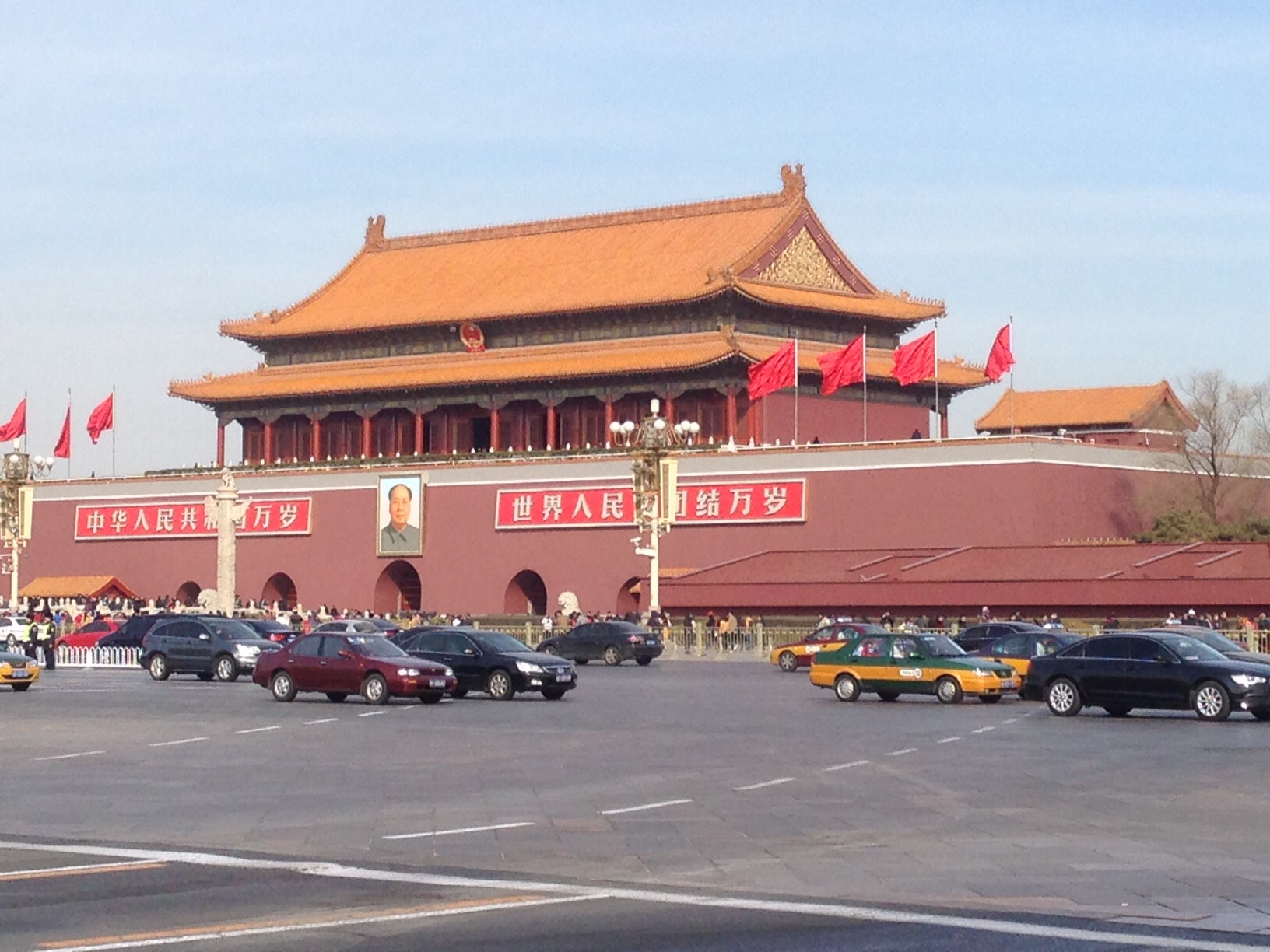
That this sentiment hasn’t really changed all that much manifested itself during my short stopover in Beijing in an interesting way. It was amazing to find free Wi-Fi everywhere, along with the Starbucks and iPhones to go with it. However, imagine my frustration upon discovering that Facebook was blocked and I was unable to upload my selfies in front of the likeness of Chairman Mao and those cute lion statues. In short, China’s lack of tolerance prevented me from alerting my nearly 500 “friends” that I had returned to my old stomping ground.

Little did I know that the Chinese government has been blocking access to Facebook since 2009, when it figured out that separatists in its far northwestern Xinjiang province had been using it to communicate with its followers to coordinate demonstrations against the government.

Of all the things that could frustrate me about Beijing (like taking over an hour to navigate the airport bureaucracy to track down our luggage, the ridiculously tight security presence on Tiananmen Square, and the prevalent line-cutting mentality of the Chinese), what does it reveal about me that blocking my access to Facebook was the only thing that really irked me?

Getting back to Starbucks, it strikes me that the green and white mermaid symbol alerting passers-by to the availability of little cups of familiar, high quality, but extremely high priced, “joe” is also a fitting symbol of the modern service industry, the new millennium, youth, and capitalism, all at once.

For all the ways that Beijing had changed over the 18 years that I was away, the essence of the city and the comfortable feeling it gives me were the same. The amazing food. The flashes of color. The welcoming nature of the people. It honestly still felt like home. When I asked, “Ni hao?” (“How are you?”) to nearly everyone I passed, they all paused, smiled broadly and said, “Ni hao.” Imagine if I had said, “How are you?” to everyone I passed in New York City. They would probably have me committed.

The little mom and pop shops nestled in between the larger modern stores, like the one where we ate our baozi, are further evidence that the essence of old China still remains. The friendly proprietors invited us to sit at their sole outdoor table, as if we were old friends. As we sat, happily drinking our Starbucks and eating our dumplings, dozens of well-dressed workers in their twenties and thirties stopped in to get baozi, soy milk, and other breakfast delicacies to go, as they hurried off to work.

After a very satisfying breakfast, in more ways than one, Angela stood up, turned to me and said, “Starbucks and baozi. My job is done. Sharon, you take it from here.” I steered us purposefully in the direction of the Tiananmen Square and the Forbidden City. And, it was not lost on me that this part of our morning’s itinerary represented another dichotomy in Chinese history, the legacies of feudal times and the Maoist era….
20140308-161006.jpg

image

Where Are You Going?

Standard

Tomorrow, I begin a 10-day trip to Asia with my old college pal, Angela Casey.  I have one foot out the door already. Recall that this trip is my insanely generous reward to myself for following through with my unexpected and difficult New Year’s resolution not to drink alcohol this year.

About twenty years ago, Ange and I had the time of our lives palling around Singapore, Hong Kong, Malaysia, and Mainland China.  Now, we’re in our mid-40s and we’re going to try to re-capture some of our glory days on a mission to check-in on my step-daughter who’s in the middle of a 4-month journey of her own. Erin and her friend Abby’s travels are documented in a separate blog here.  It’s not lost on me that Erin and Abby are about the same age now that Angela and I were back then.

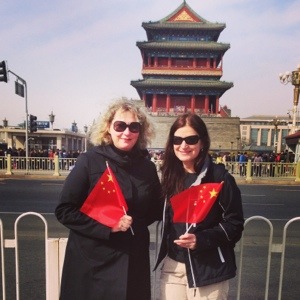
In the morning, Ange and I will rendez-vous at the Port Authority in NYC to head over to JFK Airport together. Our first stop is Beijing, my old stomping ground. Thinking about this part of our trip motivated me to quickly thumb through about 1,000 old photos. A few shots of me and Ange together in the 90’s are below:Image

Image

Image

I also couldn’t resist looking at a few of my old journal entries from the “China Years” and discovered that I had some Beijing anger issues back in 1996. A journal entry from October became a short essay in my Christmas letter that year titled  “Beijing, Bejijing, where are you going?” It’s not exactly a promo from the Beijing Tourist Bureau.  However, it’s how I felt at that moment in time, as an expatriate living and working in Beijing. 

Beijing.  Beijing.  What do I really think of you, you capital city of this huge ‘socialist’ country?  You’re no longer protected from the peasants.  Your economy remains a bubble, but the whole country is moving with you, or against you, or in spite of you.  You have it all, don’t you?  All but clean air.  I mean you have history; you have culture; you have the old and sprouting up around and over the old is the new.  The results of ‘development’.  You have cars and the pollution that accompanies them; pollution which will someday rival even Bangkok.  You also have the coffee shops and the jazz bars and even a bagel shop or two.  You must have known that Dunkin’ Donuts was only a decade behind McDonald’s and Avon.  Or had you bothered to consider this?

And, look at your populace.  Women with their tough-as-nails, calf-length nylons, their penciled eyebrows, and their sequined sweaters.  They’re almost fashionable, at least compared to the Russians who roam your streets in search of bargains to bring home to their starving nation.  And your men with their PVC briefcases and pagers.  They’ll be real businessmen someday.  But you can still see the difference between your own and your Singaporean, Hongkonger, and Taiwanese brothers, can’t you?  Your perms are a little too dry, yet.  And your shoes a little too dirty.  But you’re almost there.

You will arrive soon.  But where is it that you think you’re going?  You are rushing ahead so quickly with unparalleled determination.  But what are your goals?  What is your raison d’être?  Your 9th five-year plan.  What does that say?  What unrealistic jargon does it use to unite and confuse you as you approach the future?  I’m only asking because I want you to care, it’s not that I give a shit.  I’m just an observer here.  But I am thinking deeply as I observe.  I ask questions of your taxi cab drivers, your shop keepers.  And I sympathize with their confusion.

They own property, you know, these socialists you have raised.  You let them buy because you wanted a piece of the wealth that originated in the south and spread to the hinterland – not like wildfire – but like something.  You let them buy, but you’ve made it so difficult for them to sell.  What kind of ownership is that anyway?  You’ve confused them with this Chinese characteristic of capitalism or socialism or whatever it is you call it nowadays.  And your billboards confuse us all – foreigners and Beijingers alike.  You want your children to “seize opportunity”; you want your own reforms to “deepen”; you hail an “expansion of openness” and an “acceleration of development”.  Yet you caution all to “maintain stability.”  You fear another Tiananmen.  Or at least you want your children to fear that.  It’s a tall order, this billboard you’ve erected on Chang’anjie, a stone’s throw from Tiananmen Square.

Tiananmen says it all, doesn’t it?  That gray expanse from the Forbidden City to the Gate itself.  So symmetric it all is, with the Chairman’s mostly synthetic body on view right smack in the center of it all.  But at least you proved that your children can line up like the civilized barbarians.  They do so daily from 8:30-11:30am; I’ve seen them do it.  Quickly and orderly they wait in the queue to glimpse their deceased Chairman.  “Ten thousand years” to the preserved flesh of the man who became more than a man.  The icon of Mao.  The one who fucked you all over in his paranoia.  “Ten thousand years to Chairman Mao.”  Arguably the second most influential Chinaman who ever walked the earth.  Mao, you will fade, though.  You will not live in human memory 10,000 years.  You are not Confucius, didn’t you know?

So, Beijing, where did you say you were going?  Please let the world know when you get there, won’t you?  We are all interested.  And we’re almost as confused as you are.

Ange and I will pause less than 24 hours in Beijing, as we journey toward Laos. As you can imagine, we plan to make the most of our brief return to one of our old stomping grounds. It will be very interesting to see how much (or how little?) things have changed in the past 18 years. 

When In Doubt, Haiku

Standard

Working on my memoir last year, I re-discovered my old journals. Although filled with many boring entries, every so often, the pages revealed heartfelt poems, prose, and short stories. I was particularly struck by my poetry and regretted that I had not kept writing poems through the years. Seeing that some Facebook friends are writing haiku as statuses, I decided to reacquaint myself with this type of writing.

Haiku is a Japanese poetic form. Traditionally, these poems are 17 total syllables in 3 lines, comprised of 5 syllables for the first and third lines and 7 syllables for the second line. Here’s a good introduction on haiku and how to write them.

Many modern writers do all sorts of things and call them “haiku.” The purist that I am, I prefer the challenge of forcing myself to articulate my thoughts economically, so I stick to the traditional pattern, like this:

When in doubt, haiku.
Just seventeen syllables
To express your thoughts.

In the past, many Japanese haiku were about nature and the last line contained some sort of surprise, twist, or change. I can see why. When I started trying this out for myself, I discovered first-hand how easy it is to be inspired by nature and to see life lessons within it.

The three haiku below, I wrote in the same week, before, during, and after a major snow storm:

Clear. Crisp. New Year’s Day.
Blue skies slowly turning gray.
Calm before the storm.

Quiet, peaceful morn.
Dark with no promise of light,
‘Til after the storm.

Tracks on snowy mound.
Signs of life after the storm.
Can’t hide Beaver’s lodge.

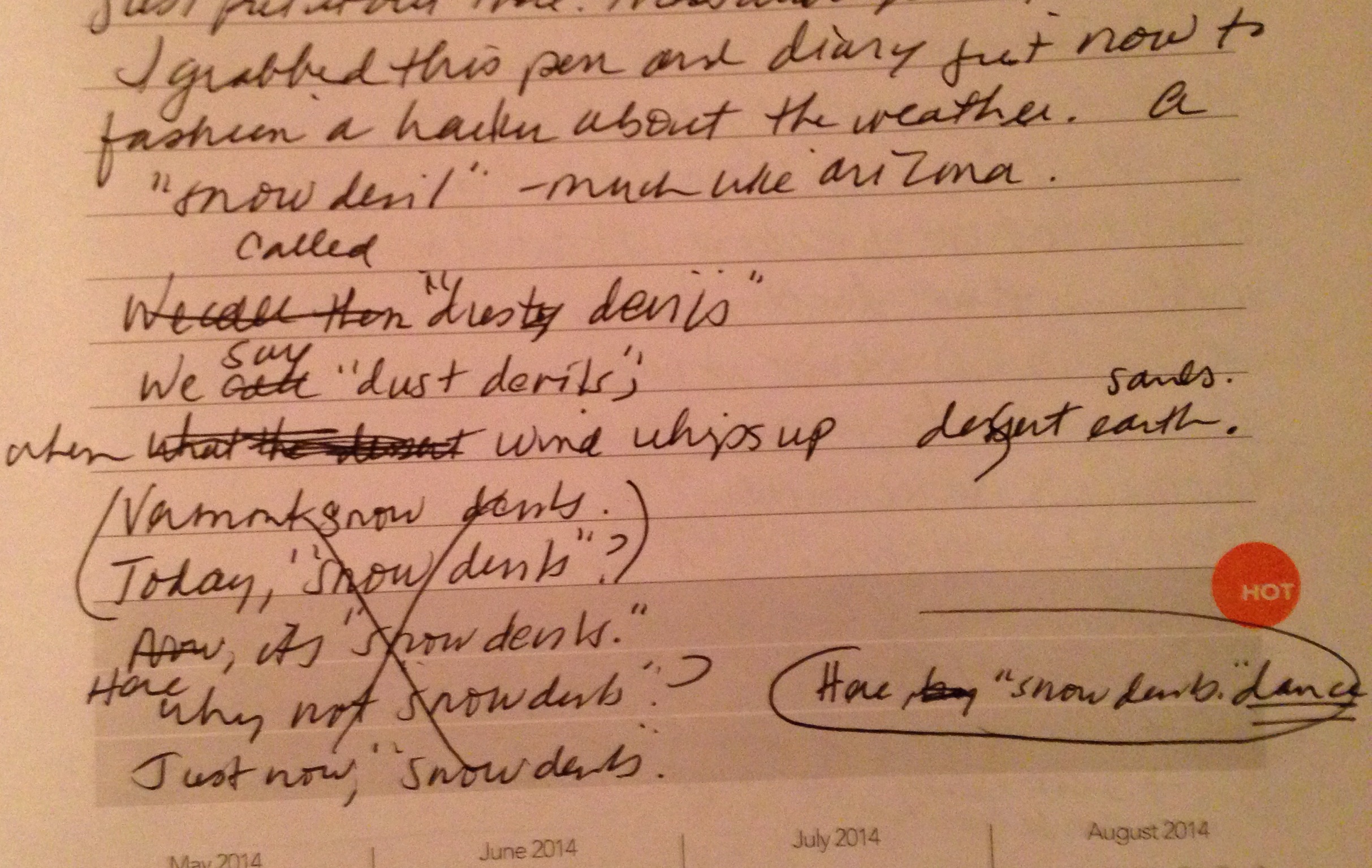
My favorite of my recent nature-related haiku was the most difficult to write. I saw snow whipping up and traveling across our field and I said ”snow devil” out loud to myself.  Then I laughed, realizing that I was talking to myself and also that this was not an actual term. So, I decided to explain it in a haiku.

Image

This is the final result:  

We say “dust devils,”
When wind whips up desert sands.
Here, “snow devils” dance.

Forcing my thoughts and feelings into these patterns has gotten somewhat addictive. On a particularly long and pleasurable training run with my dog the other day, I decided to articulate my feelings in a haiku. 

My running partner,
Always listens, never tires.
Four-legged “best friend.”

My dog, Cleopatra, has been the subject of a few other recent poems, including these below, written on different days when reflecting on playing fetch with her before my 90 minute drive to work:

Tossing ball for pup.
At peace, playing in the rain.
Montpelier waiting.

Playing fetch at dawn.
Reluctant moon. Purple skies.
Warm despite the cold.

Sometimes, I want to hold fond feelings close to me and preserve them, so I compose a haiku. This happened twice this winter, while I was skiing. The first one was inspired by a great time I had with my nephew Liam.  We composed the first two lines together on the chairlift and each had a different third line. My version is below:

Good light and powder,
Rewards after the clearing.
Welcomed by old knees.

The second flooded over me while I was skiing with my friend Blair. I had to pause on the slopes to count syllables with my ski pole in the snow, until the haiku was completed and memorized.  It refers to a close friend of mine who died four years ago. He’s the person who finally got me skiing again after nearly a 25-year hiatus:

First mogul run since
Stephen said, “You can do it!”
Great times, then and now.

Finally, I come to a haiku that requires more explanation than I can afford here. It’s about my maternal grandmother and the unintended impact her unorthodox and complicated personality had on me as a child. Hopefully, the words can speak for themselves, at least on some level:

Mémère’s voice inside
My head is unforgiving.
Self-doubt in disguise.

I hope you enjoyed this blog, despite its departure from my usual topics. Please feel free to comment with some of your own haiku. I’d really love to read them.

Laying the Foundation

Standard

Now that I have breezed into February without incident and it seems clear that my drinking ban is going to stick, it’s time for me to start focusing on some of the reasons why I began this social experiment in the first place. This month, I want to lay the foundation for achieving two goals, both of which were top contenders for my New Year’s resolution originally and, in my mind, are part of the package.

My theory from the outset was that eliminating alcohol will enable me to finally achieve two important personal goals that I have been thinking about for a while. They are: losing 20 pounds and running a marathon in personal record (PR) time. In this post, I’ll give background on these goals, and in future articles, I will explain my plan for and progress toward achieving them. I have also already thought of several related and interesting research topics that I will explore, as well.

Let’s start with losing weight. No, I don’t think I’m fat. And, yes, if I were destined to remain at my current weight, I would have a happy, healthy, and productive life. However, I used to be much thinner and, with my continued commitment to exercise, I should have a shot at getting back to my “ideal” weight.

I’m not comfortable giving you the exact numbers. But, I will confess that on January 1, 2012, I stepped on the scale at a personal high weight which was 35 pounds higher than my lowest adult weight. The good news is that I’ve already made progress. After going down and then all the way back up again over the course of 2012, I managed to drop seven pounds in 2013. And, I already reported that I’ve lost another six pounds so far this year. For those of you who are having trouble with the math, this means I am down 13 pounds from my highest weight.

My first challenge is deciding on where to set the marker on counting down the 20 pounds. I plugged “what is my ideal weight” into Google and got the most amazingly helpful information from Self, a magazine to which I am often subscribed. The two questions asked by the trusty Ideal Weight Calculator were my gender and my height. I am female and I am 5-feet 7-inches tall. The results?

Image

Thanks, Self. I already weigh somewhere in this 40 pound range (whew!) and I still remember the one day in my life when I weighed 118 pounds. I was in 8th grade and it was the most dreaded day of the school year, when all the girls had to lineup in alphabetical order to file into the nurse’s office two at a time to get on the scale. I vividly recall the nurse writing what seemed like a very large number onto a little slip of paper that she handed to me: “118.” I assure you, this weight is not remotely plausible or desirable for me as an adult.

Since I’m too lazy to do any measurements to figure out my body mass index, I’m just going to pick the stretch goal of losing 20 pounds this year. It’s near the middle of the range, it’s a weight I would feel very accomplished to achieve again, and it’s about what I weighed in 1999, when I started training for my first marathon. I have 14 pounds to go.

Speaking of marathons, the first one I ran was the Vermont City Marathon in Burlington, in 2000, with my sister-in-law Moira. We crossed the finish line holding hands, with a time of four hours 41 minutes and 41 seconds. I swore I would never run another one. That feeling lasted about five years, and then, in 2006, I attempted Rock-n-Roll Phoenix. At that time, I was a very active member of the Arizona Road Racers, and I had recently achieved my PR half marathon time of one hour 55′ 55″. That’s fast for a recreational runner at my age and level. I was a bit disappointed with my subsequent marathon time of four hours 31′ 10″. Little did I know then that it would remain my PR today.

I’ve only run three marathons since: the Air Force Marathon in 2012, which I ran in about four hours and 45 minutes with a hip injury; Vermont City 2013, which I treated as a training run since it was so early in the season; and the 20th running of the Philadelphia Marathon this past November, which kicked my butt at about mile 18 and took me a few minutes longer than did Air Force the prior year.

I’m already signed up for the Around the Lake Marathon for my birthday and my goal is to do that in under four hours and 30 minutes — a PR! I am filling in my race calendar with a handful of other marathons and half marathons, kicking off my race season with the Run for the Border Half Marathon in late March. Speaking of which, it’s time for me to take advantage of the break in the cold weather and get in a training run right now.

Alcohol is Big Business

Standard

Alcohol is big business in the United States, and I used to be a part of it to the tune of more than $4,000 per year. Exactly how big an industry is it? According to a new report by Ken Research, the U.S. market for alcohol will grow to $252.5 billion in 2017. If this report is accurate, the alcohol market in the U.S. this year will be $218 billion. This is significantly larger than what was estimated by the U.S. Department of Agriculture for 2012, $170.5 billion. 

My apologies to those of you whose eyes are already starting to glaze over. As my husband said when he edited this post: “Statistics. Damn statistics!”  I, for one, find this very interesting. One reason is that I’m a closet data geek with a Master’s degree in Applied Economics. Another is that I was curious whether my estimate for the cost of my own annual wine consumption ($4,440) is a reasonable estimate. Hopefully, there are others out there who are also interested to see the numbers.

To evaluate whether I’m in the ballpark, I was going to start by comparing my estimate to the best available figure for the average American’s spending on alcohol. I was thinking something as simple as dividing the total spending in the industry in one year by the number of Americans who drink. For every dozen people that drink PBR or do shots of Jäger, there must be at least a few people who like classier wine than I can afford, or who regularly sip Cosmos in Greenwich Village.  I know I’m in between these two types of drinkers, but where, exactly? I’ll start by comparing myself to the average and go from there.

I’ve decided to use the lower U.S.D.A number, because it’s based on the “total value of all food expenditures by final purchasers.” Perhaps the other report includes wholesale purchases, marketing spending, and other stuff. That U.S.D.A. number was $170.5 billion in 2012. The Census data I found is also for 2012, so that works perfectly. The Census says the total U.S. population then was 312 million, with about 242 million of these people being adults. A recent Gallup Survey estimates that two-thirds of American adults drink alcohol. This is consistent with the estimate I found when researching a previous article. 

Image

What does all of this mean? It means that the average drinking American spent about $1,068 a year on alcohol in 2012. My estimated spend is four times that figure. Holy crap! Is that possible? An answer to that must be embedded in the Gallup data.

Indeed, the Gallup Survey says that only 44% of Americans “appear to be regular drinkers, consuming at least one alcoholic beverage in a week.” If I divide all spending on alcohol by just those people, the average goes up to $1,602 per person. Further, after playing with the data, I figured out that the average weekly consumption for the folks who drink is 6.4 drinks per person. My weekly consumption used to be at least 14 glasses of wine (2 per day), or 2.2 times more than the average for drinkers in the survey. Since $1,602 multiplied by 2.2 equals $3,504, we’re getting much closer to my estimate.

The survey also reveals that men by far prefer beer to wine and also that men report drinking much more than women did. Since wine is more expensive than beer — this price list shows a 24-pack of PBR is about the cost of a mid-priced bottle of wine, my number is looking pretty darn accurate.

Although it’s nice to know that I still have mad applied economics skills, it’s embarrassing to discover that I was spending this much more than the average American on alcohol. I’m so glad I’m not doing that this year. To those readers who stayed with me to the very end of this piece, I thank you very much!


My Husband’s Take

Standard

One of the other things I didn’t put much thought into before I plunged into this really difficult and seemingly all-consuming “Dry Year” project is what impact my not drinking would have on my husband, Bruce.  Of course, it had occurred to me that there would be an adjustment period, because so much of our lives seemed to involve dinner parties and other social engagements where wine and other alcoholic beverages were featured. Like they are for so many others, these occasions were a fixture of our marriage. Surely a change of this magnitude must be affecting my husband.

Image

(My husband at the launch party for his latest book.)

Since Bruce is a writer, I decided to let him speak for himself, and so I emailed him a few questions. I asked him to write very brief answers and to try to be colloquial to fit the style of my blog.  If you know Bruce, you’ll know why I gave him these instructions.  🙂 The resulting Q & A is below.

What was your first reaction when you heard about my New Year’s resolution?

I was bemused, mainly, because I figured the only reason you would want to do this is if you thought you drank too much, and I didn’t happen to think you did.

Do you think I will stick to it for the whole year? Why or why not?

I absolutely think you will stick to it for a year.  I have no doubt in my mind.  Why?  Because I know you and know how focused and determined you are about whatever you might set out to do.

How has my not drinking affected your drinking, if at all?

Surprisingly, I’ve been drinking somewhat less than I normally do (which really wasn’t that much to begin with).  It reminds me how social drinking is, or what a “team sport” it can be.

Has anything else about this process surprised you? If so, what?

In addition to what I responded to the previous question, what surprised me is how deeply you’ve gone into your blog and how many universal issues you’ve touched on with your research and your articles.  Also, I’m surprised at some of the highly supportive response you’ve gotten from different family members and friends of ours.  Not that they merely support you, which I would expect, but how engaged they’ve become in your commitment to this.

What are your thoughts about this blog?

I’m very impressed with the professionalism and commitment you’re making to it, and the response you’re getting from a wide assortment of people.  I am also surprised at how open you are about your experiences. I would not be able to open myself up the way that you are.

Am I less fun as a non-drinker than I was as a drinker?

I would say it’s less fun to plan a dinner or to simply go out to hear music or some other place where drinking is usually involved.  Knowing that you won’t be partaking lessens the mutual enjoyment, in my opinion.

What other changes have you noticed since I stopped drinking?

As I pointed out to you the other day, I’ve noticed that you’ve lost weight!

When I probed Bruce for more changes either in me or in general since I quit drinking, he said that he couldn’t think of anything.  (I’m so happy he didn’t mention that little meltdown about our Netflix account password that I revealed in my post about my withdrawal symptoms.)

So there you have it. The main impact on Bruce is that he is also drinking less and that it’s less fun to go out and plan dinners. I guess I’ll have to dream up other ways to make it a little more exciting around here.

Nonalcoholic beer?

Standard

It’s no secret that over the past ten days I have been sampling several nonalcoholic beers. I started doing this when I was hanging out with my husband for the second time this year at our favorite local watering hole, DJ’s.  The first time, I drank several glasses of soda water mixed with cranberry juice. Frankly, I just couldn’t do that again. So, I tried a St. Pauli N.A. instead.

I’ve never really been a beer drinker and previously had no reason to try nonalcoholic beer, so the whole beverage category is completely new to me.  It was a surprise when I learned from two separate friends who responded to the Facebook photo of me with my St. Pauli N.A. that “nonalcoholic beer” is not nonalcoholic.  That’s weird, isn’t it?

Image

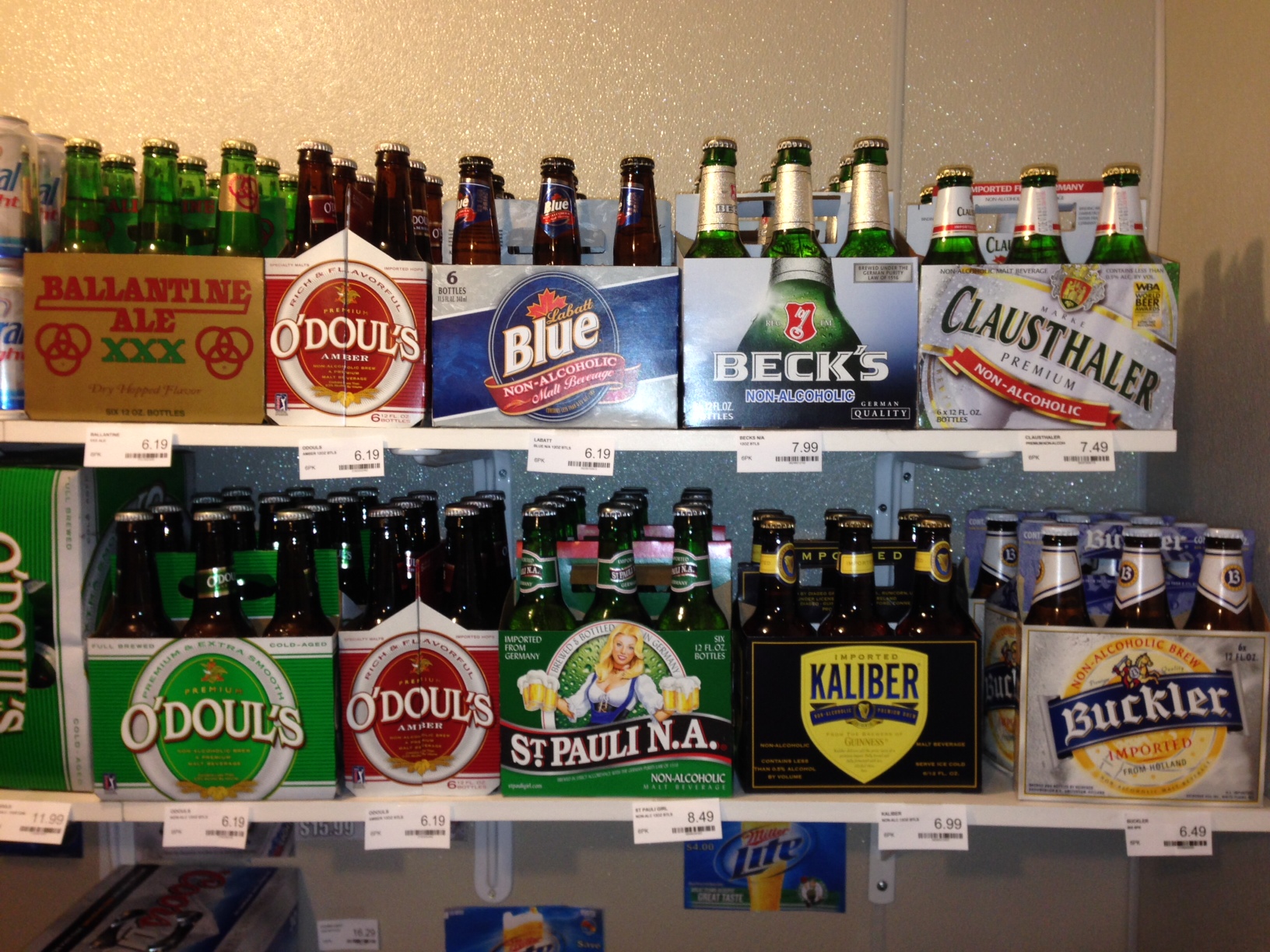
(The nonalcoholic beer section in my home town’s “Beer Cave” at Brewfest Beverage Co.)

It turns out that nonalcoholic beer is made the same way as regular beer and then the alcohol is removed afterwards.  Evidently, the more alcohol you remove, the more expensive the process is. Even though brewers set out to take out the alcohol, it isn’t cost effective to do so fully and they do not want to guarantee that all of the alcohol gets removed. If you’re interested in knowing more about this process, take a gander at this article from Chow, my favorite online source for all things culinary, or Wikipedia.

The FDA’s requirements for a beer to get the “nonalcoholic” designation are quite detailed and available here.   The net-net is that the brewer has to guarantee that the alcohol percentage is less than 0.5% by volume.  Since there is some alcohol, you have to be 21 in the U.S. to purchase or to be served nonalcoholic beer. Before you ask the inevitable question…No, I do not think I have broken my New Year’s resolution by sampling these NA beers. I figure that if pregnant women and on-the-wagon alcoholics can drink this stuff, so can I.

Since it’s the football post-season and my team — the New England Patriots — is still in the running, I decided it was a great time for me to figure out which locally available nonalcoholic beers are the most enjoyable. This will allow me to make the most of not drinking all the way through to the Super Bowl.

Only 3 nonalcoholic options were available at the three different local restaurants I visited over the past several days.  These are O’Doul’s Premium, St. Pauli N.A., and O’Doul’s Amber.  The tastiest and most drinkable of these three, by far, was the O’Doul’s Amber.  The worst was St. Pauli. Frankly, once the glass was no longer cold, it was nearly undrinkable. Of the three, I could be very happy drinking O’Doul’s Amber at parties, watching games, and hanging out at bars – no problem.  If all that’s available is O’Doul’s Premium, I would order it, drink part of it and let the glass sit there to look social. If my only option is St. Pauli’s N.A., I’d get the soda water and cran.

Knowing that there are many more NA beers in the beverage category, I did some online searching to see which labels get the highest praise.  This article from 11 Points and this one from Gizmodo were the most complete and helpful. Armed with this information, when I got into my local “beer cave” I knew just what I needed to complete my NA taste-testing: Kaliber by Guinness and the German import Clausthaler.

I wish I knew more about beer so that I could accurately describe why these two beers blew away the others I had tried. There’s a lot in both the art and science of the taste of beer, or mouthfeel, as I discovered it is called, that I don’t understand. All I can say is the Clausthaler had a wonderful flavor with a bit of a citrus tang that makes it a great accompaniment to food, especially Asian or Mexican.  And, the Kaliber has a very substantial body and good overall flavor that make it a great beer to drink on its own.

I don’t expect to drink a lot more NA beer this year.  However, I will definitely find a few occasions to fit Clausthaler, Kaliber, and even O’Doul’s Amber into my busy social schedule.

Hole in My Pocket

Standard

I led you astray in my last post when I titled it “I’m Saving Big Bucks!” Although I am really excited about saving more than $4,000 of our family income by not drinking alcohol this year, all that cash is already starting to burn a hole in my pocket. Sure, saving it would be great. But, in keeping a resolution as difficult as this one, I would really like to reward myself. That’s precisely what all the experts say I need to do, in order to increase my chances of success.

For example, a well-received book by Charles Duhigg is all about New Year’s Resolutions and the power of habit. Of course, at the heart of my resolution is to create a new lifelong habit of reduced alcohol consumption.  Duhigg places “rewards” as the third most important factor out of 5 for creating new habits like mine.

Additionally, there are dozens of online articles that also stress the link between rewards and resolution success. Among these, I find this Top 10 Tips to New Year’s Resolution Success particularly awesome, because I didn’t do steps 1 through 4. One is to “be realistic”; 2 is to “plan ahead”; 3 is to “outline your plan”; and 4 is to “make a pros and cons list.” I just skipped straight to 5, which is to “talk about it.”  That said (no pun intended), the sixth thing on this Top 10 List is to reward yourself. This other article, makes it clear that there are different types of rewards — daily rewards, milestone rewards, and having a large great reward when the resolution is successfully completed.

In terms of daily rewards, I have already found that the routine of herbal tea with my husband in the evening is both very relaxing and enjoyable. And, also that my newfound ability to exercise in the evening (something I couldn’t do when I was drinking wine every night) is a reward both in that it makes me feel healthier and it enables me to sleep later in the morning. 

I have decided to roll all the rest of the rewards that I deserve into one really big one. With my budget of over $4,000, I have an opportunity to make it really meaningful and awesome. No, it’s not paying down the mortgage, increasing contributions to my IRA, or finishing the ceiling for our basement re-model.  These are all important and practical things that deserve consideration. However, the research says that my reward should be personal to me. I have decided to make it a once in a lifetime experience.

What is my reward? I’m planning an amazing 10-day vacation to Laos.

Image

(photo: courtesy of Phoenix Tours)

There are several great benefits wrapped into this reward.  First and foremost, I’ll have a chance to check-in on my step-daughter, Erin, who recently took a leave of absence from her career as a fashion designer and is traveling in Southeast Asia for the next four months. (You can follow her journey here). Being with Erin on a small part of her personal journey should be something both of us will cherish for the rest of our lives.  Secondly, I’ve enlisted my old college pal, Angela, to make this trip with me. Ange and I both studied Mandarin and, back in the 90’s, traveled together in Singapore, Hong Kong, and Mainland China. What a hoot it’s going to be for us to go to Bangkok and Laos on this trip twenty years later!

I’ll be a full two months into the resolution before we start our journey to Laos.  This means that I will be well on my way to creating a new habit. In fact, the experts say that it only takes 28 days. And, I’m sure that the memories and experiences I’ll take back home will continue to reward me for the rest of my resolution journey.

It’s quite a reward, don’t you think?

I’m Saving Big Bucks!

Standard

Saving money was not a deciding factor in choosing not to drink alcohol for my 2014 New Year’s resolution. In fact, the list I jotted down in my journal puts it at number nine in a list of nine. (I couldn’t come up with a 10th reason). Despite this, I amused myself the other night by doing a quick estimate of how much money I expect to save this year by not drinking. Of course, I immediately followed my note-taking by creating an Excel spreadsheet.

Image

Let me walk you through the table. I mentioned in a previous post that I used to drink at least two glasses of wine every night. So, my estimate assumes that, had I not made this New Year’s resolution, I would drink two glasses of wine every night in 2014. It also assumes that I would eat at home 5 nights a week, eat out twice per week, and that once per month, my husband and I would “splurge” on something that would result in spending more on alcohol. These are the three “line items” represented in the rows in the table.

In the columns, I show a conservative estimate of how much money I would have spent per time on each of these drinking occasions, how many time per month I would have engaged in each, and then I annualize the cost by multiplying the results by 12. Finally, I add up the dollar amounts in the last column to get the total expected annualized cost savings.

For the wine at home, I used a cost of $15 per bottle, and assumed that my husband and I would share it and finish a bottle each night. So, we would have spent $7.50 (or half the cost) per night on me. Sure, we all know that there are times when I would have been drinking a $12 bottle of Pinot Grigio. And also times when we would be sharing a $30 bottle of reserve Pinot Noir. This is an estimate, and I am sure that it is conservative. In fact, Bruce opened a bottle of Bridlewood Reserve Pinot earlier this week. It had cost $30, and it took him three days to finish it. If I had been helping him with it, it would have been a dead soldier in one night – guaranteed.

To estimate the cost of drinking wine out, I simply figured two glasses of wine all in at $10 each, or $20 for each outing. Bruce and I love(d) to go to wine tastings and wine dinners, we like(d) to share a special bottle of wine on special occasions, and we also greatly enjoy going out to listen to local music. I account for this additional spending in the “Splurge” line item. Here, I assumed that it was only once per month, and that the additional spending just for me, above and beyond the typical cost, was $20.

$4,440 is a lot of money! To be honest, this is more than I had guessed. And, let’s face it, this is probably an under-estimate of how much I will save this year by not drinking alcohol. Why wasn’t cost savings higher on my list? In my next post, I’ll reveal what I’m going to do with all that cash…

I Dreamed of Red Wine

Standard

I had a dream about red wine. Literally. Well, actually, it was kind of a nightmare. The important thing is that it forced me to think about two critical aspects of my New Year’s resolution, both while I was still dreaming and after I awoke.

Image

My dream involved a near empty bottle of Kendall-Jackson Cabernet Sauvignon. People who know anything about my wine consumption prior to January 1 can guess that Cab Sauv is one of my least favorite reds and also that I think KJ is completely over-rated and over-drunk (if that’s a word). I am not sure if I would feel differently about this dream if it had been a bottle of Châteauneuf-du-Pape or Bridlewood Reserve Pinot Noir. My guess is that the type of wine probably doesn’t matter.

In the dream, I am sitting on the floor in front of a coffee table in a cozy room that is like a library or large sitting room.  I am among a small group of people who are scattered about the room; the others in the room are a mix of family, friends, and strangers. We are all gathered there to listen to something. I don’t know what. My father is sitting on the couch behind the coffee table. On the coffee table is the aforementioned bottle of wine. At some point, between songs or readings, I decide to take a sip of the wine just to see what it tastes like. A few minutes after trying the wine, I realize what I had done and I quickly glance around the room to see if anyone had seen me take that little sip.  Busted. My dad had, although he didn’t say anything to acknowledge it. I just knew he had and that he was probably the only one.

I start to panic.  What do I do about my blog? Do I confess to my followers that I had already broken my New Year’s resolution, so early in the year and over such a mediocre bottle of wine for no good reason? Both in the dream and thinking about it now, the answer is the same. The goal of the blog is to be honest and accessible.  In my dream, I decided that yes, I would confess this lapse to my blog followers. And, if I am unable to keep my resolution in real life, I will also confess it.

Given that, what of the second and, perhaps, more important question? In the dream, I pondered whether I would continue my resolution after having broken it. However, I awoke before coming up with an answer.  This question requires more thought. But the answer is the same — Yes.

This is a very difficult resolution, because it allows no room for no mistakes. “I resolve to drink no alcohol in 2014” is unequivocal. If I am unable to live up to the full spirit of my resolution, I will still go back to it, again and again if necessary, to see how far I can take it. And, I promise that I won’t be sipping on any KJ, cab or otherwise, anytime soon!