Why Not Try It for One Month?

Standard

Earlier this year, I was talking to someone I had just met and it came up that I had recently lost over 20 pounds. The guy was really excited when he heard this and asked the inevitable question: “How did you do it?” I told him the same thing that I told all of you in this blog post: the foundation was quitting drinking alcohol as my New Year’s resolution.  He didn’t miss a beat before giving me a wide grin and saying: “No, thanks. I don’t need to lose weight that bad.” (In my opinion, he certainly did.)

I have gotten similar responses from more than a few other people. Every time, it saddens me. I was able to lose 20 pounds in a little over three months after quitting drinking. And I want other people who express an interest in losing weight to try it. What does it say about someone if they’re not even willing to consider quitting drinking for 90 days? Perhaps it indicates that these are precisely the people who should be putting alcohol on hiatus.

Don’t get me wrong. I know there are as many ways to lose 20 pounds as there are people who need to lose the weight. But my own experience makes me wish there were more willingness to – just temporarily — change this one thing. It’s true that you have to do a few other things to make real progress. However, quitting alcohol is one of the best starts you can make.

Months ago, I described the many reasons why I felt that cutting out alcohol was the best way for me to kick-start my dieting process in this post. It was, by far, the easiest time I had losing weight. Sometimes I still don’t believe it’s true. However, every time I step on the scale, I see that I have really lost over 20 pounds this year.

It’s not just me. There are also plenty of others who say the same thing. A blogger on a similar journey to my own shares these insights gained from giving up alcohol to lose weight. Also check out this article, this one, and this one from Livestrong. Not to mention these thoughts from a woman who lost 100 pounds and says that giving up alcohol was the most important step for her. It’s no coincidence that the South Beach Diet, one of the most popular and effective diets for more than a decade, bans all alcohol in Phase 1.

If you don’t want to lose weight, ignore this advice. However, if you are one of those people who envies me for having returned to my ideal weight or knows deep down that you would feel much happier and be much healthier if you lost a little weight, try it. Quit drinking for just one month and let me know how it goes.

My sixth month without alcohol is drawing to a close and I certainly wouldn’t trade what I’ve experienced along the way for one sip of anything.

Will I Drink Again? (cont.)

Standard

My blog post last week generated a lot of comments both in the blogosphere and in real life. It seems my friends are as split as my own mind is on the subject of whether I should drink again when my New Year’s resolution is over.

It seems like those who think I should not drink again are the most adamant. Folks on this side of the ledger point to how much I’ve accomplished in six short months and ask why I would even consider drinking again. A few of these people pointed to the dramatic difference in my physical appearance from the weight loss and another pointed me to my own words in last week’s blog, the part about liking who I am now.

When I was explaining to one of my mother’s good friends how it would be nice to have the option of celebrating special occasions with alcohol, she responded, “Why would you do that? Once you do it for one special occasion, you’ll find a way to make every occasion special.”

A family member even went so far as to imply that it would be a major mistake to go back to drinking alcohol. His words really stuck with me and also got me to thinking that I have really opened a can of worms by asking for feedback on the matter.

Luckily, there are at least an equal number of people lined up on the other side. Another family member suggests that setting boundaries for executing a plan at moderate alcohol consumption would be a great New Year’s resolution for me in 2015. And, certainly my husband and many of my close friends look forward to a day when I will be re-joining them for wine-paired dinners and the like.

It occurs to me now that, whatever I decide, I am certain to disappoint some faction of my followers, many of whom are friends and family. My plan for handling that is to distract them with an even more challenging, more interesting, and more polarizing New Year’s resolution in 2015.

To amuse myself in the interim, I searched for articles by other people who had resolutions similar to mine. I found a former self-described “party girl” who made it through her year and decided not to drink again. Read about her here. Then, there’s this British woman who took her alcohol detox too far and became a recluse and lost most of her friends. She started drinking again. Read an article about her here. And, there’s a sporty guy who quit alcohol for a year to lose weight. He drank after the year was up and then quit again. You can read about him here.

Ultimately, whether or not to drink again is a decision I will make on my own. That said, I love pondering the diverse opinions generated along the way. Please continue to post your views and comments.

Will I Drink Again?

Standard

By far, the question I get most often these days is: “Do you think you will drink again?” This is an interesting progression in people’s reaction to my resolution not to drink alcohol this year. In the beginning, it was: “Do you miss it?” (I answered that question in an early blog post which you can read here.)

Image

(Above: Me having my last drink, a nice glass of champagne last New Year’s Eve. Was this my last alcoholic beverage, ever?)

Initially, I assumed that I would start drinking again when New Year’s rolled around again. In my mind, I was very clear that I was giving up drinking for one full year and I would start again on January 1, 2015. In fact, I even considered contacting a few different champagne companies to see if any of them would consider sponsoring my New Year’s Eve party.

Now that I have already achieved both my weight loss goal and my marathon PR in just short five months, the question of “will I drink again?” is one that I have started to give a lot more thought. Nearly halfway through my “dry year,” I’m honestly still not sure. There are some pretty good reasons on both sides of the ledger.

3 Reasons to Drink Again:

1. I’ve earned it. I’ve lost more than 30 pounds from my highest point and now weigh my ideal weight for my body frame. Read about how I gained and lost 30 pounds here. Not drinking enabled my weight loss and my weight loss helped my marathon training and propelled me to my fastest marathon time. After all this hard work, haven’t I earned the right to drink wine again (in moderation, at least)?

2. I miss it. Like when I wrote about it earlier this year, there are still times when I miss drinking alcohol. I miss it the most when my husband, Bruce, and I got out for a nice dinner. Great food gets enhanced when it’s accompanied by a great glass of wine. One of the lowest points in this process thus far was when Bruce went to a wine and food-paired dinner without me. I also really crave a beer after a long run or road race. Simply put, there are times when an NA just doesn’t cut it.

3. I’m not an alcoholic. There were times in the past when I was disappointed in myself for drinking too much. And a few occasions when I crossed a line in my consumption. Having alcoholism in my family has always made me hypersensitive to how much I was drinking, and also caused me to worry that I might become an alcoholic. Back in January, I did some research and now feel confident that I am not an alcoholic, nor was I an alcohol abuser. (That post is here.)  

3 Reasons Not to Drink Again:

1. Why go back? This is probably the strongest argument not to drink again, and is one that was raised by my friend, Rose, in response to a very early blog post. A teetotaler herself, Rose asked: “Are you thinking of quitting for good? I mean, after you succeed in losing the weight, and you will, and running so hard that you get your PR, why go back to it?” Considering what not drinking has already enabled me to achieve, why would I go back?

2. I like who I am now. This is really just a continuation of the first reason above. In addition to achieving the goals I set for myself, not drinking has also enabled me to sleep better, given me clearer thinking, and made me a happier person. I just gave up one thing, it was relatively easy to do, and I have gained so much in the bargain. It was a fair trade, wasn’t it?  

3. Moderation is not my strong suit. I seem to have only two speeds: 100 miles per hour and full stop. Luckily, it’s also true that that when I commit to something, I go all in and don’t mess around. (This doesn’t mean that I am always successful.) Suffice it to say that moderation isn’t easy for me. This was why I gave up drinking in the first place, because just cutting back had seemed impossible.

All of the above said, although I am still mulling it over, I’m leaning toward giving moderation a try in 2015.  I think it would be really nice to celebrate all of my 2014 achievements with a glass of kick-ass champagne on New Year’s Eve. And, there’s still plenty of time for me to look for sponsors. Of course, there’s also more than six months for my thinking to evolve even further.

What are your thoughts and predictions about whether or not I should or will drink again when 2015 rolls around?

How I Gained Then Lost 30 Pounds

Standard

Believe it or not, I gained 30 pounds through the years, beginning when I lived in Scottsdale, Arizona in the early 2000s up until when I stepped on the scale here in my Vermont home on January 1, 2013.

Image

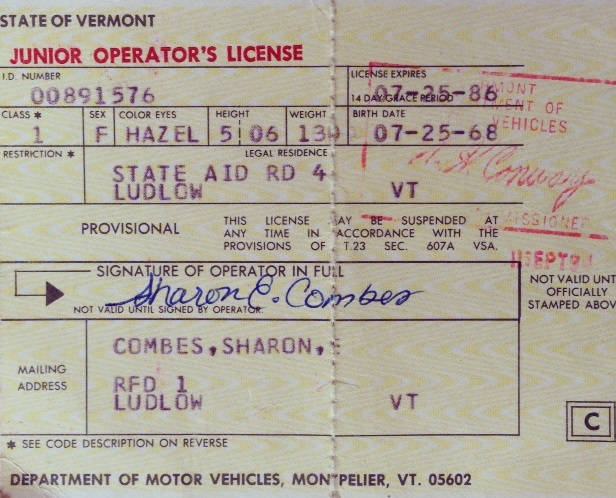
(Above: My driver’s license at age 16. I recall deducting 5 pounds from my actual weight when I filled in the form. Nearly 30 years later, I’m an inch taller and weigh the same).

This is exactly how it went down (or, should I say, up?):

The first 10 pounds were the result of my thyroid slowing down, due to the radiation treatment I received in early 2002 to combat a hyper-thyroidal condition caused by Graves’ Disease.  Although it is an interesting and somewhat scary story, I won’t bore you with the details of how it temporarily affected my life. What’s pertinent here is that, after enjoying most of my life below this weight, I didn’t get below 145 pounds again until earlier this year.

The next 10 pounds were much more enjoyable to gain. I attribute them to a combination of my husband’s excellent cooking and my love of drinking wine along with all of that great food. I guess that, without the thyroid condition, I probably still would have gained at least 10 pounds through the second half of my ‘30s as a result of discovering the joys of great food and good wine. And, to be honest, I loved every minute of it!

The last 10 pounds somehow got tacked on seasonally one winter, a few years after we moved back to Vermont, in 2007.  I started putting on a few pounds at the tail end of each running season in the late fall, and continued adding them straight through the holidays, from a combination of going out to eat more, not resisting the plethora of holiday snacks in the office and at parties, and a seasonal curtailing of my commitment to exercise. As you might have guessed, weight gain during the holiday season is common, although studies about it vary.

Most of these last 10 pounds I could lose pretty easily when I put in the effort, usually as a New Year’s Resolution. And I did so a few times. At one point in 2012, I had lost 15 pounds, only to gain it all back later in the year. Over the course of 2013, I lost 10 pounds early on, but ended up down seven pounds at year-end, mainly from a modest commitment to exercise and by not pigging-out over the holidays. 

That’s a condensed version of how I found myself weighing 158 pounds when New Year’s 2014 rolled around. Unless you’ve been living under a rock, you know that I decided to give up alcohol for the year and also to leverage this resolution to lose 20 additional pounds and to achieve my fastest marathon running time.

In a blog post in late April, I announced that I had lost the 20 pounds and attributed my success to four things: (1) Quitting drinking, (2) Telling the world about it, (3) Approaching it like a marathon, and (4) Using an app to track everything.

My marathon training schedule required me to step up my exercise regime beyond what I had done in the past. And I worked very, very hard on not “blowing it” during my training by over-compensating or over-rewarding myself; I described these strategies here. It paid off! During May, I lost 3 additional pounds.

I simply cannot believe that I have now lost all 30 pounds that I had gained these last dozen years. My new challenge is to maintain my weight at 135 pounds. In fact, I am adding a new goal to the mix: Keeping the 30 pounds off over the next year, so that I can join the National Weight Control Registry.  

How I Got My “PR” Marathon Time

Standard

I’m happy to report that I achieved my best marathon time – my “PR” or “personal record” – over the Memorial Day weekend at the Vermont City Marathon. It’s a good thing, too, since I was sort of cocky by mentioning in a blog post a few weeks ago that I knew I was going to do it.

Image

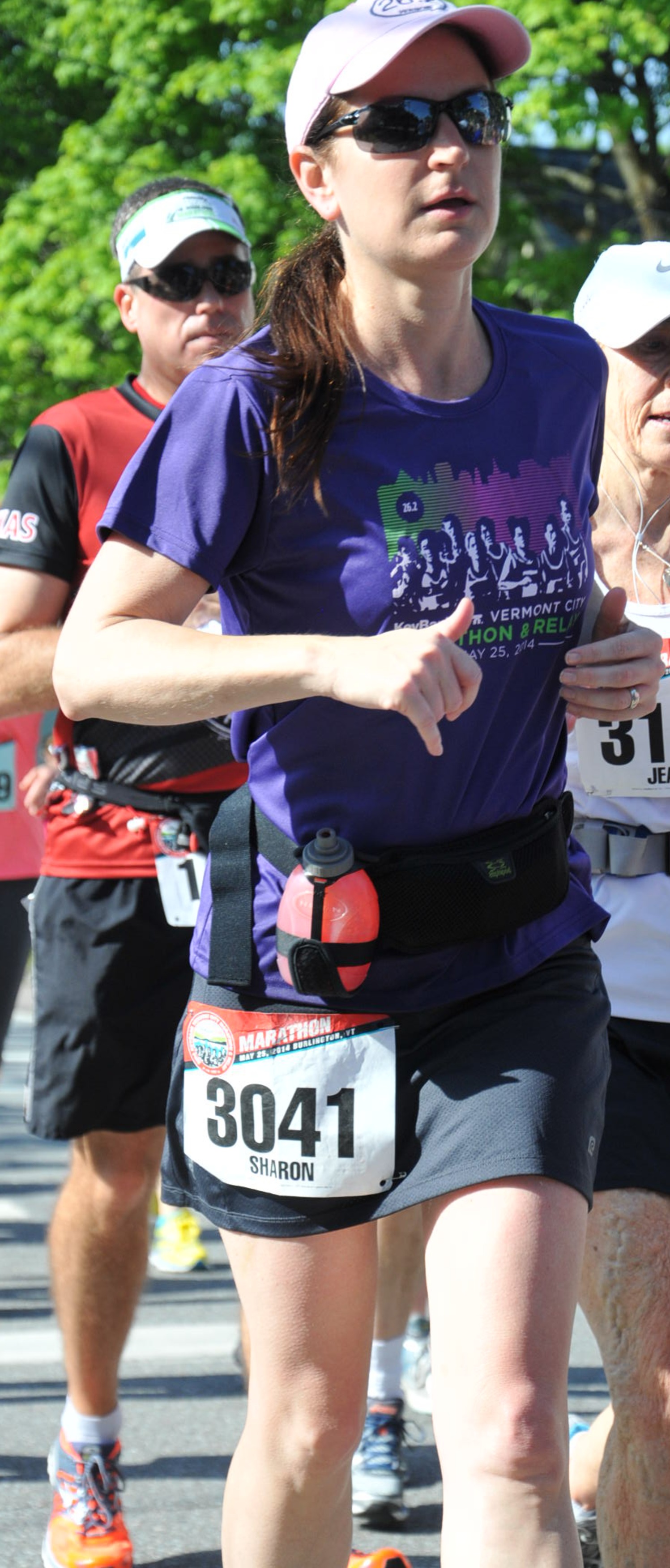
Above: My ‘selfie’ prior to the Vermont City Marathon with the 4 hour and 30 minute pace group. One of the pace leaders, Jen Sorrell, is also pictured (with sunglasses).

I ran the 26.2 miles on an unseasonably warm and sunny day in Burlington, Vermont, along a course with diverse terrain, but lots of fan support, in 4 hours 27 minutes and 11 seconds. This is 4 minutes faster than my previous best time, which was at Rock ‘n Roll Phoenix marathon, way back in 2006.

This was only my 6th marathon, but my fourth in the past three years. Up until yesterday, my recent results were very disappointing. I ran the Air Force Marathon in 2012 in 4:46:40, while nursing a bit of a hip injury. Last year at Vermont City, I pulled a calf muscle in the cold and had to walk from mile 14 until mile 17. However, I was proud that I recovered enough to run the last 7 miles, after receiving medical treatment, and cross the finish line in 5:08:53. Finally, last fall, I participated in the inspirational 20th running of the Philadelphia Marathon. I felt strong for much of the race, but really petered out after mile 18 and finished in 4:47:14.

What did I do differently this time to not only chop 20 minutes off of my recent best time, but also to achieve my PR? I attribute these results to 4 things:

  1. Quitting drinking.
  2. Losing more than 20 pounds.
  3. Stepping-up my training program.
  4. Running the race with a pace group.

Quitting drinking was instrumental, because it set me up for a successful diet and also freed-up my time for more exercise. More background about my New Year’s resolution not to drink alcohol this year can be found here, here, and here.

Losing over 20 pounds helped my confidence level and my training. I immediately saw faster running times at the start of my running season and I have had far fewer aches and pains along the way, due to losing weight.

Although I had already improved my chances to getting a marathon PR time this year by sticking to my goals of not drinking and losing weight, it was also critical that I employ both training and racing strategies to help me get the rest of the way there. Since I died in Philly at mile 18, I needed to step up my training program with more long training runs. That’s why I selected Hal Higdon’s Intermediate 2 Marathon Training Program that I described here and here.  

Having a solid 20-mile run and strong half-marathon performance under my belt prior to running Vermont City was key to my fitness level and confidence. The last piece of the puzzle was to have support on race day.  There’s a reason why they say a marathon is as mental as it is physical.

That’s why I reached out to Jen Sorrell and Kristin Lundy, the pace team for the 4 hours and 30 minute group, before race day to let them know that I would be running with their pace group. In addition to the well-documented benefits of running with a pace group (see here and here), I felt that contacting them in advance would make me accountable and improve my chances of following through.

Jen and Kristin were fantastic motivators. They cheered us on and made sure we ran consistently on pace the whole race. They also shouted out helpful tips about the upcoming terrain, where we would see motivating fans, when to consider fueling, and how to best approach special terrain like an uphill, downhill or trail. The race flew by and the first mile marker I remember clearly was 10 miles in.

Although I ultimately moved ahead of this group at mile 20 to finish at a faster pace, I don’t think I could have done it without them. My hats off to Kristin and Jen.  After the race, I emailed them both to ask what motivates them to be pace leaders, rather than running for their personal best time.

Kristin said, “It has taken me a long time to be able to run a smart, steady marathon. I have made many mistakes along the way, and learned a lot with my experience. It is really a great thing if I can help someone else along the way, and pass on any tidbit of knowledge I have picked up…Seeing people reach their goal is extremely rewarding. You not only get to revel in your own happiness of crossing the finish line, but you also get to feel good from seeing them do it. It’s a win-win!”

And, Jen added, “I personally like pacing as it’s rewarding to be able to help others meet their goals, whether it is to get a PR, run steady or just finish.”

I still have a long way to go before I can qualify for the Boston Marathon. However, following through with my training and race strategies and achieving my PR are important milestones in that journey.

Fiddlehead Season

Standard

Fleeting, fragile spring.
A hunt before they unfurl.
Fiddlehead season.

Last year, I started writing a memoir and completed the first section, which is titled “Fiddlehead Season.” There’s something about the fleeting nature of this part of spring that reminds me of childhood, both my own and generally. Below is a condensed version of a small section of my memoir with an update from last weekend tacked on the end.

Image

(Only one variety of fern is edible and you have to pick them when they are still tightly wound in early spring.)


The father of a childhood friend has a hobby of foraging and had become somewhat famous locally because of this. He was very successful in fiddlehead season, so much so that it truly amazed me after I had moved back home and started foraging for fiddleheads myself. He was also the only person I personally knew who is an avid mushroom forager. I have always hated mushrooms, so this skill was something I had never learned to appreciate.

One spring after my husband and I moved back to my home town, I got a phone call out of the blue. My friend’s dad announced himself then said: “Sharon, let your mom know that I have a bunch of fiddleheads for her. You can come by the house any time.” Click.

The next morning, my mom and I headed over there. We weren’t even sure which house it was, despite the many times I had gone over there as a child. It’s funny how, over time, you can lose faith in your memory. Is it the white one next to the brick house or the other one in front of that? Luckily, we were saved by the lady of the house, who popped out of their front door when she saw our slowing car.  We met her at the open doorway, through which she handed us some Ziploc bags and told us to head out back to take as many fiddleheads as we wanted. We found them soaking in water in a large white bucket in the shade, under the eaves of their house.

I’ve received similar calls most springs since then, and sometimes I’d even go by the house myself and just help myself to fiddleheads from the bucket in the back.  It had become an early spring routine. But the calls stopped two years ago and I learned that my friend’s father’s health had begun to fail and he was no longer able to forage.

Last summer, I had arranged for some of my friends from out of town, who have a keen interest in Vermont mushrooms, to meet and discuss mushroom foraging with my friend’s father. He had diligently prepared by assembling several photographs of different local mushrooms he himself had taken through the years. He had also marked up several reference books with notes and tabs. Although my companions already seemed to know quite a bit about the edible mushrooms in the area, I could tell they were gleaning helpful tidbits and were thrilled with all of the preparations and visual aids.

I wasn’t really participating in the conversation, except by picking up a photo here and there, nodding, and asking a few tangentially related questions.  My mind wandered to other things and then, finally, to fiddleheads. As they kept talking about puffballs, chanterelles, and whatever else, I decided that I wasn’t going to leave that house without knowing that secret spot where he successfully forages for all of those fabulous fiddleheads every spring.

When the mushroom conversation started to slow and I could sense that my companions had learned a lot about fungi and were very happy to have a few great leads on where to look for certain types, I eased my way back into the conversation again. “Do you always say that it’s April first when you go out picking fiddleheads?” I asked. “May first,” he replied. “May first.” “And…you go somewhere along the river?” I probed further…

****

Last weekend, my husband, Bruce, dropped me off at the bridge at the end of the road. I got out of the car with my baseball cap, my iPhone, and two pairs of scissors stuffed into our spaghetti strainer, which was set inside our green plastic vegetable strainer. I carried these items in my right hand and used my left to move sticks and trees and bushes out of my path. I went directly to the river bank and it wasn’t easy going.

Young green shoots were all over the place, mostly covered with dead twigs and long, brown grass that had become matted against the ground over the long, snowy winter. I went toward one patch of green and then another and another, ruling them all out. Then I made my way methodically south, staying about the same distance from the edge of the river. After moving a ways downstream, I noticed some unfurled fiddleheads to my left, the side that was away from the river. I hadn’t expected this. I was told the ferns were on the riverbank. No matter, at least I found them.

At first, I was disappointed to see the tall, thin fiddleheads already unwound, reaching toward the sun, because I thought I was too late. After all, I was told “May 1st.” However, the winter had been long, and when I looked in my usual spots the previous weekend I could see that it was still too early to pick them.

The truth is, they come and go so fast you can’t always plan to harvest them over a weekend. I knew that. I should have come during the work week. I was berating myself with these thoughts when I saw a large tight mound of perfect, tightly furled fiddleheads. They were large, and a deep, dark green, reminiscent of the ones I bought at a local market last spring. After I cut them, I spotted several others just like them nearby.

They were there all along. I just couldn’t see them when I was distracted by the unfurled ones.

Image

(My husband and I picked more than two pounds of fiddleheads at the secret spot.)

If you ever plan to be in northern New England in early May and have an interest in picking fiddleheads, check out my “how to” guide on Facebook.

Embracing Stretch Goals

Standard

To be completely honest, when I set my secondary New Year’s resolution goals of losing 20 pounds and getting my Personal Record (“PR “) marathon time, I knew that I would be successful.

Sure enough, last week, I announced that I’ve already lost the weight. And — knock on wood — with my first marathon of the season just a few weeks away, I feel confident that I will get my marathon PR early.

**If you are not very interested in running, please stop reading now and tune in next week, when I promise to write about something else.**

Image

(Above: My view during my half marathon last weekend. Having my brother as my pacer, helped be achieve my best performance since 2005.)

To help ensure that I get my PR, I already contacted the Vermont City Marathon’s 4.5 hour pace team to introduce myself. Since my fastest marathon time so far is 4:31:10, sticking with this group will help me squeak in a new record. I’ll let you know whether or not I am successful over Memorial Day weekend. 

Since I realized early on that these two sub-goals were sandbagged, I announced another goal for my dry year about a month ago. It’s the big kahuna: qualifying for the Boston Marathon. This is a “stretch goal,” defined as a goal that “cannot be achieved by incremental or small improvements but requires extending oneself to the limit to be actualized.” Some people might even say that it’s impossible for me to “Boston Qualify,” or BQ. I mentioned my current PR marathon time above. To qualify for Boston, I need to cut more than 35 minutes off my best time.

Do I think I can do it? You bet. However, like everything else worth striving for in life, it will take goal setting, commitment, and follow-through. This is a great summary on how to set athletic goals. In order to BQ, I am now approaching every single workout with multiple goals in my head: the minimum I will accept, the true goal, and the stretch goal. I find that I am reaching these true goals and, such as in the half marathon last weekend, I am sometimes even surpassing the stretch goal. 

I’ve already significantly improved my chances of cutting 35 minutes off of my marathon time by quitting drinking and losing 20 pounds. In a previous blog post I shared this summary given to Princeton athletes on the negative impacts of alcohol on athletic performance and this Runner’s World article about how running weight makes people faster.

Additionally, I am committed to a more aggressive training plan, Hal Higdon’s Marathon Intermediate 2. Compared to my past training, this plan requires me to run three times during the work week, with the Wednesday run peaking at 10 miles. It also has a very rigorous weekend running schedule that features a Saturday run at my planned marathon pace that also peaks at 10 miles. Running at pace on Saturdays means that I have to run the Sunday long run fatigued. Speaking of the Sunday long run, a beginner’s training program peaks with an 18-mile run, and an intermediate program peaks with one 20-mile run. This plan requires that I run three 20-mile training runs. Honestly, that’s rough.

A seasoned, marathon-running friend, who is affectionately known as “B-Rad,” once told me, “I run marathons at a minimum every third week, because I hate those long training runs.” I do, too. So, with B-Rad’s training in mind, I have scheduled two marathons prior to my BQ race, as well as three half marathons. This helps me mentally by limiting the number of long training runs. From here on out, I just need to do one each of a 15-, 16-, 18- and 20-mile training run in preparation for my BQ try on July 25th.

Since my recent half marathon performance exceeded my stretch goal, I absolutely believe that I can qualify for Boston. This was my first sub-2 hour “half” since 2006 (see my Arizona Road Racer results here). My time of 1:55:57 in the Middlebury Maple Run was 21 minutes faster than my own performance in the same race last year. A year ago, I placed 44th out of 62 women in my group, women in their 40’s. This year, I placed 10th out of 54, well into the top 20% of my group.

I checked in with Runner’s World’s Race Times Predictor to see how this half marathon performance should translate on marathon day. It equates to a 4:02:00 marathon time, 29 minutes faster than my current PR but seven minutes slower than what I need to BQ. This is great news! Vermont is hilly, while my BQ course is flat. Middlebury has a lot unpredictable and varied terrain, while my BQ course is a five-mile loop that I will run multiple times.

For good measure, I also put my target marathon time into the Race Times Predictor and learned that a 1:52:00 half marathon time is equivalent. I’m trying for that time, a PR for that distance, in the Crowley Road Race in early July. Wish me luck. And, as you might expect, I’ll let you know how it goes.

I Am Sisyphus (Again)

Standard

Last week, I reported the good news that I had already lost 20 pounds and returned to my goal weight of 138 pounds.  Sadly, I can already tell that weight maintenance is going to be a battle. And, unfortunately, it looks like one that may last the rest of my life. That 20th and final pound has been lost, gained, and re-claimed four times and it’s only been a few weeks. Huffington Post says I need to get used to this, because “weight maintenance is actually the state of gaining and losing small amounts of weight over and over again.”

This reminds me of the Myth of Sisyphus, about which I wrote this poem in 1997:

And I was Sisyphus again today,
Elated at the top,
Only to fall down under the rock’s
Crushing weight.
Yet I know I will be happy again tomorrow,
Only to slip back down again,
Still happy afterward, as I approach the crest.
Mankind and I, we are so simple in
Both our pleasures and our defeats.

To be successful, the Mayo Clinic suggests that “weight maintenance requires daily exercise, a healthy menu, a long-term commitment, and constant vigilance.” Wait a minute. This sounds suspiciously like dieting. They also say not to worry, because it will get easier after two to 5 years of keeping the weight off. When they said “a long-term commitment,” they weren’t kidding. It’s clear that I’m going to need as many strategies to maintain my weight as I did to lose it the first place.

My first strategy is to continue using the MyFitnessPal app every day. As I have explained in the past, this is my version of keeping a food and exercise journal. According to WebMB, I should be able to maintain my weight while consuming 2,000 calories a day.  This is significantly more than the 1,200 calorie diet I’ve been on. I just can’t bring myself to program this into my settings, so I’m starting with 1,500 and will adjust later, as needed.

My second strategy is to remain committed to exercise. This should be the easy part for me, since I am still training for marathons and have always been active. This article in Women’s Health Magazine suggests that exercise is the single most important factor in keeping weight off. The stat came from The National Weight Control Registry which tracks people who successfully maintained weight loss of 30 pounds or more. It turns out that 90% of these people exercise an average of one hour per day.

This study using data from the Registry confirms that my first two strategies are important to maintaining my weight and also suggests two others. These are monitoring my weight regularly and having a low-fat diet. We have a digital scale in our master bathroom and I use it almost every day, making the weight monitoring no problem. Focusing on lowering fat is another matter. I lost the weight by counting calories and exercising. The only significant diet change I made was cutting out alcohol. Generally speaking, I ate essentially whatever I wanted in lower quantities or I exercised more to burn it off. I’m going to mull over the low-fat focus a bit more…

Image


(Above: My brother helped pace my half marathon run in Middlebury, VT on May 4, enabling me to finish well under a 9 minute-per-mile pace.) 

What is going to be critical to maintaining my weight is to be vigilant on race weekends. Take this past weekend for example:  I ran a half marathon faster than my goal, in 1 hour and 56 minutes. My average pace of 8:51 per mile is under my marathon pace needed to qualify for the Boston Marathon. I even ranked in the upper 20% of all female runners in their 40s, my “group.” That’s the great news. The bad news is that it’s two days after the race and I’ve gained three pounds. 

Evidently this is common, especially for women, when training for marathons.  A few of the many online articles about this can be found here, here, and here. The main causes of the weight gain include overestimating energy needs, feeling you deserve to eat what you want, and not being active enough outside of the actual training. Originally, I was thinking of not using my app during race weekends as a reward. I’m scratching that idea to make sure I keep the 20 pounds off. If I’m destined to be Sisyphus, I should at least make rolling that stone up the hill easier on myself.

How I Lost 20 Pounds

Standard

Month four of my resolution not to drink alcohol has come to an end.  I’m both surprised and proud to report that I have lost 20 pounds and have returned to what I consider to be my “ideal weight.”

Image (My weight loss is most obvious in my face. Above, at 155 pounds. Below, at 138 pounds.)

Image

More often than not over the past 12 years, my New Year’s resolution was to lose 20 pounds. In all those times, I didn’t even come close, not even during the years when I tried really, really hard. As I mentioned in my blog last week, we all know that trying is not enough on its own. In this blog post, I try my best to answer the inevitable question of “How did I Do It?”

I attribute my successful weight loss this year to these four things:

  1. Quitting drinking
  2. Telling the world about it
  3. Approaching it like a marathon
  4. Using an app to track everything

Quitting Drinking

Not drinking is the single-most important factor in my weight loss.  As I’ve said before, the first 8 pounds I lost was solely due to not drinking. Everyone knows that alcohol has calories. When I was drinking two glasses of wine a night, I was adding approximately 350 calories to my daily calorie intake. This online article has a wealth of information about wine and calories.  It’s hard to stick to a diet of 1,200 calories-a-day if you consume 29% in the form of a liquid with no nutritional value. Studies have also shown that you eat 20% more when you are drinking while you are eating. This recent article talks about that and many more negative effectives of alcohol on weight. In addition to these reasons above, I am now also able to exercise at night, something I never could have done after drinking wine at dinner.

Telling the World

As I mentioned in my inaugural blog post in late December, I improved my chances of sticking to my resolution because I told other people about it and wrote it down. That’s the point of this blog – I’ve made myself accountable not only to my close friends and family, but also to anyone who stumbles across this blog. As of this writing, I have 132 followers and that number increases every week. I don’t think I would have been able to stick to my resolution to quit drinking without the blog. Also, having the blog forces me to think through many issues and ideas associated with drinking, dieting, and exercising. All of this keeps me trying harder and staying more focused. After all, I have to report something interesting back to the blogosphere.

Marathon Approach

I’m aware that it’s a cliché to say that something “is a marathon and not a sprint.” However, since I actually run marathons, I think it’s okay for me to use this phrase.  Also, it’s true. I am approaching my weight loss and fitness goals like I approach a marathon, both literally and figuratively. Literally, I am actually training for a marathon, and that means I exercise six days every single week, culminating in both a strenuous race pace run every Saturday and a long run every Sunday. Figuratively, I have chunked out my goals into smaller goals and am taking a long view.  I am not following a fad diet or eating different things than I normally would in order to lose weight quickly. With the one exception of cutting out alcohol, I am eating pretty much as I did before. However, when I realize I need to change my diet in order to be more successful at losing weight, I change one thing at a time, so that the change is gradual.

To me, a marathon approach also means that it’s okay to screw up. During a marathon, you’re going to have slow miles and fast miles. The slow miles are not bits of failure, they are just a part of the process. The goal for the marathon runner is the average pace run over the full distance. There can be many points of exhaustion along the way, so even walking is okay. A successful diet is much the same.

Using A Fitness App

Once the easy weight from quitting drinking was gone, it was all about my commitment to use the app. I have a daily goal of 1,200 calories that I track using a free fitness Web application called MyFitnessPal. I lost between 1-1.5 pounds per week without fail by inputting everything I ate into the app. When I exercised, I also input that into that app and earned more calories for that day. If I ate too much, I exercised more.  It was that simple; but it was not magic.  It takes focus and commitment to leverage this tool in order to lose weight.

The thread that pulls through all of these contributors to my success in losing 20 pounds — quitting drinking, telling the world, having a marathon approach, and using a fitness app – is commitment. In the end, that’s the most important thing.

Dogs As Running Partners

Standard

For the third year in a row, I am training for a marathon. This year, my secret weapon is my new running partner. She was carefully selected from hundreds of available options. She is relatively tall and lean and from a long line of very energetic stock. In fact, you could say that she was bred to run around all day long. She is always ready to go and, no matter what, she encourages me forward, particularly on my longest training runs.

Who is this amazing running partner? My dog, Cleopatra, a 15-month old Jack Russell-hound mix that my husband and I rescued in October last year. This link takes you to the website of the wonderful organization in New York State that pulled Cleo out of a kill shelter in Alabama, from which we adopted her.

Image

(Above: This selfie was taken the day we adopted Cleo, in the car on the way home.)

I knew at first sight that she’d make a great running partner. I didn’t know how great until one day after an 8-mile run when Cleo ran circles around our house and property in a full-on sprint for several minutes. “Hmmmm,” I murmured out loud, “I guess she can run further than 8 miles.”

When I told my husband and some of my friends about Cleo’s running prowess, each time I was asked things like “Is it good for her?” and “How far can she run?” This prompted me to do some research.

According to all of the articles I found, including this one from Outside, this one from Animal Planet, and this one from Runner’s World, Cleo makes it into the top 10 running dogs on both sides of her family. She’s half Jack Russell which is number 10 and half some sort of hound that is most likely a pointer. The pointers are represented in the top 10 by Weimaraner at number 2 and Vizsla at number 8. German pointer is also on the list.

Animal Planet points to these breeds as being particularly great at running long distances. According to the article, “If your daily journey consists of a ten mile trek or more, then the following dogs will be able to keep up with you because of their medium build and the muscles in their hind parts: German shorthaired pointers, Goldendoodles, Jack Russell terriers, Weimaraners and Vizslas.”

Image

(Above: Cleo loves to run and has a great build for it.)

This information was very encouraging and also seemed validated in my several training runs with Cleo so far. However, I was reminded by this post at The SparkPeople that it’s important to check with my vet before pushing her too hard. I immediately called to make an appointment and decided to wait until seeing the vet before taking Cleo beyond 10 miles again. I’m very glad I did.

Dr. Heath McNutt, at Riverside Pet Care in Ludlow and Rutland, Vermont, is a wonderful person who is remarkably dedicated to the animals he treats. Based on our experience with him as the vet for our dearly departed and beloved Roxy, I have great trust in his expertise and opinion. During Cleo’s check-up, I told Dr. McNutt what I learned online about dogs running and that I was hoping Cleo could come along on all of my training runs, even the 20 milers.  His response gave me a lot to think about.

“When I think about dogs running long distances, it stresses me out,” Dr. McNutt began ominously. “Human bodies are built better for running. Dogs are generally designed to run really fast for short periods of time. Just because they are willing to do it, it doesn’t mean it’s best for them. That said, I also acknowledge that some breeds are better suited to running than others.”

He then told me that it’s important for me to check-in with Cleo on the faster runs and the longer runs and to stop or significantly slow down if she is excessively panting or has a dry tongue. He further explained that terrain is important. “For example, stay off of asphalt in the summer and watch for sore feet,” he said.

Dr. McNutt could tell that I wanted him to be more specific in his guidance about how to best incorporate Cleo into my training schedule. I was glad when he thought for an extra few moments and added, “I think the long runs at your pace are fine. She can move all day long. But, I would be more concerned about the (racing) pace runs. She won’t complain, because she is a natural athlete.”

This was really great information. I’m so glad that I checked with my vet to make sure that what I had researched made sense in our specific situation. Now, I better understand which parts of my training are appropriate for Cleo and which are not. I have decided to limit Cleo’s pace runs to 6 miles. On the long runs, I’ll be sure to check her feet, panting, and tongue every 3-4 miles. Finally, I’m going to map my longer runs in loops near my house, so that I have a bail-out for Cleo mid-run, just in case.


P.S. Since Cleo is so popular, I’m adding some additional photos of her. She is full grown at almost 31 pounds.

Cleo 4

Cleo 1

Cleo 3

Cleo 2