Boston Strong

Standard

It was almost exactly a year ago that I heard the first live reports of the Boston Marathon bombing on the radio, while I was driving to a business meeting. Tears immediately welled up in my eyes, when I thought of marathon runners so close to the finish line being cut down in their tracks, unable to finish. And, in watching the televised coverage, I remember relating to the 78 year-old runner who was helped across the finish line right after the bomb went off. I think any runner would say that finishing the race would be a higher personal priority at that moment than worrying about your own injuries. Within 24 hours of the bombing, I knew that I was going to try my best to make it to Boston this year. 

Unfortunately, Plan A of trying to qualify for Boston — or “BQ” as we runners call it — based on my marathon running time didn’t pan out. Although I ran several half marathons and trained quite heavily, it was pretty apparent by late summer that I simply wasn’t capable of running a marathon in less than three hours and 55 minutes. Although I continued training, I also put a lot of effort into Plan B, which was to get to the Boston Marathon with a charity racing team. 

Due to the overwhelming response to the bombing from runners around the world, I wasn’t able to make it onto the charity team I selected either. It was devastating to get an email from the Dana-Farber Marathon Challenge that read: “We sincerely regret that we are not able to provide you a Boston ’14 marathon entry.  As much as we would like to accept every applicant, that is simply not possible due to truly overwhelming demand.  Thank you for your patience and understanding throughout this unprecedented situation.”

Why am I telling you this story? Because, I just revived my dream of running the Boston Marathon. Here’s how it happened.

Two months ago, I revealed my two tag-along New Year’s resolutions of losing 20 pounds and running my fastest marathon — called a “PR” for “personal record.” I decided to focus on my diet over the months of February and March, in hopes of losing 15 pounds by that time. The weight loss was expected to help me run faster, when I started by marathon training in April.

When I shared my Quarterly Report post earlier this week on Facebook, something in it caught the eye of my good friend, Lisa.  I should probably explain that Lisa is a REAL marathon runner. She’s in the midst of running her third set of marathons in all 50 states. What Lisa noticed is that I ran my first long-distance race of the season at a 9-minute per mile pace, which is a full minute and a half faster than my pace during my first race last year.  Since Lisa and I already had plans to run the Around the Lake Marathon on my birthday in late July, she suggested that I tweak my goal. Now, with Lisa’s encouragement, instead of just trying to PR at that race, we’re both going to try to BQ!

My best marathon time was at the Rock ‘n’ Roll Marathon in Phoenix, back in January, 2006. I ran that in just over four-and-a-half hours.  As I mentioned above, my BQ time is less than four hours. That means I have to cut a half hour off my best time to qualify for Boston.

Image

(My official race photo when I got my PR at the P.F. Chang’s Rock ‘n’ Roll Marathon in Phoenix, in January, 2006.)

I’ve started using the Hal Higdon Marathon Intermediate 2 Training Program which is an 18 week program that starts out with a 10-miler on the weekly Sunday long run. It also features three training runs of 20 miles prior to the marathon and strong Saturday runs to achieve a little fatigue during the weekly long runs.  This is more aggressive than the Hal Higdon training plans that I have used in the past. Looking at the races in my area, I adapted Hal’s plan by fitting in some competitive distance runs before my BQ try on July 25th.

It’s my hope that more serious training, combined with my weight loss and increase in overall fitness from not drinking, is going to make a real difference in my marathon performance. This is not going to be easy. But, I’m game to give it one heck of a try.

Image

(My modification of the “Hal Higdon Intermediate 2 Marathon Training Plan” with race schedule.)
Lose Weight, Run Faster

Standard

As you can imagine, taking alcohol off the table is a good first step for both my diet and training goals. I’m encouraged that I lost 6 pounds so quickly and also that I felt great on my 6 mile run earlier today. In this post, I focus on two questions. Exactly how does alcohol impact diet and exercise? And, given my two ambitious goals, where do I start?

This article is a great summary of the detrimental effects consuming alcohol can have to your body and diet. In a nut shell, the human body has trouble processing alcohol, because it contains a bunch of calories with no nutritional value. This can slow your metabolism and contribute to weight gain, not to mention the direct effects of consuming all of those empty calories.

Alcohol also has several negative impacts on athletic performance, such as causing dehydration and reducing performance through lowered glucose production.  This summary article provides more detail on this, as does this one from the Guardian, and this one from Runner’s World; the latter focusing on impacts to running performance. The best one-stop-shop on the range of negative impacts alcohol has on the athlete is this amazing brochure from Princeton, produced by the NCAA.

Given all of this, I’m really happy I don’t have to worry about how drinking wine is going to affect my diet and my marathon training this year. It took just a few additional minutes of research and a lot of common sense to realize that I should lose the weight first and then concentrate on my training.

Exercising certainly can help you to lose weight. But, the reverse is also true. I noticed as I trained for multiple long distance races through the years that it’s a real pain to lug the extra pounds around, literally and figuratively. I also found that when I’m seriously training for half and whole marathons, I tend not to lose weight, because I eat more, both from being hungrier and from feeling I’ve earned it.

Making more progress on losing weight will surely lead to faster running times, and hopefully that marathon PR in July. How much faster should I expect to be? According to Runner’s World, if I lose 10 pounds, I should be able to shave 20 seconds off of my per-mile pace. Other blogs and articles, like Active.com and Livestrong.com, also echo this view. This means I could see an automatic 30 second reduction in my pace, if I lose 15 of my 20 pounds prior to the start of my running season. (I’ll worry about the final 5 pounds later in the year.)

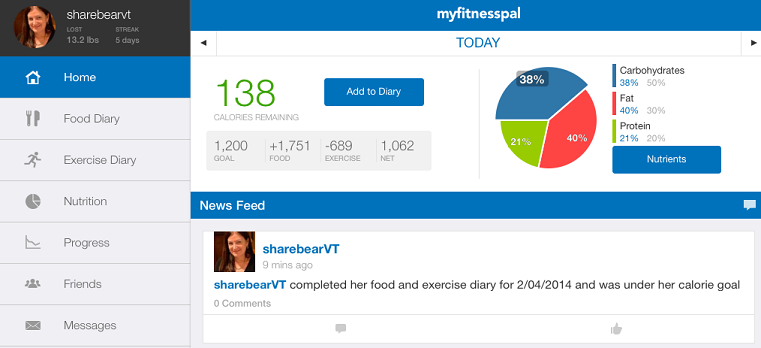
With these multiple inputs and outputs, how am I going to keep it all straight to make sure I actually lose weight? That’s easy. I’m going to use MyFitnessPal to track my calorie consumption and stick to a specific daily calorie target determined by my goals and inputs when I created my account. As I exercise, I also log that into the daily diary and it will allow me to consume more calories.  It’s easy to use and completely free. I use the mobile app version and do most of my tracking on my iPhone. There are a ton of great features, including a prediction when you complete your daily log of what you will weigh in 5 weeks, “if every day were like today.” This is motivational both on good days and bad.

Image

This month and in March, when push comes to shove, I commit to focusing on my diet first and my training regime second. Hopefully, I’ll get within 5 pounds of my ideal weight by April Fools’ Day, allowing me plenty of time to crank up my training schedule for the race season. If all goes according to plan, I’ll be aided by a 30 second reduction in my average pace from the weight loss alone.

Laying the Foundation

Standard

Now that I have breezed into February without incident and it seems clear that my drinking ban is going to stick, it’s time for me to start focusing on some of the reasons why I began this social experiment in the first place. This month, I want to lay the foundation for achieving two goals, both of which were top contenders for my New Year’s resolution originally and, in my mind, are part of the package.

My theory from the outset was that eliminating alcohol will enable me to finally achieve two important personal goals that I have been thinking about for a while. They are: losing 20 pounds and running a marathon in personal record (PR) time. In this post, I’ll give background on these goals, and in future articles, I will explain my plan for and progress toward achieving them. I have also already thought of several related and interesting research topics that I will explore, as well.

Let’s start with losing weight. No, I don’t think I’m fat. And, yes, if I were destined to remain at my current weight, I would have a happy, healthy, and productive life. However, I used to be much thinner and, with my continued commitment to exercise, I should have a shot at getting back to my “ideal” weight.

I’m not comfortable giving you the exact numbers. But, I will confess that on January 1, 2012, I stepped on the scale at a personal high weight which was 35 pounds higher than my lowest adult weight. The good news is that I’ve already made progress. After going down and then all the way back up again over the course of 2012, I managed to drop seven pounds in 2013. And, I already reported that I’ve lost another six pounds so far this year. For those of you who are having trouble with the math, this means I am down 13 pounds from my highest weight.

My first challenge is deciding on where to set the marker on counting down the 20 pounds. I plugged “what is my ideal weight” into Google and got the most amazingly helpful information from Self, a magazine to which I am often subscribed. The two questions asked by the trusty Ideal Weight Calculator were my gender and my height. I am female and I am 5-feet 7-inches tall. The results?

Image

Thanks, Self. I already weigh somewhere in this 40 pound range (whew!) and I still remember the one day in my life when I weighed 118 pounds. I was in 8th grade and it was the most dreaded day of the school year, when all the girls had to lineup in alphabetical order to file into the nurse’s office two at a time to get on the scale. I vividly recall the nurse writing what seemed like a very large number onto a little slip of paper that she handed to me: “118.” I assure you, this weight is not remotely plausible or desirable for me as an adult.

Since I’m too lazy to do any measurements to figure out my body mass index, I’m just going to pick the stretch goal of losing 20 pounds this year. It’s near the middle of the range, it’s a weight I would feel very accomplished to achieve again, and it’s about what I weighed in 1999, when I started training for my first marathon. I have 14 pounds to go.

Speaking of marathons, the first one I ran was the Vermont City Marathon in Burlington, in 2000, with my sister-in-law Moira. We crossed the finish line holding hands, with a time of four hours 41 minutes and 41 seconds. I swore I would never run another one. That feeling lasted about five years, and then, in 2006, I attempted Rock-n-Roll Phoenix. At that time, I was a very active member of the Arizona Road Racers, and I had recently achieved my PR half marathon time of one hour 55′ 55″. That’s fast for a recreational runner at my age and level. I was a bit disappointed with my subsequent marathon time of four hours 31′ 10″. Little did I know then that it would remain my PR today.

I’ve only run three marathons since: the Air Force Marathon in 2012, which I ran in about four hours and 45 minutes with a hip injury; Vermont City 2013, which I treated as a training run since it was so early in the season; and the 20th running of the Philadelphia Marathon this past November, which kicked my butt at about mile 18 and took me a few minutes longer than did Air Force the prior year.

I’m already signed up for the Around the Lake Marathon for my birthday and my goal is to do that in under four hours and 30 minutes — a PR! I am filling in my race calendar with a handful of other marathons and half marathons, kicking off my race season with the Run for the Border Half Marathon in late March. Speaking of which, it’s time for me to take advantage of the break in the cold weather and get in a training run right now.