New York State of Mind

Standard

In my bid to tell as many inn-keeping stories as possible in the run-up to my parents’ retirement as innkeepers of the Combes Family Inn, I’ve selected several anecdotes about winter guests from New York City. More specifically, they all hail from Manhattan.

Please don’t get the wrong idea. The Combes Family Inn loves (nearly) all of its guests, including those from New York. After all, New York, by far, is home to the largest chunk of inn guests through the years, right down to this very day. It’s also worth noting that my father is originally from Long Island. Sometimes, however, when people travel away from their urban lives and end up this far out in the country, strange things can happen. This is particularly true during winter storms.

119winter CFI


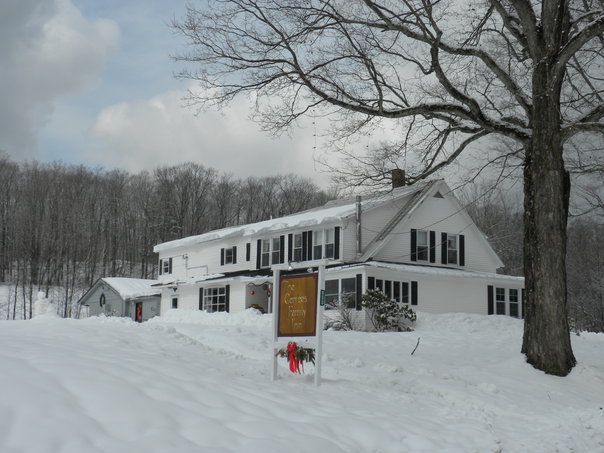
(Above: The Combes Family Inn is within sight of Okemo Mountain Resort and is typically surrounded by bountiful snow all winter long.)

Back in the old days, my mother always stayed up for the last guests to arrive. During the ski seasons of the late 70s and early 80s, she spent many Friday nights (that stretched into Saturday mornings, if necessary) reading alone in the sitting room, waiting for guests to check-in for the weekend. One particularly snowy night, just before he retired for the evening, my father snow-blowed an extra wide path from the end of the inn’s long, curving driveway and down the 30-foot walk-way to the front door.

Several hours later, my mother was interrupted from her reading by the sound of an approaching car. Then, she was startled to see headlights pass right by the sitting room windows, where there is no driveway, just a sidewalk for guests to get to the front door by foot. By the time my mom got to the front door, the car was gone. But there stood two people with their luggage!  As it turned out, it was a couple from Manhattan who had booked a reservation for the weekend.

photo 3

(Above: The posts in the foreground of this photo now prevent cars from driving through the driveway and parking lot up to the front door. You wouldn’t think they’d be necessary. Evidently, they are!)

After exchanging pleasantries with the couple, my mother glanced into the parking lot, thinking about the headlights she had seen just moments earlier. “What happened to your car?” she asked.

The woman replied, “Oh. We were just a mile or so from here, when we came upon a guy by the side of the road whose car was stuck in a snow bank. We stopped to help him out, but it was too dark and too difficult to do anything. He explained that he really needed to get to his condo five miles up the road. We told him to jump in, and then we let him borrow our car after he dropped us off here.”

“Did you know him?” my mother asked, a bit incredulously. “No. But we’re sure he’ll bring our car back,” the man replied. My mother was shocked that they were so trusting of a stranger and feared that they would never see their car again.

Very early the next morning, when my father got up to prep for breakfast, he walked out to the parking lot and saw a gorgeous new BMW parked right out front.  After the couple came down for breakfast and went out to check on the car, they told my parents that the stranger had not only returned their vehicle as he’d promised, but he also left a nice note and a 50-dollar bill in the cup holder!

Another time, when my mom was up late waiting for guests, she watched a huge black limo glide into the inn’s driveway. Curious, she went outside to meet the vehicle. The driver stepped out and explained that he had a couple from Manhattan in the back who wanted a room for the evening. Evidently they had hired the limo after clubbing in New York, and one of them had gotten the brilliant idea to visit a friend with a ski chalet at one of the southern Vermont ski areas. Mind you, this was before the era of everyone owning a cell phone. As the limo got deeper into Vermont, the passengers realized that they had no idea where their friend’s condo was. The limo driver saw the inn’s sign on Route 100 and was probably thinking he would drop the couple off there, presumably to just get them off his hands.

My mom took one look at the “post-party” couple sleeping it off in the back of the car and said, “Well, you can’t drop them off here.”

“What am I supposed to do?” asked the driver. People who know my mother will not be surprised that she replied: “You’re going to have to drive them back to New York City.” And, that’s exactly what he did.

After several years of successful inn-keeping, my mother stopped staying up after midnight, waiting for guests, opting instead to leave little notes with pleasantries and room assignments on the front door, which is inside a covered entryway.

One stormy winter night, a couple was driving to the inn from Manhattan, with their baby in tow.  My father had gone to great lengths to set up a crib for them before he went to bed, at around 10 o’clock. My mom waited up another hour or so and then resorted to leaving a note on the front door. Later, in her slumber, Mom heard people come in at around two a.m. The next morning, mom saw the couple sitting at breakfast, but with no baby in sight.

“Wow. What a storm last night! It must have been frightful driving through that with the baby,” Mom said to them. They just nodded and smiled. My mother continued, “The baby must be sleeping really soundly.” Again, they just smiled. A few minutes later, they finished breakfast and asked for their bill; they had to be on their way.

About a minute later, the phone rang. It was the couple with the baby from Manhattan! They explained that the driving had been so bad during the storm the previous night that they had to stop halfway and spend the night en route. They would be arriving at my parents’ inn in just a few hours!

Mom didn’t tell the other couple what she had learned. Instead, she processed their payment and dashed to the room to clean it and make it ready for the family that had actually reserved it.  She figured out that the first couple must have been desperate when they happened upon the inn during the storm. Seeing the note, they likely assumed that the people with the reservation wouldn’t make it, in such bad weather.

photo 1 photo 2

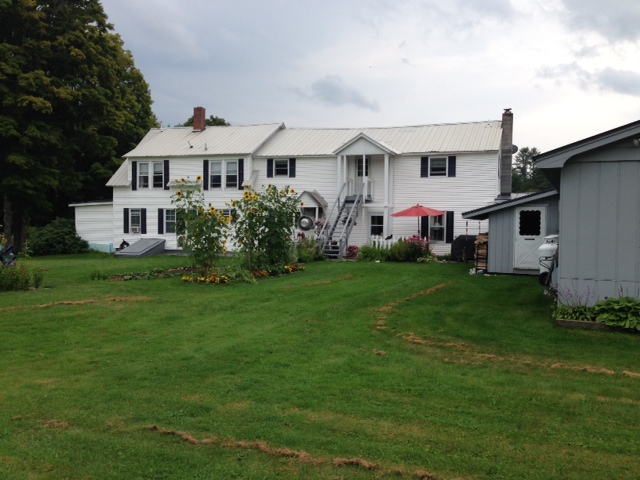
(Above: The inn’s long drive way curves around the side of the inn and around the motel units. The entrance is on the opposite side of the building, at the end of the long driveway and walkway. Also pictured, the “back side” of the inn, with a view of the back door and fire stairs; you pass by this side of the inn as you travel through the driveway and into the parking lot.)

During another snowstorm, a woman from Manhattan got confused about how to enter the inn. Instead of following the driveway all the way around the inn to the actual entrance, she stopped her car on the side by the back door. She then proceeded to hike through the snow and ice and found the back door either stuck or locked. So, she hiked through more snow and ice and climbed up the fire stairs, which lead to a door on the second floor. A moment later, my parents were startled to hear a knock on their upstairs bedroom door. When my mother opened it, the woman said, “Gee. Your inn is really hard to get into.”

Mom looked her up and down and noticed she was in high heels and that her nylons were completely shredded on both legs. Without missing a beat, Mom said, “I guess so.”

How CNN Changed My Life

Standard

CNN Press Pass

Some of you asked to know more about the “Throwback Thursday” photo of my CNN press pass (pictured above). Although my two-week stint with CNN seemed a mere blip on the screen, it completely changed my life.

After graduate school, I moved to Singapore as a newly-wed in January 1994. The following spring my husband’s job transferred to Beijing. I joined him there after a brief vacation to visit my family in the U.S. I arrived in China that April inexplicably obsessed with the O.J. Simpson trial, having read an old People Magazine on the return flight. How had I not heard about the sensational trial and all of the hoopla surrounding it?

Rather than settling in smoothly as I had always done before, I felt isolated and wrestled with my sense of self. Very quickly, I became depressed. My journals from this time show how CNN became a symptom of my depression and, incredibly, the cure of it, just three months later.

China Journals

(Above: One of my journals open an entry about my work with CNN in Beijing in 1995.)

A journal entry from June 8, 1995 is below:

It’s so lame that I have all of this free time right now, yet I can’t seem to get myself to do anything with it. For someone with so many dreams and ‘goals,’ it’s bizarre that I am completely incapable of following through with even just one of them. I sent that fax to CNN, but I’m sure in my mind that they won’t call. I know I need to get fluent in Chinese, yet I stay at home all day and don’t even try to read the local papers or listen to the local newscasts. It’s pathetic. I mean, look at all these seemingly pathetic characters who appear as guests on Donahue, Oprah, etc. Half of them got their shit together long enough to write a book. I’ll be turning 27 and I don’t have a real focus…I’m into this TV journalism thing, yet I doubt anyone would hire me.

Perhaps, lame to say, watching Larry King Live’s 10th Anniversary Special was beneficial, because I learned that many famous and talented people also lack confidence and are still fearful to face the camera and audiences that idolize them. On Larry King, I’m embarrassed to admit how wonderful it really is to watch his live interviews….I also seem to have developed something of a crush on Barry Scheck, O. J. Simpson’s attorney for DNA issues.

Completely unmotivated to do anything else, I watched endless coverage of the O.J. Simpson trial on CNN International in our apartment, while my husband traveled for work. Who knows how far downhill I would have gone had CNN not responded to my fax? Luckily, CNN called me, and it became the catalyst for a remarkable change in my life.

The United Nations Fourth World Conference on Women was held in Beijing for two weeks in September 1995. CNN devoted significant coverage to it, because then First Lady Hillary Clinton was attending, despite very loud calls for a boycott due to Chinese human rights violations. At the conference, Clinton took the government to task for its treatment of young girls and made the iconic statement “that human rights are women’s rights — and women’s rights are human rights.” (The full text of her speech is here and a video here.)

CNN temporarily augmented the local bureau with network heavyweights Judy Woodruff, Larry Register, and Richard Roth, and a handful of locals, including me. My job was to watch, read, and summarize Chinese media coverage of the conference, so that the CNN team could keep its pulse on the extent of Beijing’s censorship. At first, it simply got me out of the apartment. It didn’t take long, however, for that walk down the hallway to become a walk out of my depressive state.  As I wrote on September 18th, 1995:

Last Friday was my last day at CNN, but it was incredible!! Most notably, Judy Woodruff and Larry Register gave me quite a lot of responsibility by allowing me to single-handedly select three short clips of young people giving their impressions of the Conference…

I will never forget the interview with an eleven-year-old Nigerian girl…Her speech was slow, and deliberate – she chose words carefully and spoke with intelligence about the government having to listen to the voices of the people. She said that the platform (the Beijing Women’s Conference) could help bring the voice to the government – but that people must be heard for it to make a difference.

Larry thought it was too harsh…But Judy Woodruff liked it – so it was in. I had no idea that they would close the series with 28 seconds of clips chosen single-handedly by me!!

My work at CNN was quickly followed by a few job offers, including the one I accepted as the China Marketing Manager for an American automotive company. That I had never heard of the field of “marketing” didn’t prevent me from acing my interviews and getting the offer that led to a long and successful marketing career. I remember a question the HR director asked at the end of my first interview: “The women’s conference is coming to Beijing very soon. Have you thought about taking part in some way?”

 “Oh, yes.  I cannot start with your company until after it’s over. I’ll be working for CNN during the conference,” I replied. I’ll never forget the look on his face.

Best Laid Plans

Standard

I am the captain of a team that runs a 100-mile relay race along Vermont’s scenic Route 100, the appropriately named 100 on 100 Heart of Vermont Relay. The race is an exercise in teamwork. The route is divided into 18 segments of varying length and difficulty. Each team usually has six runners, each of whom runs three legs of the race, passing a wristband as a baton to the next runner at pre-determined transition points along the course. Our team loads up the vehicle at about 3:30 in the morning and gets on the road by 4, to make our 6 o’clock team check-in time and 6:30 start in Stowe.

As team captain, I do the planning and race management. I’m pretty detail-oriented and the team generally appreciates that I take care of everything. When I say “everything,” I mean a host of tasks, from registering the team to forecasting our running times for each segment to managing our fans along the course. One year, I predicted the nearly 15-hour running time within two minutes! In essence, I am a “planner,” and my team was following a well-thought-out plan on race day. This year, our plan was to run most of the race with four runners (instead of six) and be joined by another team member mid-race, who would run a 12-mile stretch to help us out.

En route to Stowe early race day morning, the tire pressure warning light came on. I told the team not to worry, because it was just a slow leak in one of the back tires. We had plenty of time to get air, after we got off the highway in Waterbury.  And we did.

Starting Line

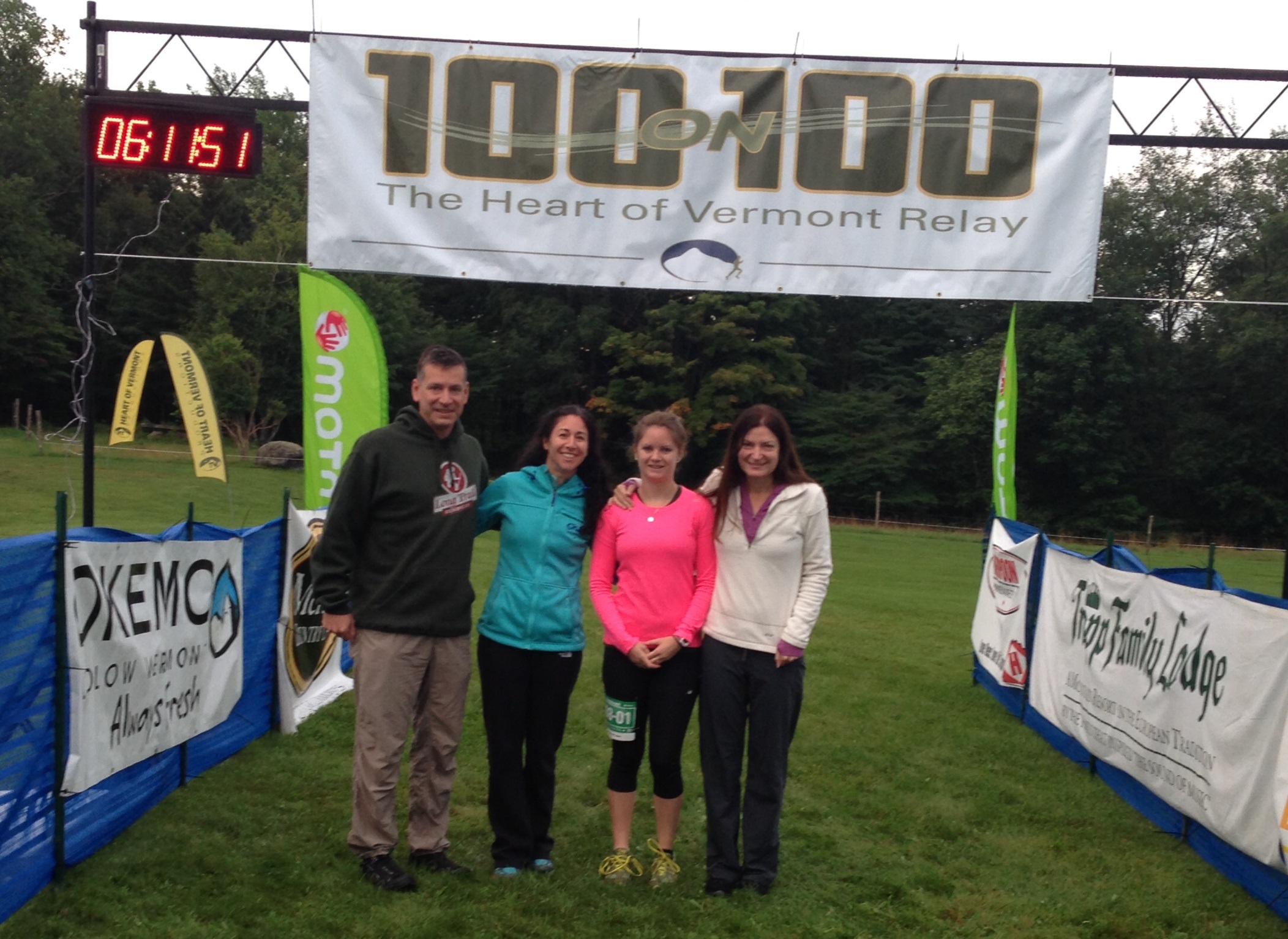
(Our 4 core team members at the starting line. Left to right: Bill, Erica, Bridget, and me.)

After team check-in, we took some team photos at the starting line, watched my cousin Bridget start the race, and then went back to the car. That tire looked pretty soft again—so much so that a runner from another team even pointed it out. My brother suggested I go cheer Bridget on while he and our fourth team member, Erica, changed the tire.  After Bridget ran through the first transition point and proceeded into the second leg of the race, I walked back to the car and found all of our duffle bags, other gear, and cases of water and Gatorade on the grass. When he saw me, Bill shook his head and said with a slight hint of frustration, “There’s no spare.”

Bridget on 2nd Leg

(Bridget completed the first leg and started the second completely unaware of the situation with our team vehicle.)

We loaded back up and headed out to look for a service station, truly believing that the low tire might have been an optical illusion caused by the car tilting downhill on grass. As we pulled out of the parking lot, I stopped a guy directing traffic and asked him how the tire looked. “Pretty flat,” he said. Instead of heading down the mountain, we turned into another parking lot and jumped out to check the tire on level ground. “Pretty flat? Is he nuts?” I yelled. We were looking at metal on asphalt. The tire was completely flat and our race vehicle was not drivable.

We quickly reviewed several possible solutions and decided to have my father bring the spare tire up from Ludlow—where it was sitting in our garage—and  for me to hitch a ride with another team in time to get the baton from Bridget at the next transition point, in about 45 minutes. Since I was also going to be running two legs in a row, we hoped there was enough time to get the spare up to Stowe and on the car, and the four of us to meet at the start of the fifth race segment.

Range Rover

(Unfortunately, this was Bill and Erica’s view for over four hours!)

As it turned out, we were not reunited until after 11 o’clock. While Bill and Erica waited at the starting line in the car for my father to overcome several obstacles of his own on the drive up with the spare, Bridget and I kept running and passing the baton to one another for four-and-a-half hours and bummed rides from other teams to each subsequent transition point. I was truly ecstatic when I heard the familiar sound of a ringing cow bell and looked up to see my brother hanging out the window of our team vehicle and then, moments later, when I passed the baton to Erica for her to complete the remainder of the uphill climb of segment six, outside Waitsfield.

In addition to the grace with which my team dealt with both planned and unexpected challenges, it was extremely heartening how every team we approached for help gave it without question. At the starting line, the “American Bandits” welcomed me, a stranger, and gave me a lift down the mountain. Later, when I explained my predicament to my friend Stacie, her “Sole Sixters” team was enthusiastic about adopting Bridget, while I ran more than 12 miles. After Bridget completed her first run and passed the baton to me, utterly exhausted, Stacie’s calm and smiling face made the difference, as I briefly explained the situation of our team’s catastrophe before turning around to start my run. Then, when Bridget took the baton back over from me for segment five, an acquaintance named Stephanie and her team brought me along to Waitsfield and fed me cookies and water before I was handed the baton back again and started the uphill climb of segment six.

Team Swim Blueberry Lake

(Erica, Bridget, and Bill in Blueberry Lake during a welcomed break mid-race, while Lee was cranking out 12 miles for the team.)

We finished the race at 8:48pm, by far the fastest performance for my team in the six years we’ve run the race.  And, more importantly, we all had a blast, made a lot of new friends, and gained many new stories to tell than can possibly be told here. It’s a great reminder that the best plan of all is to have a great team to start with, and to have fun, no matter what.

Dinner Is Served

Standard

Six weeks ago, I added a new thread to my blog to give voice to the rich lore resulting from my parents’ 36 years as Vermont innkeepers. There’s only 62 weeks until their expected retirement, so it’s time to get cracking on documenting these stories.

First, I want to explain my process. I rely on a combination of my own memories growing up in the inn and recollections of my mother’s re-telling of events to come up with the subject for each post. Then, I interview my parents, usually over dinner, to fact check my memory, gain more context, and add dimension to each story. At last Sunday’s dinner, a few questions about serving dinner at the inn yielded so much material that this post only includes stories from the first year.

CFI Menu Cards and Ads

(Above: Saved menu notes and weekly newspaper ads from the inn’s first year of serving dinner to the general public.)

In a previous post, I explained that my parents started renovating the property that became the Combes Family Inn in March 1978 and we hosted our first inn guests that August. After working out some kinks in the rooms business and making additional renovations, the three innkeepers were finally ready to serve dinner to guests by October. In the inn-keeping world, it is much more prestigious to serve dinner, in addition to offering bed and breakfast (“B&B”). As my mom explained: “Before moving to Vermont to become an innkeeper with us, your Aunt Nancy had taken a commercial cooking class on Long Island, so we thought we were hot shit.”

The very first dinner guest of the Combes Family Inn was a gentleman in his 80’s who booked a week by himself during the October foliage season. The first night of his stay, Aunt Nancy decided to make a recipe from her cooking class, Beef Rouladen in Burgundy Sauce.  “It came out so rich,” my mom recalls, “we thought we had killed him.”

Beef Rolade

(Above: My Aunt Nancy’s Professional Chef Cook Book, open to the page with the recipe she and my mother served their first dinner guest.)

The following month, the inn-keepers were getting ready to start preparations for Thanksgiving dinner and discovered that they had run out of propane and couldn’t light the stove. My dad frantically tracked down the guy at the local gas company. Unfortunately, after listening to my dad’s sob story about needing to cook for a house full of people, he replied: “I have my own problems.”

Undeterred, Dad made a few more calls and came up with a plan. He jumped in his Blazer with the turkey and headed down to our friend Jerry’s restaurant, the Winchester. Jerry had cranked up his stove to 500 degrees and proceeded to cook our turkey for the hour that it took my father to drive to and from Chester, where he picked up a hand-held drum of propane, something he wasn’t even sure was legal.  

In spite of the drama, Mom swears it was the best tasting turkey they’ve ever served.

Bill’s Super Quick Thanksgiving Turkey Recipe

Unstuffed 20-pound turkey.
Salt and pepper rubbed inside.
Place in turkey roasting pan with an inch of water.
Cover.
Cook at 500 degrees for one hour.

The day after Thanksgiving, Dad made two phone calls. First, he called a different propane company to promptly switch-over the inn’s service. Second, he called the original company and left the following message: “This is Bill Combes from the Combes Family Inn. I’m disconnecting my service. Now, my problems are your problems.”

What happened that New Year’s Eve is a story I remember like it was yesterday. We had a large group of 5 or 6 Japanese families who stayed at our inn, while they were skiing at Okemo Mountain. My Mom, Dad, and Aunt Nancy put together this impressive menu: roast beef, twice baked potatoes, Yorkshire pudding, glazed carrots, home-baked bread, and chocolate mousse.

When Dad took the beef out of the oven to get drippings to make the Yorkshire pudding, there were no drippings and the beef looked like a huge leather shoe. That’s when he discovered that he had bought a pre-cooked roast beef (usually used to slice off luncheon meat) and not a raw beef slab. Lacking other alternatives, they reluctantly served the beef, carrots, bread and potatoes, without the Yorkshire pudding. The guests were so polite that nearly every one of them asked for seconds. I am the only member of my family who entertains the possibility that our Japanese guests actually liked the beef.

Bill’s Yorkshire Pudding Recipe

Eggs, whole 20.
Milk 2 qt.
Bread Flour 2 lb.
Salt 1 oz.
Butter, melted 24 oz.
Drippings from Roast Beef (fat only) 24 oz.

Break eggs in mixing bowl; beat well. Add milk; mix well. Add flour and salt; beat until smooth. Beat in melted butter.

Place 12 oz. drippings in each of 2 15- x 18-in baking pans. Place pans on range and when smoking hot, divide batter evenly between pans.

Place pans in 375 degree oven on shelf in bottom half. Do not open door for 25 minutes; total cooking time, 35-40 min. Remove from oven and drain excess fat by tipping pan. Cut in squares to serve, 25 portions per pan.

The following summer, my parents and Aunt Nancy decided to serve dinners to the general public, in order to generate cash flow to help keep the business going through the slower summer season.  I should explain that the Combes Family Inn has always had one seating each night for dinner (7pm Thursday through Saturday and 5pm Sunday) and serves the same three course meal to each guest, unless there is a prearranged special request. The menu changes nightly.

The innkeepers promoted their new dinner service throughout 1979 and 1980 with ads in the local weekly paper which included the dinner menu for the three course meal planned for that Thursday, Friday, and Saturday night, as well as a Sunday buffet. Each night, the meal was $5.95 complete with dessert and coffee. BYOB.

One night, they had 12 reservations for outside diners. The menu included stuffed pork chops with homemade apple sauce, corn chowder, scalloped potatoes, green beans, and apple crisp. At about ten minutes before 7pm, Mom was just about to go into the sitting room to chat with the guests before ringing the dinner bell, when she checked the progress of her pork chops and discovered that she had never turned the oven on. Instead of grabbing the dinner bell, she cranked the oven up to 450 and went into the sitting room and said “Good evening, I’m Ruth Combes, the innkeeper. Dinner’s going to be a few more minutes.”

Ruth’s Apple Sauce Recipe

5 lbs regular Macintosh apples.
1/4 c. water, apple cider, or apple juice.
1 T lemon juice.
1/2 c. brown sugar.
Cinnamon (to taste).

Slice apples. Do not peel or remove cores. Put apples, sugar, and liquid in large covered pot and cook over medium flame for about 1/2 hour or until apples are tender. Put apple mixture through food mill (this is a great kitchen gadget, especially for pureeing soups and vegetables). Add lemon juice and cinnamon.

It may not seem like it based on the stories I’ve told above. However, my parents are both excellent cooks. And, needless-to-say, dining at the Combes Family Inn is a truly one of a kind experience. 

The Middle Miles

Standard

Last weekend came and went and I never found the time to write a blog post. It’s true that we were extremely busy with social obligations (more about that later). However, that was only part of it. The bigger issue was that I wasn’t inspired enough by a topic to start writing anything down. Since that has rarely happened since I started this blog, I did a little soul searching to figure out the problem. The problem is that my resolution has hit, to quote one of my old running partners, “the middle miles.”

Although I entered the weekend having successfully completed 7 months of my year-long New Year’s resolution not to drink alcohol, I was feeling down and uninspired. Not only did I have lingering disappointment about my marathon run on July 25th, I was also having trouble with my weight maintenance.

When I say “having trouble” what I really mean is that I temporarily stopped watching what I eat and also haven’t been consistent with recording things in my MyFitnessPal food journal. Who can blame me for the latter? It would have been really demoralizing to record everything I ate at the barbecue at the lake on Saturday afternoon. I started out with chips and guacamole, moved on to chips and hummus, and then had some brie and crackers. A few hours later, I nearly filled my plate with an array of lunch offerings, including a hot dog. Before I left the party, I even went back up to the buffet to get two chocolate chip cookies. Unfortunately, the day didn’t end there. We went to a different party that evening and I proceeded to eat different things in a similar fashion, including two cupcakes for dessert. I didn’t need MyFitnessPal to tell me that my 8-mile run that morning couldn’t even put a dent in what I had eaten over the course of the day and evening.

Sunday morning, I forced myself to step on the scale to confirm that I had crossed back over my dreaded weight threshold of 140 pounds. Although it’s a bit of a bummer, like the proverbial middle miles of a long run that I referred to earlier, this set-back is completely normal and only temporary.

In long-distance running, it’s natural to have a break in concentration and to slow during the middle miles. That’s because the mental and physical freshness you had at the start are long gone, but there is still too much distance yet to cover for you to start tasting the finish line. Your mind and body can play tricks on you that negatively impact your overall performance. In running, you mitigate this through your training plan in the months and weeks before the race and through your pacing on race day.

The middle miles of my resolution are even easier to solve. I just have to go back to what made me successful and set a few new reasonable goals. The fact is that I have gone 7 months without a drink and, during that time, have attained my weight-loss goal and have achieved my marathon PR time. These accomplishments are still valid and it will not take very much additional focus to lose a few of those pounds that have crept back on.

Here’s my simple plan to get back on track:

  1. Re-commit to using MyFitnessPal to record what I eat and how much I exercise every day.
  2. Reduce my daily calorie target by about 250 calories a day, since I am (temporarily) no longer in maintenance mode.
  3. Target getting back down to 135 pounds by the end of August.

Notice that I didn’t say stop eating chocolate chip cookies and cupcakes! Hopefully I won’t eat too many of them. However, if I do, it just means that I have to lace up my running shoes and get in an extra workout.

Try, Try Again

Standard

Over the weekend, I celebrated my 46th birthday by trying to run a nighttime marathon, which consisted of eight, roughly 3-mile laps around a lake near Boston. My friend Lisa and I were running it together to try to qualify for next year’s Boston Marathon. When it was clear early on that she wasn’t going to keep up our intended pace, I ran ahead of Lisa. I felt great for the first 11 miles or so. Thoughts of how awesome it was going to be to get my personal best marathon finish time and possibly even qualify for Boston flashed through my mind.

Sharon and Lisa - Around the Lake
(Above: Me and Lisa just before our marathon in Wakefield, Mass. on 7/25/14.)

Somewhere between mile 11 or 12, I lapped our mutual friend Brad and was feeling on top of the world. Shortly thereafter, I started to get stomach cramps and things got progressively worse. The official race timer website reveals that my lap times tanked to 10:00 minutes per mile on the 4th lap, 12:27 minutes per mile on the 5th, 14:38 minutes per mile on the 6th, and 17:59 minutes per mile on the 7th lap. Around 1:30 a.m., I posted a status on Facebook that said: “Do you know what I just realized? I am a morning person.”

It was obvious that I was dehydrated, unable to even absorb water or Gatorade and I had to make trips to the port-a-potty in between laps.  Woozy after the 7th lap, instead of starting my 8th and final lap, I headed to the medical tent. The medic ordered me to eat a couple of handfuls of goldfish crackers—to get salt into my system—before he would let me walk the final lap.  I scarfed down a ton of goldfish and pretzels and my stomach felt much better. My legs, however, were extremely fatigued and the thought of continuing around the lake one more time seemed pointless.

I stared at the finish line and watched the reaction of the other runners as many completed the marathon and others proceeded back around the lake to either complete their marathon run or to keep going for the full 24-hour ultra-marathon. Just when I was about to walk over to the car to try to sleep on the wet grass and wait for Lisa and Brad to finish, Lisa crossed the finish line. I ran to meet her, so happy that she had finished the marathon, even though it was without me.

Lisa asked how I had done, hoping that at least one of has had run well enough to qualify for Boston. I just shook my head and gave her the short version of how terribly it had gone for me. She grabbed my arm and pulled me over to the snack table. After we munched on a bunch more snacks, Lisa confessed, “That was only my 7th lap. Here, hold my coke while I hit the port-a-potty. Let’s walk the last lap together.”

Lap #8 was without a doubt the best part of the race. It was much more enjoyable to chat and catch up with Lisa than it was to tell Brad at mile 11 that I was on Boston qualifying pace. We finished together with the most incredibly horrendous finishing time of 5 hours and 53 minutes, at 2:53 in the morning. Considering how close I came to throwing in the towel, it was actually a victory, wasn’t it? And, as you might expect, we’re signing up for other marathons as we speak, keeping alive our dreams of qualifying for the Boston Marathon.

Casualties of Childhood

Standard

My husband Bruce and I drove to his hometown last weekend to attend a poetry reading by one of his high school mates, the poet Tom Lux. Tom has published more than a dozen volumes of poetry in his illustrious career, including New and Selected Poems, 1975-1995 for which he was a finalist for the 1998 Lenore Marshall Poetry Prize and Split Horizon for which he received the Kingsley Tufts Poetry Award. Two great online articles about Tom and his writing can be found here and here. He is currently the Bourne Professor of Poetry at Georgia Tech.

At White Square Books, a charming little book store, on a Sunday afternoon, Tom read poems that he had selected for the occasion that were autobiographical of events and people in his hometown of Easthampton, Massachusetts. Most of these poems were nothing short of extraordinary. One of his newer poems, which I believe hasn’t been published yet, is haunting. Tom called it “the most autobiographical” of all his poetry. It’s a recounting of a time as a 15-year-old, when he used his shot gun to kill a small brown bird. Through the narrative and detail of the poem, it was evident that he had researched the habitat and habits of the type of bird to show how much he had thought of this bird in the more than 50 years that have passed since the day he killed it.

The poem ends with the bird’s talons and little legs remaining attached to the tiny branch, after the rest of the bird had been blown to smithereens. Tom watched the result of his mischief and saw the talons still clinging eerily and upright on the branch and, after a bit of wind, swinging down, still attached.

You could have heard a pin drop for more than a few moments after Tom had finished reading the poem. Everyone in the room was shocked into thinking about Tom’s dead bird and then, perhaps, some casualties of their own childhoods. I briefly mourned this bird, and then recalled one my brother Billy had killed with his BB gun when I was 6 and he was 8, at our Pépère’s hunting camp in Tinmouth, Vermont.

I think it was my cousin Kelly who dared him to shoot the young woodpecker which was in the tree down behind the outhouse at the camp. In the dense fog of childhood memory, I had thought that it was my more mischievous brother, Wayne, who was the bird executioner. To my surprise, the answer to my text to Billy this morning “Do you remember at Tinmouth camp the time Wayne killed a bird with a BB gun?” was this: “That was me. A small woodpecker. I cried. It was very traumatic for me. I still think about it.” And, then, he added in a second text: “Pépère consoled me and taught me the importance of not aiming a gun at something you do not want to kill.”

I see it vividly in my mind now. Billy killed it with his first shot and it fell dead with a thump. We all ran over to it. Kelly and I immediately began crying and ran to find the adults to tell them of Billy’s mischief. I also remember clearly that Billy and Wayne both cried too, as they followed behind us up the hill. When I shared these memories with Billy this morning, he replied: “It is funny about childhood memories, I don’t remember anyone else being around. It was me. My BB gun. A live woodpecker. An excellent shot. A dead woodpecker. Me crying because of what I had done. Pépère imparting that valuable life lesson. The burial ceremony.”

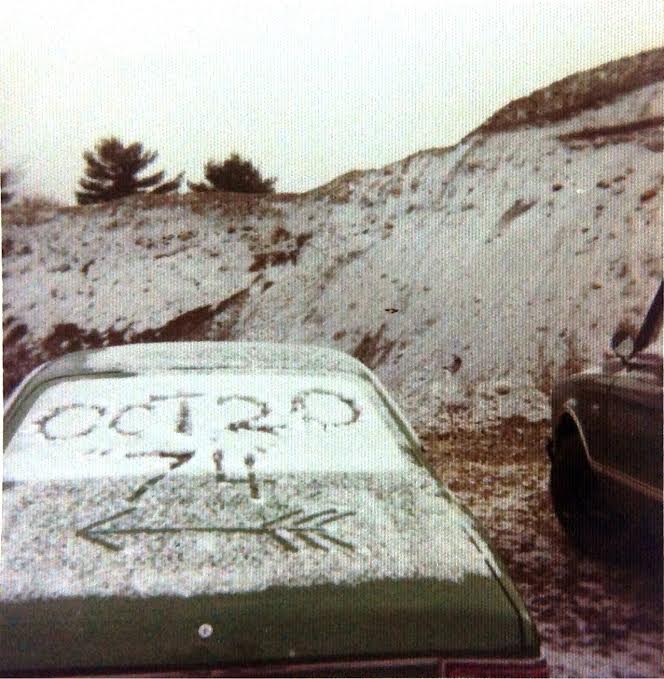
The incident was so memorable for my brother that he had saved photographs from that day and knows the exact date, October 20, 1974. Incredible. A few of those photos are below.

Pepere and deer Motley Crew Hunting Camp in Oct 74 Oct 20 1974

In the moments after Tom had finished reading his poem, I thought more about the old hunting camp. More than a few of Tom’s autobiographical poems involved boys with their hunting rifles. It was easy for me to relate to these childhood stories. I had grown up in a similar fashion in New Hampshire and Vermont, although a few decades after Tom’s upbringing in Western Massachusetts.

My brother came up to Vermont a few months ago and we decided to tool around a bit and found ourselves heading through Wallingford on Route 140, on our way to Tinmouth. Billy hadn’t been out there since childhood. I, on the other hand, had gone out a few summers before with Bruce to show him the land that was a part of so many childhood memories. I used to call the annual rite of going there as a very young child, “going to Vermont.” When I was nine, we moved to Vermont. Pépère died shortly thereafter and the camp lasted just a few years following that, until Mémère died when I was 12.

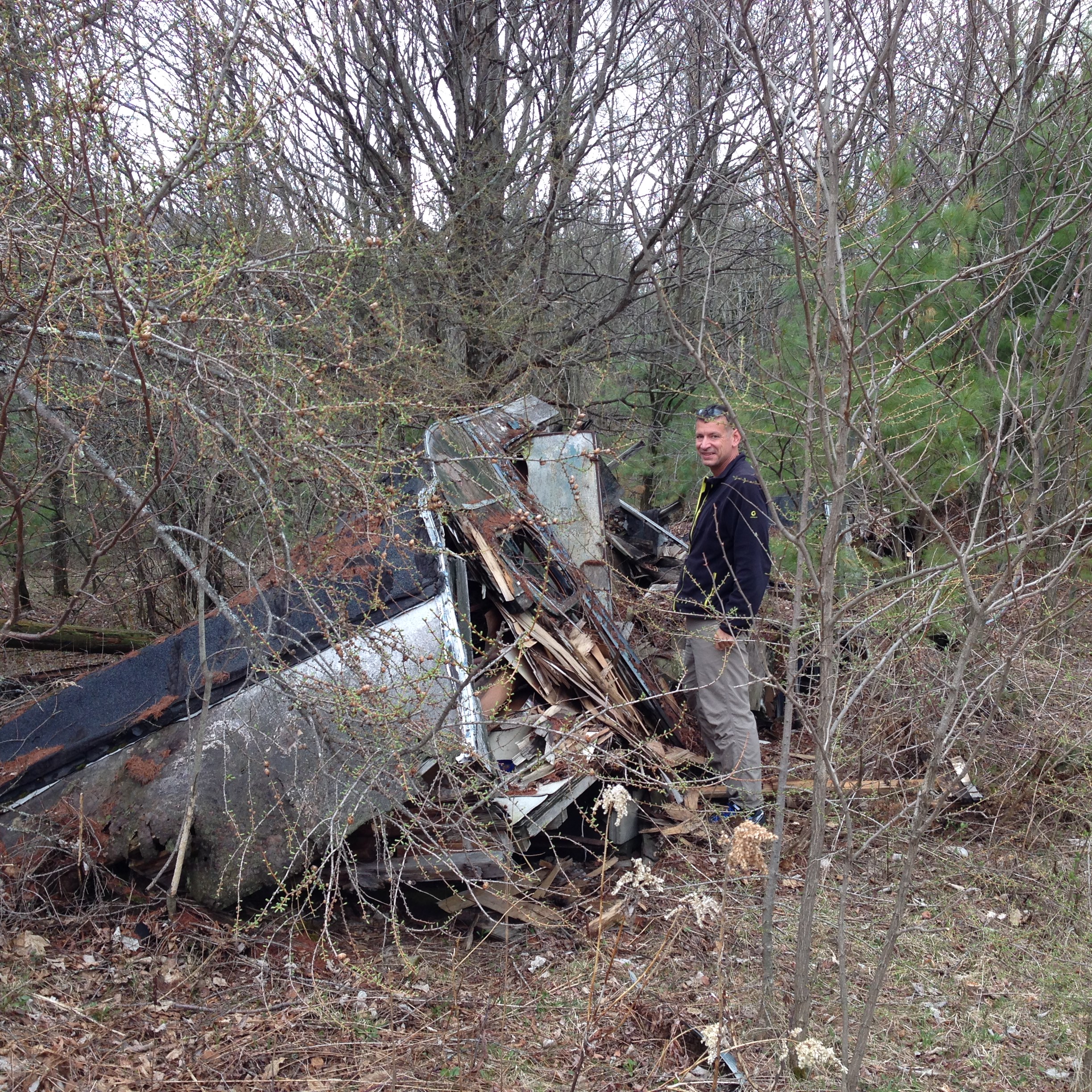
When Billy and I pulled up to the old cemetery in Tinmouth, we parked the car on the opposite side of the road, jumped the gate, and headed into the field, in search of the old camp and the outhouse. The trailer was there, a caved in pile of trash, and the outhouse was nowhere to be found.

Camp as trash

It Was Like Camping

Standard

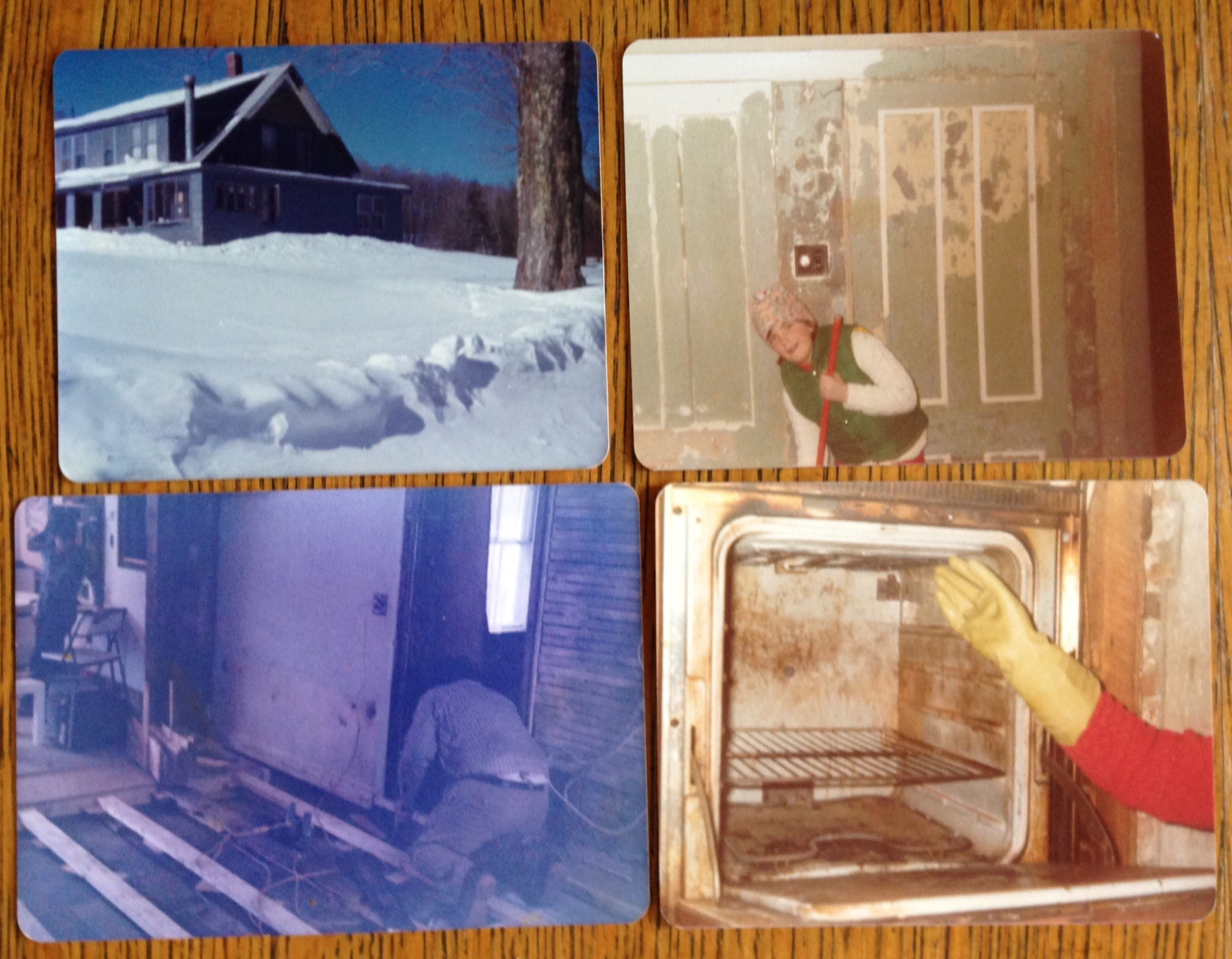
Before CFI photos

I had no idea that my threat to reveal my parents’ inn-keeping stories would get such an enthusiastic response. Given that it did, I decided to strike while the iron is still hot. I’ve been telling my own stories about the inn since I was nine years old. This post includes some of my memories from those first few days in March of 1978, when we first moved into the inn. Next time, I’ll follow up with recollections from that same period, from my parents, innkeepers Ruth and Bill.

Last time, you were left with the image of me crying in the car, not wanting to come to grips with the reality that, after all, I wasn’t moving to the Snow Mansion on the hill as I’d been fantasizing I would. Instead, our new home was a decrepit and, frankly, filthy, old farmhouse that was several years removed from its glory days as a vibrant and beautiful working farm. That is was at the gloomy end of a long winter when we took possession didn’t help matters, since the property seemed even more barren in the ice and snow.

My father lured me out of the car and into our new life by promising me that it would be like camping. And, in the beginning, it really was.

Since the inn was not going to be livable until the garbage was removed and it was properly disinfected, the six of us — our family of five and my dad’s sister, who was co-owner of the soon-to-be Combes Family Inn — took up residence in three of the motel rooms that the previous owner had built as outside units, separate from the main house. These had been the previous owner’s main source of income, particularly during ski season. Our family project was to turn the main farmhouse itself into a beautiful inn, filled with guest bedrooms and common rooms, in addition to upgrading the motel rooms.

My parents moved into room number three, while my brothers, Billy and Wayne, shared room number two.  My beloved Aunt Nancy and I shared room number one, which was closest to the main house. I adored my Aunt Nancy. Before she lived with us at the inn in Vermont, it was always the highlight of my summer to spend time with her. Over the years, she had taught me how to make beds with hospital corners, how to cook scrambled eggs with cheese and how to play various card games, “rummy 500” being my favorite.

This arrangement lasted for the two weeks it took all of us to clean out the farmhouse. Day one after the move, brother Billy was already loving the new adventure, because mom gave him a crisp twenty dollar bill to clean out a particularly nasty cupboard. He still recalls this story fondly. I, on the other hand, don’t remember about the cleaning phase—I’m sure I’ve put all that nasty business out of my mind! However, I have two strong recollections about those first few days.

One is of my first day joining the fourth grade at Ludlow Elementary School. Kim Benson, who became one of my best friends all through school and is still my friend today, asked me where I was from. When I answered “New Hampshire,” she declared “You are not a flatlander.” As that first day wore on, Kim introduced me to each classmate with the same odd introduction: “This is Sharon, she’s not a flatlander….” I could tell by the reaction of the other kids that this was a very good thing to not be a ‘flatlander’, although I had no idea what it meant. It was so exciting, in fact, that when I got off the school bus that first afternoon, I announced to my parents, “Mom, Dad, guess what? I’m not a flatlander!”  

My other memory of that period was my recognition that Dad was right, it really was like camping. My Aunt Nancy told me stories at night in our motel room before we went to sleep, which reminded me of being around a camp fire. And, since we weren’t yet able to use the kitchen inside, there were many nights that we heated up dinners camp-style, on a little hot plate, and ate them in the motel rooms.

So it was that despite my initial reluctance to step out of that car and into our new life, all of my memories about the start of the incredible adventure called the Combes Family Inn are fond and happy.

Old Stories through New Eyes

Standard

A few weeks ago, my brother sent me a very interesting New York Times opinion piece that’s on topic with the “Dry Year” thread of this blog. In it, poet John Skoyles reveals how he had spent much of his graduate school years drinking heavily, and had engaged in risky behaviors as a result. In fact, he wrote a memoir about it called “A Moveable Famine” without realizing that his own alcohol abuse was a theme in the book. It wasn’t until he reflected back on his story after reconnecting with an old girlfriend that he acknowledged his alcoholism. Although I considered reading the memoir, I’m hoping he’ll write another one that looks back on that time with new eyes.

In the same email in which he alerted me to Skoyles’ article, my brother also suggested that I consider adding a new thread or two to my blog, in order to keep people interested and entertained. He felt I needed to branch out from my too-narrow focus on not drinking, dieting and running. I couldn’t agree with him more, so, as a result, I’m introducing a new thread related to the memoir section of my blog.

My two brothers and I grew up in a busy inn, in a Vermont ski-resort town. Although hard to believe given that they’re now both in their 70’s, my parents still run the very bustling Combes Family Inn. Through the years, my mom has threatened now and then to write a book filled with stories from her and Dad’s 36 years as innkeepers. Since they’ve recently begun formulating their retirement plans and even picked a tentative date for closing the doors on their business, I decided it’s time to help Mom document some of her favorite inn-keeping stories.

My parents, while in their mid-30’s, had a dream of becoming innkeepers, long before it became fashionable. My mom was always a great cook and my dad an exceptional handyman. When our original hometown in New Hampshire was becoming over-developed, they began looking for an inn in earnest. They looked for two years to find a suitable one in either rural New Hampshire or Vermont, where they could raise their three young children while creating a business.

My mom’s story doesn’t make sense unless you understand how vibrant and beautiful the inn and its property are today. The photos below give you a taste of what I’m talking about. There are two photos of the inn and the grounds today and four of the “before” pictures.

“I’ll tell you the very first inn-keeping story that I want people to know,” Mom said the other night, after I mentioned this new idea for a blog thread. She was addressing me, my father, my husband Bruce, and my brother Bill, who is visiting for the long July 4th weekend. “The story relates the moment when we all walked through that door, as we took possession of the house in March, 1978,” she said.

“The entrance way had piles of garbage and large, opened bags of large-animal feed. Wafting out of the first room beyond the entrance was the smell of animal feces. A quick look inside, revealed more garbage and a partially collapsed ceiling,” she related. “Our cat, Gimpy, was so skeptical about the place that he wouldn’t walk through the doorway. I’ll never forget that I turned to look at my eldest child Billy, after Gimpy walked away from the front door. Billy, who was just 11 years old at the time, shook his head and asked ‘What have you gotten us all into?’”

Little did any of us know then that 36 years later the inn would be still be in business. Although I have heard the story a million times, I have no recollection of the cat’s disgust or my brother’s reaction, because, in a similar reaction as my cat, I ran back to the car and refused to get out again. I just sat in the car and cried. When my parents came back to force me out, I kept screaming “I want to go to the Snow Mansion!”

I was referring to one of the handful of other inns my parents had looked at before finally selecting the ramshackle farmhouse.  What I called the “Snow Mansion” was really the Snowvillage Inn, a resort near Conway, New Hampshire that had a large pond, tennis courts, and rolling fields. It’s still around today. This is what it looks like now. When we left our home in Merrimack, New Hampshire, in my mind, the Snow Mansion was the type of place we were moving to.  In fact, it was with considerable pride on my last day in elementary school that I told everyone I was moving to the Snow Mansion.

What my nine-year-old self and my cat Gimpy couldn’t conceive of was the potential that my parents had seen in the place. According to my mother, as she reflected back on why they risked uprooting their three young children and moving to start a new life in a house that could truthfully be described as “a dump”: “It was a place we could put our own mark on and start our new business slowly. We loved the area. It was near a small town with a village center with a growing ski resort, and it had a local school for you kids. And, on top of all that, the house itself had more than 50 acres and was on a country back road with a great view.”

Once each month, I’m going to interview my mom and share her stories. Some of them are absolutely hysterical.

Semi Annual Report

Standard

We’re exactly half-way through 2014. This means that I am also half-way through my New Year’s resolution not to drink alcohol. What an amazing 6 months it’s been. I’m a few pounds below the weight I was striving for, after losing more than 20 pounds this year and exactly 30 pounds overall. I also achieved my lifetime PR (fastest) marathon time already and still have two more on the schedule. And, most importantly, I cannot remember feeling happier, more centered, or more confident.

Since this is a major landmark, I finally put some effort into “before and after” photos.  Below is a photo that Bruce took of me yesterday, before we left the house for a wedding. Right next to it is a photo taken when I was 20 pounds heavier last Thanksgiving. 

 ImageImage

What I particularly like about the before photo is the ever-present glass of wine. I can see a big difference in my face in the two photos and, upon looking more closely, also in my arms and stomach. For those just tuning in, you can find out more about how I lost twenty pounds here and thirty pounds here.

Since I’ve been exercising a lot, I was able to lose the weight without cutting out anything specific except for the alcohol. Although I kept close track of my calorie in-take in order to lose the weight, I wasn’t following a low-carb or a low-fat diet. I ate pretty much what I wanted, but controlled calories through portion size and, if that failed, I exercised more.

Speaking of exercise, I have a dramatic set of “before and after” photos of me running.  In the first one, I am running a relay race in August last year and I look terribly heavy at 155 pounds. It’s difficult for me to look at this photo and believe that it’s really me. The second photo was taken during a marathon in Phoenix in 2006, when I weighed about 145 pounds. The third photo is from about a month ago at the Vermont City Marathon at my current weight.  


ImageImageImage


Just imagine how much more work it was for my legs, my heart, and every other part of my body to run 26.2 miles carrying 20 additional pounds.

Over the past month, I’ve grown accustomed to my return to a smaller size. Luckily, I had a few boxes of really nice summer clothes from when we lived in Arizona tucked away in the attic. These things had made the move with us 7 years ago, but never saw the light of day since, until now. I filled up those boxes and more with things from my closet that are now just too baggy to deal with. I also have a pretty good sized pile of other clothes that I plan to take to a tailor sometime soon.

Even though I’m still working through my closet to find out what still fits and what doesn’t and what’s salvageable and what isn’t, it’s no longer stressful to think about what I’m going to wear. That’s because I feel great.

Analyzing how I feel about myself now, it’s not easy to pinpoint the most important cause. Is it because I’m not drinking? Is it because I have lost so much weight? Is it the buzz I get from running? Or, to quote my friend Camille, is it all of it? Luckily, I have 6 more months to figure that out and also to decide what to do next.