How I Lost 20 Pounds

Standard

Month four of my resolution not to drink alcohol has come to an end.  I’m both surprised and proud to report that I have lost 20 pounds and have returned to what I consider to be my “ideal weight.”

Image (My weight loss is most obvious in my face. Above, at 155 pounds. Below, at 138 pounds.)

Image

More often than not over the past 12 years, my New Year’s resolution was to lose 20 pounds. In all those times, I didn’t even come close, not even during the years when I tried really, really hard. As I mentioned in my blog last week, we all know that trying is not enough on its own. In this blog post, I try my best to answer the inevitable question of “How did I Do It?”

I attribute my successful weight loss this year to these four things:

  1. Quitting drinking
  2. Telling the world about it
  3. Approaching it like a marathon
  4. Using an app to track everything

Quitting Drinking

Not drinking is the single-most important factor in my weight loss.  As I’ve said before, the first 8 pounds I lost was solely due to not drinking. Everyone knows that alcohol has calories. When I was drinking two glasses of wine a night, I was adding approximately 350 calories to my daily calorie intake. This online article has a wealth of information about wine and calories.  It’s hard to stick to a diet of 1,200 calories-a-day if you consume 29% in the form of a liquid with no nutritional value. Studies have also shown that you eat 20% more when you are drinking while you are eating. This recent article talks about that and many more negative effectives of alcohol on weight. In addition to these reasons above, I am now also able to exercise at night, something I never could have done after drinking wine at dinner.

Telling the World

As I mentioned in my inaugural blog post in late December, I improved my chances of sticking to my resolution because I told other people about it and wrote it down. That’s the point of this blog – I’ve made myself accountable not only to my close friends and family, but also to anyone who stumbles across this blog. As of this writing, I have 132 followers and that number increases every week. I don’t think I would have been able to stick to my resolution to quit drinking without the blog. Also, having the blog forces me to think through many issues and ideas associated with drinking, dieting, and exercising. All of this keeps me trying harder and staying more focused. After all, I have to report something interesting back to the blogosphere.

Marathon Approach

I’m aware that it’s a cliché to say that something “is a marathon and not a sprint.” However, since I actually run marathons, I think it’s okay for me to use this phrase.  Also, it’s true. I am approaching my weight loss and fitness goals like I approach a marathon, both literally and figuratively. Literally, I am actually training for a marathon, and that means I exercise six days every single week, culminating in both a strenuous race pace run every Saturday and a long run every Sunday. Figuratively, I have chunked out my goals into smaller goals and am taking a long view.  I am not following a fad diet or eating different things than I normally would in order to lose weight quickly. With the one exception of cutting out alcohol, I am eating pretty much as I did before. However, when I realize I need to change my diet in order to be more successful at losing weight, I change one thing at a time, so that the change is gradual.

To me, a marathon approach also means that it’s okay to screw up. During a marathon, you’re going to have slow miles and fast miles. The slow miles are not bits of failure, they are just a part of the process. The goal for the marathon runner is the average pace run over the full distance. There can be many points of exhaustion along the way, so even walking is okay. A successful diet is much the same.

Using A Fitness App

Once the easy weight from quitting drinking was gone, it was all about my commitment to use the app. I have a daily goal of 1,200 calories that I track using a free fitness Web application called MyFitnessPal. I lost between 1-1.5 pounds per week without fail by inputting everything I ate into the app. When I exercised, I also input that into that app and earned more calories for that day. If I ate too much, I exercised more.  It was that simple; but it was not magic.  It takes focus and commitment to leverage this tool in order to lose weight.

The thread that pulls through all of these contributors to my success in losing 20 pounds — quitting drinking, telling the world, having a marathon approach, and using a fitness app – is commitment. In the end, that’s the most important thing.

Dogs As Running Partners

Standard

For the third year in a row, I am training for a marathon. This year, my secret weapon is my new running partner. She was carefully selected from hundreds of available options. She is relatively tall and lean and from a long line of very energetic stock. In fact, you could say that she was bred to run around all day long. She is always ready to go and, no matter what, she encourages me forward, particularly on my longest training runs.

Who is this amazing running partner? My dog, Cleopatra, a 15-month old Jack Russell-hound mix that my husband and I rescued in October last year. This link takes you to the website of the wonderful organization in New York State that pulled Cleo out of a kill shelter in Alabama, from which we adopted her.

Image

(Above: This selfie was taken the day we adopted Cleo, in the car on the way home.)

I knew at first sight that she’d make a great running partner. I didn’t know how great until one day after an 8-mile run when Cleo ran circles around our house and property in a full-on sprint for several minutes. “Hmmmm,” I murmured out loud, “I guess she can run further than 8 miles.”

When I told my husband and some of my friends about Cleo’s running prowess, each time I was asked things like “Is it good for her?” and “How far can she run?” This prompted me to do some research.

According to all of the articles I found, including this one from Outside, this one from Animal Planet, and this one from Runner’s World, Cleo makes it into the top 10 running dogs on both sides of her family. She’s half Jack Russell which is number 10 and half some sort of hound that is most likely a pointer. The pointers are represented in the top 10 by Weimaraner at number 2 and Vizsla at number 8. German pointer is also on the list.

Animal Planet points to these breeds as being particularly great at running long distances. According to the article, “If your daily journey consists of a ten mile trek or more, then the following dogs will be able to keep up with you because of their medium build and the muscles in their hind parts: German shorthaired pointers, Goldendoodles, Jack Russell terriers, Weimaraners and Vizslas.”

Image

(Above: Cleo loves to run and has a great build for it.)

This information was very encouraging and also seemed validated in my several training runs with Cleo so far. However, I was reminded by this post at The SparkPeople that it’s important to check with my vet before pushing her too hard. I immediately called to make an appointment and decided to wait until seeing the vet before taking Cleo beyond 10 miles again. I’m very glad I did.

Dr. Heath McNutt, at Riverside Pet Care in Ludlow and Rutland, Vermont, is a wonderful person who is remarkably dedicated to the animals he treats. Based on our experience with him as the vet for our dearly departed and beloved Roxy, I have great trust in his expertise and opinion. During Cleo’s check-up, I told Dr. McNutt what I learned online about dogs running and that I was hoping Cleo could come along on all of my training runs, even the 20 milers.  His response gave me a lot to think about.

“When I think about dogs running long distances, it stresses me out,” Dr. McNutt began ominously. “Human bodies are built better for running. Dogs are generally designed to run really fast for short periods of time. Just because they are willing to do it, it doesn’t mean it’s best for them. That said, I also acknowledge that some breeds are better suited to running than others.”

He then told me that it’s important for me to check-in with Cleo on the faster runs and the longer runs and to stop or significantly slow down if she is excessively panting or has a dry tongue. He further explained that terrain is important. “For example, stay off of asphalt in the summer and watch for sore feet,” he said.

Dr. McNutt could tell that I wanted him to be more specific in his guidance about how to best incorporate Cleo into my training schedule. I was glad when he thought for an extra few moments and added, “I think the long runs at your pace are fine. She can move all day long. But, I would be more concerned about the (racing) pace runs. She won’t complain, because she is a natural athlete.”

This was really great information. I’m so glad that I checked with my vet to make sure that what I had researched made sense in our specific situation. Now, I better understand which parts of my training are appropriate for Cleo and which are not. I have decided to limit Cleo’s pace runs to 6 miles. On the long runs, I’ll be sure to check her feet, panting, and tongue every 3-4 miles. Finally, I’m going to map my longer runs in loops near my house, so that I have a bail-out for Cleo mid-run, just in case.


P.S. Since Cleo is so popular, I’m adding some additional photos of her. She is full grown at almost 31 pounds.

Cleo 4

Cleo 1

Cleo 3

Cleo 2

Any Damned Fool

Standard

Talking with a friend of mine last week about our respective running schedules, I was reminded of a lesson I learned at basketball camp the summer before my freshman year of high school.

Image(Above: Armed with the knowledge I gained at basketball camp, I made varsity my freshman year. I’m in the back row, with the short, poofy hair, in between the two girls with glasses.)

When I asked my friend about her running plans for the weekend, she said that she was going to “try to make time for a run.” I know this might sound harsh, but it became clear to me in the middle of our conversation that my friend wasn’t going to be running. Sure enough, when I checked in with her on Sunday night, she said she hadn’t run.

Clearly, I don’t have the ability to read minds or to predict the future. A long time ago, however, through my own trial and error, I learned that exercise is just like anything else in life. The first step to achieving something is to actually believe that it will happen.

What does this have to do with basketball camp? When I went to K.C. Jones‘ Celtics Basketball Camp after 8th grade, the former Celtics assistant coach, Donald “Ducky” Meade, told us a story on this very topic that I have never forgotten. In fact, his story is the sole recollection I have from that whole week at camp. It’s a life lesson worth its weight in gold, and certainly worth the cost of one week of summer camp!

The story Ducky told went something like this:

There is a very close basketball game and the key player on the other team has been scoring over and over again. It’s clear to the coach that there’s just no way his home team is going to win, if they can’t shore up their defenses against this one, hot-shot player. 

So the coach turns to the bench and walks toward one of the players–let’s call him Jimmy.  The coach says to him, “Jimmy, I need you to go in there right now and stick with #14. Do not let him score again.”

Jimmy immediately stands up and says, “Coach, I’ll try,” and then moves toward the score keepers to check-in.

The coach steps between Jimmy and the check-in table and says, “Any damned fool can try. Sit down.” He then points to another player and asks him to go into the game instead of Jimmy.

After telling the story, Ducky asked us why the coach didn’t put Jimmy in. None of the girls, including me, immediately understood why, and thought it was really mean of the coach to bench Jimmy. A few of us shook our heads, indicating “No.”

Ducky was a very, very small older man who was extremely energetic and animated. He nearly went ballistic that we didn’t understand the point of his story. So, he jumped around in front of us and explained that, in sports you have to commit 200%, and really believe that you are going to succeed in order to do so. And that’s why Jimmy didn’t get to play in that game. By saying the he would “try” he indicated to his coach that he wasn’t fully committed, and that, inside, he did not have true belief that he could stop that other player from scoring.

After hearing the explanation, it made perfect sense to me. In sports and in life, I’ve been reminded of this truth many times since. In fact, in the short time since I decided to write about this topic, a significant event involving athletic belief has taken place that puts an even finer point on my story. It is much more powerful and positive than the tale about my friend who didn’t fully commit to planning for a weekend run.

I am referring to the story of Meb Keflezighi, who won yesterday’s Boston Marathon, the first American man to do so since 1983. Meb certainly is one of the great American long-distance runners of his generation, having won the New York City Marathon (2009) and earned an Olympic silver medal at the Athens summer games (2004). However, he is turning 39 in a few short days and was listed on the 4th page of the elite runners list in the Boston Marathon press kit (the names were placed in order of their fastest marathon times).

Because of this, no one believed that Meb was going to win the Boston Marathon. When I say “no one,” of course, what I really mean is that no one other than Meb himself thought that he could win it. Yet, on a fine running day in Boston, Meb beat scores of runners significantly younger and faster than himself and crossed the finish line first, thus cementing himself among the all-time great American runners.

Not everyone who believes they will be successful will be. However, if you do not believe it, you can be pretty certain that you will fail.

From the Mailbag 2

Standard

Image

How’s It Going? And, By the Way, What’s a Blog?
The other day, my neighbor asked me: “How’s it going, now that you’re a quarter of the way through?” He was, of course, asking about my resolution not to drink alcohol this year. “Aren’t you following my blog?” I asked in return. “What’s a blog?” he replied.

If you knew my neighbor, you wouldn’t be at all surprised to hear that he didn’t know what a blog was.  After all, his pickup truck is vintage 1980s.  What was surprising, however, was that I had trouble coherently and succinctly summing up how I feel about my resolution thus far. What stumped me is that I didn’t have any expectations going into this. I had made the decision to do it on extremely short notice and just jumped in head first with the resolution and the blog, all at once.

After not making sense for a few seconds, I went into the details about my weight loss so far, my running goals, and so on.  My neighbor interrupted and offered: “So, it’s been positive?” I had no hesitation, saying: “Yes. Yes. Absolutely. It’s very positive. I’m at the point where I’m not sure I will drink again when 2015 rolls around.”

Wow. I didn’t see that coming. Did you?  So, for the curious who’ve asked, here are some other Q’s and A’s related to this project:

How Much Was the Weight Loss From Not Drinking vs. Other Reasons?
The first 8 pounds I lost was solely from not drinking. In the beginning, I purposefully did not want to change anything else, including my diet or exercise routine. Without a purposeful diet, I would not have lost any additional weight.

I lost another 8 pounds (and counting) by sticking maniacally to a daily calorie goal that I track in an app called MyFitnessPal. My daily goal of 1,200 calories allows me to lose 1-1.5 pounds per week.  I input everything I eat into the app. When I exercise, I also input that into that app and earn more calories for that day. If I eat too much, I exercise more.  It’s that simple.  Despite the simplicity, it can be very difficult to be completely honest with yourself about how much you have eaten. But if you honestly use the app every day, it will work.

Not drinking is the single-most important factor in my weight loss, for several reasons. Taking those empty calories off the table has made a tremendous difference. In the past, one glass of wine could lead to another glass and that could lead to eating things I didn’t need to eat. Also, I am now able to exercise at night, something I never could have done after drinking wine at dinner.

What Are the Unexpected Benefits From Not Drinking?
This is a great question.  From a general health standpoint, what I noticed within days is that I was getting better quality sleep and was sleeping through the night much more often than before.  Over time, I also started to feel more mentally alert and more confident. Because not drinking has led to losing weight and allowed more time for reading and writing, I also feel happier and more balanced.

Have You Experienced Clearer Thinking?
Yes. Definitely. It is particularly acute when I am around other people who are drinking. It’s a strange sensation of being very present and keenly aware of what is going on.

What’s Up With that Ideal Weight Calculator?
In my last post, I talked about so-called “ideal weight” and used this calculator to confirm that my weight loss goal was realistic. I received feedback from several guys, all of whom felt the calculator was off for them and seem to be reporting unrealistically low weights. One of them even said it reported his weight from 8th grade as ideal! A few of these guys are very muscular. Therefore, I’d like to recommend that they focus on percentage of body fat, rather than weight. Here’s info from Livestrong about that and here’s a body fat calculator.

Also, I want to caution that research indicates women tend to under-estimate their ideal weight, while men tend to over-estimate it.

Regular followers of my blog may recall that my first “From the Mailbag” post answered several other questions back in late February, including “why did you really start this blog?” Check it out if you haven’t already.

And, please keep the questions coming. I promise to answer each and every one.

Ideal Weight?

Standard

People are starting to notice that I’ve lost weight. Judging by their reactions, the first 10 pounds disappeared without much fanfare, but it was the next five that seemed more apparent to everyone, including me. That’s pretty much how the process went too:  10 pounds were relatively easy to lose and the last five took much more commitment and focus.  And I have five more to go.

One of my friends who hadn’t seen me in a while said the other day: “Wow! You look great! Don’t lose anymore.” Although that’s a positive reaction and one that I was initially happy to hear. The “don’t lose anymore” bit has been stuck in my craw. I’ll tell you why.

I think I am a pretty good judge of my own weight and that my goal of losing 20 pounds is realistic and healthy. When I topped out at 165 pounds, I was clearly overweight. And, when I began this year at 158 pounds, it was evident that I still had quite a bit of weight to lose.  Photos confirm this, as did the many tight or impossible-to-wear clothes in my closet.

Image


(Above: Me with Karl Roemer, my high school soccer coach, last summer. I weighed 155 pounds at the time.)

My whole life, I’ve heard things like “You have those soccer legs” or “You have a big frame and carry weight well” and the like. Actually, I don’t have a big frame.  I have a medium to small frame, something I just confirmed by consulting several websites. The first suggested that I take my fingers on my right hand and wrap them around my left wrist. Since I can go all the way around and then some that indicates a small to medium frame.  This other website claims that the best way is to actually measure your wrist. My wrist is 6.25 inches around, also indicating that I have a small to medium frame. 

I’m talking about my body frame, because that is one of the key inputs that helps to establish “ideal weight.” Reflecting back on my weight through the years, I consider 135 pounds to be ideal.  And, as you know, my goal this year is to weigh 138. Because of my friend’s comment, I took some time to confirm that my goal is reasonable.

After my sophomore year of college, I went on a serious diet for the first time, in order to lose what I had gained resulting from the combination of a serious soccer injury and typical college drinking. Before that diet, I weighed about 160 pounds. I lost the weight and swore I would never weigh over 140 pounds again.  I kept that promise until things went a little wacky after being treated for a serious thyroid disease about 12 years ago.

Fast forwarding to today, I now weigh 143. Losing 5 additional pounds would put me at my goal of 138. Even though I know through experience that it is a good weight for me, I did research on “my ideal weight.” That’s how I found this nifty Ideal Weight Calculator.  

Self-described this way: “The Ideal Weight Calculator computes the ideal body weight as well as a healthy body weight range based on height, gender, and age. People have pursued an ideal weight formula for centuries, and hundreds of formulas and tables have been created. However, there is still no definite answer regarding the ‘best’ weight for a person. However, the results obtained by most formulas are very good. The Ideal Weight Calculator provides the results of all the popular formulas for comparison purposes.”

Image

(Above: My results using the “Ideal Weight Calculator”)

When I plug in my age, gender and height, these four methods of determining ideal weight come up with a very small range of between 134 and 138 pounds. And, very interestingly, this other website uses a database of survey responses to indicate an ideal weight. Halls, M.D. believes that ”almost all ‘ideal body weight’ websites use obsolete formulas or tables created in 1979 or earlier” and that his page tells “what people just like you think about their ideal weight.” Guess what? People just like me evidently think their ideal weight is 136, which happens to be right in between the range indicated by all of those “obsolete formulas.”

At any rate, I’m pleased that this exercise confirmed what I already knew to be true. Not only is my goal of weighing 138 pounds realistic, it is very close to my ideal weight. It may not be easy to lose these last 5 pounds, but at least I’m not crazy or unhealthy for trying.

Boston Strong

Standard

It was almost exactly a year ago that I heard the first live reports of the Boston Marathon bombing on the radio, while I was driving to a business meeting. Tears immediately welled up in my eyes, when I thought of marathon runners so close to the finish line being cut down in their tracks, unable to finish. And, in watching the televised coverage, I remember relating to the 78 year-old runner who was helped across the finish line right after the bomb went off. I think any runner would say that finishing the race would be a higher personal priority at that moment than worrying about your own injuries. Within 24 hours of the bombing, I knew that I was going to try my best to make it to Boston this year. 

Unfortunately, Plan A of trying to qualify for Boston — or “BQ” as we runners call it — based on my marathon running time didn’t pan out. Although I ran several half marathons and trained quite heavily, it was pretty apparent by late summer that I simply wasn’t capable of running a marathon in less than three hours and 55 minutes. Although I continued training, I also put a lot of effort into Plan B, which was to get to the Boston Marathon with a charity racing team. 

Due to the overwhelming response to the bombing from runners around the world, I wasn’t able to make it onto the charity team I selected either. It was devastating to get an email from the Dana-Farber Marathon Challenge that read: “We sincerely regret that we are not able to provide you a Boston ’14 marathon entry.  As much as we would like to accept every applicant, that is simply not possible due to truly overwhelming demand.  Thank you for your patience and understanding throughout this unprecedented situation.”

Why am I telling you this story? Because, I just revived my dream of running the Boston Marathon. Here’s how it happened.

Two months ago, I revealed my two tag-along New Year’s resolutions of losing 20 pounds and running my fastest marathon — called a “PR” for “personal record.” I decided to focus on my diet over the months of February and March, in hopes of losing 15 pounds by that time. The weight loss was expected to help me run faster, when I started by marathon training in April.

When I shared my Quarterly Report post earlier this week on Facebook, something in it caught the eye of my good friend, Lisa.  I should probably explain that Lisa is a REAL marathon runner. She’s in the midst of running her third set of marathons in all 50 states. What Lisa noticed is that I ran my first long-distance race of the season at a 9-minute per mile pace, which is a full minute and a half faster than my pace during my first race last year.  Since Lisa and I already had plans to run the Around the Lake Marathon on my birthday in late July, she suggested that I tweak my goal. Now, with Lisa’s encouragement, instead of just trying to PR at that race, we’re both going to try to BQ!

My best marathon time was at the Rock ‘n’ Roll Marathon in Phoenix, back in January, 2006. I ran that in just over four-and-a-half hours.  As I mentioned above, my BQ time is less than four hours. That means I have to cut a half hour off my best time to qualify for Boston.

Image

(My official race photo when I got my PR at the P.F. Chang’s Rock ‘n’ Roll Marathon in Phoenix, in January, 2006.)

I’ve started using the Hal Higdon Marathon Intermediate 2 Training Program which is an 18 week program that starts out with a 10-miler on the weekly Sunday long run. It also features three training runs of 20 miles prior to the marathon and strong Saturday runs to achieve a little fatigue during the weekly long runs.  This is more aggressive than the Hal Higdon training plans that I have used in the past. Looking at the races in my area, I adapted Hal’s plan by fitting in some competitive distance runs before my BQ try on July 25th.

It’s my hope that more serious training, combined with my weight loss and increase in overall fitness from not drinking, is going to make a real difference in my marathon performance. This is not going to be easy. But, I’m game to give it one heck of a try.

Image

(My modification of the “Hal Higdon Intermediate 2 Marathon Training Plan” with race schedule.)

Quarterly Report

Standard

This is the first quarter status report on my dry year.  Believe it or not, three months have come and gone since I quit drinking as my New Year’s resolution, and started this blog to share my thoughts about that and other things. To be perfectly honest, I’m completely over the whole not drinking thing. By that, I don’t mean that I want to start drinking again. What I mean is that not drinking alcohol has become so ingrained in me that I just don’t think about it very much. And that’s making it difficult to find things to write about.

At the end of my first month, I reported that I had lost six pounds simply by not drinking, and that I was dismayed that forming a new habit was going to take a lot longer than I had expected. Then, at the end of my second month, I realized that my old habit of drinking wine every night had disappeared unnoticed, and I was 11 pounds lighter. In between those two posts, I revealed that a big motivator for embarking on my “dry year” was my belief that alcohol was preventing me from losing the 20+ pounds I had gained over the past several years, as well as from being a more competitive runner.

In chunking out my planning and goals into more manageable bits, I decided not to change anything else about my eating or fitness routine in January. And, in February and March, to focus on my diet first, mainly by using MyFitnessPal to track everything I eat, as well as my exercise. I hoped to lose 15 of my goal of 20 pounds by that time. My plan was to then pivot from my diet to my running and race training in April, and to try for my personal best marathon time on my 46th birthday in late July. Assuming all goes accordingly, I would still have five months to complete my diet goal before the end of the year.

Even though there’s still snow on the ground here in Vermont, March is over. The inevitable question is: How am I doing? Drum roll please…..

I lost 15 pounds! I’m particularly proud of that, because I was on vacation the first two weeks of March. In just 90 days, my Body Mass Index dropped from 24.7 to 22.4. According to the U.S. Navy body fat calculator, my percentage of body fat dropped from 27% in mid-February to 24% today. I’m not quite in the “fit” category yet, so there’s more work to do. However, I’m really getting close to my ideal weight and fitness level, and feel very happy with my results.

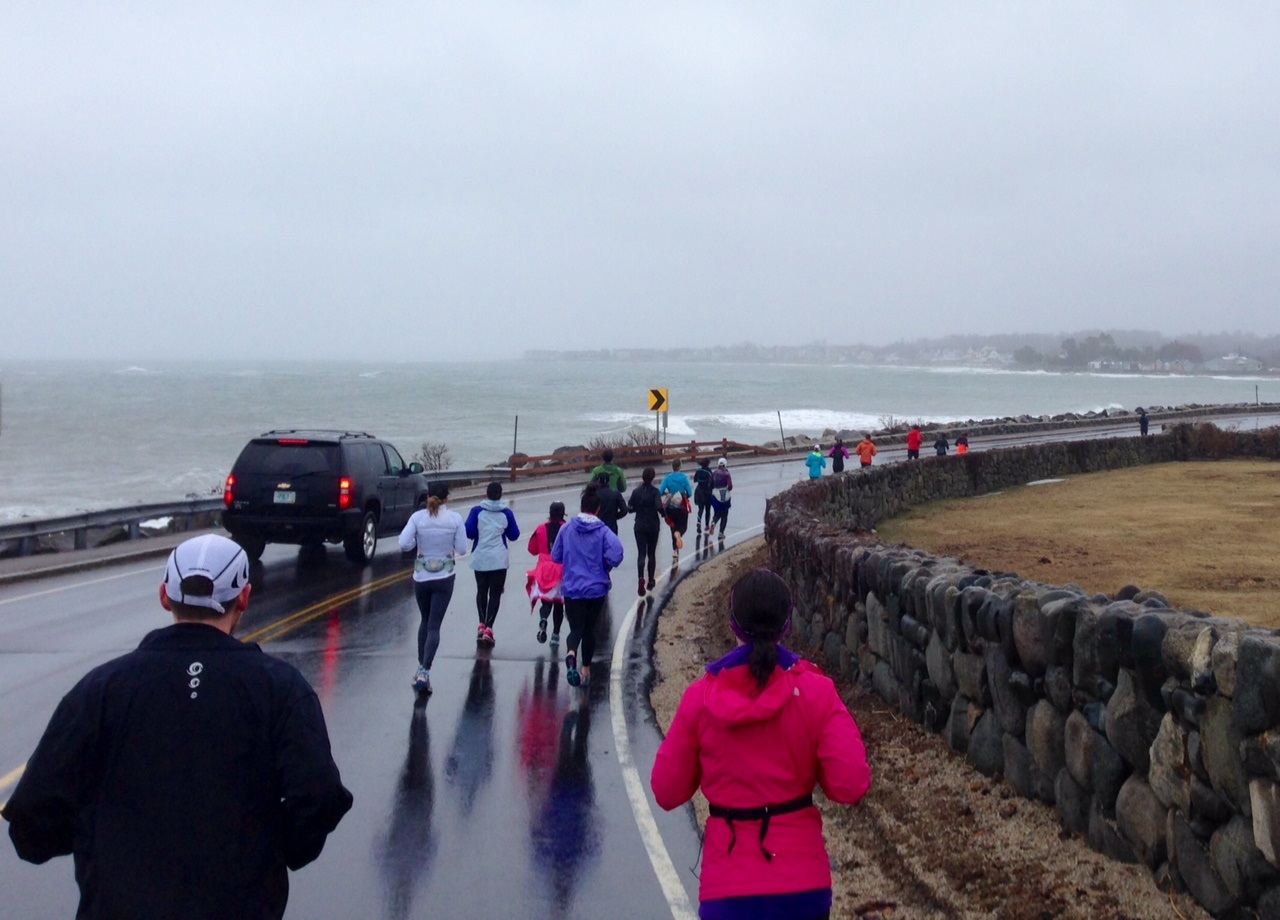
So far, my theory that losing weight will make me run faster appears to be correct. I took part in the Run for the Border Half Marathon on the New Hampshire coast this past Sunday.  It was raining, windy and cold – I got hit by foam and sea water from waves that crashed against the seawall and sprayed onto the race route! Because of the crazy weather and coastal flood warnings, the race was shortened to 10.19 miles. I surprised myself by racing at a 9:02 per-mile pace, much faster than expected. Last year’s half marathon results were all slower than this, ranging from a 10:27 per-mile pace in Middlebury in May, to a 9:20 pace down in Manchester, Vermont, in early September. I felt very comfortable the whole race and definitely had more in the tank when I crossed the finish line.

Image

(My vantage point running the Run for the Border Half Marathon in coastal New Hampshire on March 30, 2014.)

Over the past three months, the most important thing is that I had decided to reward myself early with a trip to Laos. Since I was saving well over $4,000 this year by not drinking, and it was burning a hole in my pocket, I deserved a big reward for all of my efforts. My 10-day trip was unforgettable and under budget — around $2,500. Later this year, when I reach all of the other goals I’ve outlined, maybe Bruce and I will take another trip together to celebrate.

From the Mailbag

Standard

Image

Since the idea of my New Year’s resolution and this blog came to me rather suddenly over the holidays, I didn’t have time to develop any expectations. It took me completely by surprise that 100 people would actually “follow” me and that dozens would take time to comment here or privately. These messages range from support for my journey, to thanks for offering an inspiring example, to challenges to my assumptions and opinions. Increasingly, folks are asking thoughtful questions about me and this experiment. This “From the Mailbag” post addresses three of the most thought-provoking responses from this past month.

Why did you really start this blog?

My sister-in-law, Martha, asked me to expound upon the other reasons, besides losing weight and running faster, that led to my decision to start this blog.

Several weeks ago, I wrote about how saving money was my #9 of 9 reasons for this project. In fact, I have journal entry in my “Dry Year” diary that was written on January 7th titled “Top 5 reasons why I’m not drinking.” The list ran longer than 5, but didn’t quite reach 10. The order below is exactly as written, and may or may not reflect the order of priority.

1. I fear becoming an alcohol abuser, because of family history.
2. I’ve recently done a lot of personal research for my memoir and the theme of alcohol over-consumption is one that is difficult to ignore.
3. I want to see if I can do it.
4. I’ve tried with moderate effort and no success to cut back consumption in the past.
5. I thought it would help me lose weight.
6. I thought I would free up time for more important things.
7. I thought it would be a very interesting topic for a blog and I need one to promote my upcoming memoir.
8. I thought it might make me a faster runner.
9. To save money.

Is it common for someone to quit drinking for just a year?

This question comes from fellow blogger, Terry McCarthy. As he put it: “I don’t think I’ve ever heard of anybody quitting for a year. As they say in AA, take one DAY at a time.”

Many more people have written about quitting drinking for a month or even 100 days. And, although I didn’t know this when I started this project, I have found a few people who also tried this for a year and wrote about it, including this guy and this woman. My true goal regarding alcohol is moderation, so I didn’t go into this thinking that I would quit drinking forever. I felt alcohol was preventing some of my other goals, so I wanted to take alcohol out of my life for a significant length of time. On one level, this resolution is a social experiment.

If you achieve your goals during your “dry year,” why bother drinking again?

This comes from my friend Rose, who is a teetotaler herself: “I love reading about your journey and I’m rooting for you! Are you thinking of quitting for good? I mean, after you succeed in losing the weight, and you will, and running so hard that you get your PR, why go back to it? Just a thought.”

This is similar to Terry’s question, but is more direct. Of all the comments I have received, I have thought about this one the most. It is much easier for me to think about this as a one year “project.” Once I’m further down the road, I will have a better idea of what the ideal future should be. No one knows what the end of this year will bring. As I get deeper into this journey, I may come back to this question several more times.

I hope that you’ll keep the comments and questions coming. If so, I’ll do a “From the Mailbag” post every month.

Pushing Past the Plateau

Standard

The connections between drinking or not drinking alcohol and gaining or losing weight are obvious and well-documented.  As I previously stated, one of my motivations in pledging to not drink for a solid year was to drop a few stubborn pounds.  Thus far, not drinking has helped me to lose eight pounds with relative ease. Yet, for the past month, I’ve been going up and down in a range of two-three pounds, at the same “weight plateau” that has irked me since before my 40th birthday.  Having given up so much this time, I am determined to break through and, once and for all, return to my goal weight. This raises two questions with me: Why am I at a plateau? And how do I push past it?

The Mayo Clinic does a great job of describing this plateau. It happens when your metabolism slows as your body gets used to the new level of reduced calorie intake, something they refer to as a “new equilibrium.”  Unfortunately, there’s really only one way to push past it, according to the Mayo folks: “To lose more weight, you need to increase activity or decrease the calories you eat. Using the same approach that worked initially may maintain your weight loss, but it won’t lead to more weight loss.” Translation: losing 12 more pounds is going to be hard work. 

Luckily, there is by far more helpful advice on this topic than for any other I have researched for this blog. Let’s check in with Jillian Michaels, weight loss and fitness guru, and the star of the “Biggest Loser.” She thinks the plateau is a myth, so I need to honestly ask myself a few questions. First, am I keeping track of my daily calories? Yes. I’ve been using MyFitnessPal to track everything I eat, as well as all of my exercise. Secondly, am I trying to lose vanity pounds? To answer this question, I need to understand how much of my body is actually fat.

Image

Previously, I calculated my Body Mass Index (BMI). For my height of five feet, seven inches, a “healthy” BMI is between 18.5 and 25. Checking my current BMI at my weight plateau of 150 pounds, I see I’m in that range, with a BMI of 23.5. However, after reading more about BMI, including this NPR article with 10 reasons why BMI is bogus, I understand that BMI was developed over 100 years ago and is a straight formula based only on height and weight.  It doesn’t really take into account anything important – such as gender, age, or musculature.

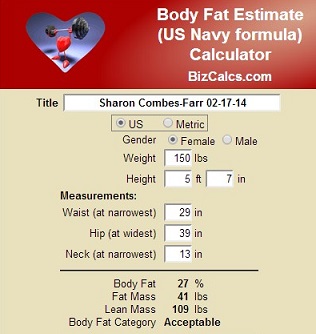
Sadly, this means I had to take out my tape measure so that I could estimate my actual body fat. I used this calculator from the U.S. Navy. I took three measurements: my waist at the narrowest point (29 inches), my hips at the widest point (39 inches), and my neck at the narrowest point (13 inches).  This estimates my body fat at 27%. I know that is too high. According to this chart, it’s in the middle of the “average” category for women. I don’t want to be average. I want to break into the top end of the “fitness” category, which is between 21% and 24%. Some of you will, no doubt, debate this. However, my answer to Jillian’s second question is, no, I am not trying to lose vanity pounds.

Given that, I need some solid strategies to lose 12 more pounds to get to my goal weight of 138. Among several other suggestions out there, WebMD has 10 tips for moving beyond the plateau, as do About.com and ActiveBeat.com. I don’t know about you, but 10 things seems like a lot to keep track of. The solution to this, as with all things, is to create a spreadsheet. I tracked the tips from these three sources and found they contained a total of 22 different tips. I was able to scratch off a bunch of these, because I am already doing nine of these things, and, frankly, another five of them just seemed lame.

My analysis left me with eight things to focus on, five of which are diet-related and three about exercise. On the food side, I need to beware of calorie creep, celebratory calories, and restaurant overeating, and try to manage my hunger with low-fat protein and by eating more fruits & veggies. This seems like solid dieting advice. At the same time, I need to add in more exercise, particularly by trying to be more active during the day and by adding strength training.

Like I said, this is going to be hard work. Wish me luck!

Lose Weight, Run Faster

Standard

As you can imagine, taking alcohol off the table is a good first step for both my diet and training goals. I’m encouraged that I lost 6 pounds so quickly and also that I felt great on my 6 mile run earlier today. In this post, I focus on two questions. Exactly how does alcohol impact diet and exercise? And, given my two ambitious goals, where do I start?

This article is a great summary of the detrimental effects consuming alcohol can have to your body and diet. In a nut shell, the human body has trouble processing alcohol, because it contains a bunch of calories with no nutritional value. This can slow your metabolism and contribute to weight gain, not to mention the direct effects of consuming all of those empty calories.

Alcohol also has several negative impacts on athletic performance, such as causing dehydration and reducing performance through lowered glucose production.  This summary article provides more detail on this, as does this one from the Guardian, and this one from Runner’s World; the latter focusing on impacts to running performance. The best one-stop-shop on the range of negative impacts alcohol has on the athlete is this amazing brochure from Princeton, produced by the NCAA.

Given all of this, I’m really happy I don’t have to worry about how drinking wine is going to affect my diet and my marathon training this year. It took just a few additional minutes of research and a lot of common sense to realize that I should lose the weight first and then concentrate on my training.

Exercising certainly can help you to lose weight. But, the reverse is also true. I noticed as I trained for multiple long distance races through the years that it’s a real pain to lug the extra pounds around, literally and figuratively. I also found that when I’m seriously training for half and whole marathons, I tend not to lose weight, because I eat more, both from being hungrier and from feeling I’ve earned it.

Making more progress on losing weight will surely lead to faster running times, and hopefully that marathon PR in July. How much faster should I expect to be? According to Runner’s World, if I lose 10 pounds, I should be able to shave 20 seconds off of my per-mile pace. Other blogs and articles, like Active.com and Livestrong.com, also echo this view. This means I could see an automatic 30 second reduction in my pace, if I lose 15 of my 20 pounds prior to the start of my running season. (I’ll worry about the final 5 pounds later in the year.)

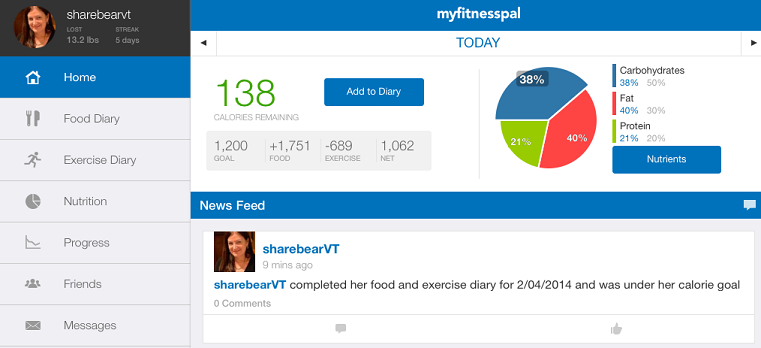
With these multiple inputs and outputs, how am I going to keep it all straight to make sure I actually lose weight? That’s easy. I’m going to use MyFitnessPal to track my calorie consumption and stick to a specific daily calorie target determined by my goals and inputs when I created my account. As I exercise, I also log that into the daily diary and it will allow me to consume more calories.  It’s easy to use and completely free. I use the mobile app version and do most of my tracking on my iPhone. There are a ton of great features, including a prediction when you complete your daily log of what you will weigh in 5 weeks, “if every day were like today.” This is motivational both on good days and bad.

Image

This month and in March, when push comes to shove, I commit to focusing on my diet first and my training regime second. Hopefully, I’ll get within 5 pounds of my ideal weight by April Fools’ Day, allowing me plenty of time to crank up my training schedule for the race season. If all goes according to plan, I’ll be aided by a 30 second reduction in my average pace from the weight loss alone.