Dinner Is Served

Standard

Six weeks ago, I added a new thread to my blog to give voice to the rich lore resulting from my parents’ 36 years as Vermont innkeepers. There’s only 62 weeks until their expected retirement, so it’s time to get cracking on documenting these stories.

First, I want to explain my process. I rely on a combination of my own memories growing up in the inn and recollections of my mother’s re-telling of events to come up with the subject for each post. Then, I interview my parents, usually over dinner, to fact check my memory, gain more context, and add dimension to each story. At last Sunday’s dinner, a few questions about serving dinner at the inn yielded so much material that this post only includes stories from the first year.

CFI Menu Cards and Ads

(Above: Saved menu notes and weekly newspaper ads from the inn’s first year of serving dinner to the general public.)

In a previous post, I explained that my parents started renovating the property that became the Combes Family Inn in March 1978 and we hosted our first inn guests that August. After working out some kinks in the rooms business and making additional renovations, the three innkeepers were finally ready to serve dinner to guests by October. In the inn-keeping world, it is much more prestigious to serve dinner, in addition to offering bed and breakfast (“B&B”). As my mom explained: “Before moving to Vermont to become an innkeeper with us, your Aunt Nancy had taken a commercial cooking class on Long Island, so we thought we were hot shit.”

The very first dinner guest of the Combes Family Inn was a gentleman in his 80’s who booked a week by himself during the October foliage season. The first night of his stay, Aunt Nancy decided to make a recipe from her cooking class, Beef Rouladen in Burgundy Sauce.  “It came out so rich,” my mom recalls, “we thought we had killed him.”

Beef Rolade

(Above: My Aunt Nancy’s Professional Chef Cook Book, open to the page with the recipe she and my mother served their first dinner guest.)

The following month, the inn-keepers were getting ready to start preparations for Thanksgiving dinner and discovered that they had run out of propane and couldn’t light the stove. My dad frantically tracked down the guy at the local gas company. Unfortunately, after listening to my dad’s sob story about needing to cook for a house full of people, he replied: “I have my own problems.”

Undeterred, Dad made a few more calls and came up with a plan. He jumped in his Blazer with the turkey and headed down to our friend Jerry’s restaurant, the Winchester. Jerry had cranked up his stove to 500 degrees and proceeded to cook our turkey for the hour that it took my father to drive to and from Chester, where he picked up a hand-held drum of propane, something he wasn’t even sure was legal.  

In spite of the drama, Mom swears it was the best tasting turkey they’ve ever served.

Bill’s Super Quick Thanksgiving Turkey Recipe

Unstuffed 20-pound turkey.
Salt and pepper rubbed inside.
Place in turkey roasting pan with an inch of water.
Cover.
Cook at 500 degrees for one hour.

The day after Thanksgiving, Dad made two phone calls. First, he called a different propane company to promptly switch-over the inn’s service. Second, he called the original company and left the following message: “This is Bill Combes from the Combes Family Inn. I’m disconnecting my service. Now, my problems are your problems.”

What happened that New Year’s Eve is a story I remember like it was yesterday. We had a large group of 5 or 6 Japanese families who stayed at our inn, while they were skiing at Okemo Mountain. My Mom, Dad, and Aunt Nancy put together this impressive menu: roast beef, twice baked potatoes, Yorkshire pudding, glazed carrots, home-baked bread, and chocolate mousse.

When Dad took the beef out of the oven to get drippings to make the Yorkshire pudding, there were no drippings and the beef looked like a huge leather shoe. That’s when he discovered that he had bought a pre-cooked roast beef (usually used to slice off luncheon meat) and not a raw beef slab. Lacking other alternatives, they reluctantly served the beef, carrots, bread and potatoes, without the Yorkshire pudding. The guests were so polite that nearly every one of them asked for seconds. I am the only member of my family who entertains the possibility that our Japanese guests actually liked the beef.

Bill’s Yorkshire Pudding Recipe

Eggs, whole 20.
Milk 2 qt.
Bread Flour 2 lb.
Salt 1 oz.
Butter, melted 24 oz.
Drippings from Roast Beef (fat only) 24 oz.

Break eggs in mixing bowl; beat well. Add milk; mix well. Add flour and salt; beat until smooth. Beat in melted butter.

Place 12 oz. drippings in each of 2 15- x 18-in baking pans. Place pans on range and when smoking hot, divide batter evenly between pans.

Place pans in 375 degree oven on shelf in bottom half. Do not open door for 25 minutes; total cooking time, 35-40 min. Remove from oven and drain excess fat by tipping pan. Cut in squares to serve, 25 portions per pan.

The following summer, my parents and Aunt Nancy decided to serve dinners to the general public, in order to generate cash flow to help keep the business going through the slower summer season.  I should explain that the Combes Family Inn has always had one seating each night for dinner (7pm Thursday through Saturday and 5pm Sunday) and serves the same three course meal to each guest, unless there is a prearranged special request. The menu changes nightly.

The innkeepers promoted their new dinner service throughout 1979 and 1980 with ads in the local weekly paper which included the dinner menu for the three course meal planned for that Thursday, Friday, and Saturday night, as well as a Sunday buffet. Each night, the meal was $5.95 complete with dessert and coffee. BYOB.

One night, they had 12 reservations for outside diners. The menu included stuffed pork chops with homemade apple sauce, corn chowder, scalloped potatoes, green beans, and apple crisp. At about ten minutes before 7pm, Mom was just about to go into the sitting room to chat with the guests before ringing the dinner bell, when she checked the progress of her pork chops and discovered that she had never turned the oven on. Instead of grabbing the dinner bell, she cranked the oven up to 450 and went into the sitting room and said “Good evening, I’m Ruth Combes, the innkeeper. Dinner’s going to be a few more minutes.”

Ruth’s Apple Sauce Recipe

5 lbs regular Macintosh apples.
1/4 c. water, apple cider, or apple juice.
1 T lemon juice.
1/2 c. brown sugar.
Cinnamon (to taste).

Slice apples. Do not peel or remove cores. Put apples, sugar, and liquid in large covered pot and cook over medium flame for about 1/2 hour or until apples are tender. Put apple mixture through food mill (this is a great kitchen gadget, especially for pureeing soups and vegetables). Add lemon juice and cinnamon.

It may not seem like it based on the stories I’ve told above. However, my parents are both excellent cooks. And, needless-to-say, dining at the Combes Family Inn is a truly one of a kind experience. 
It Was Like Camping

Standard

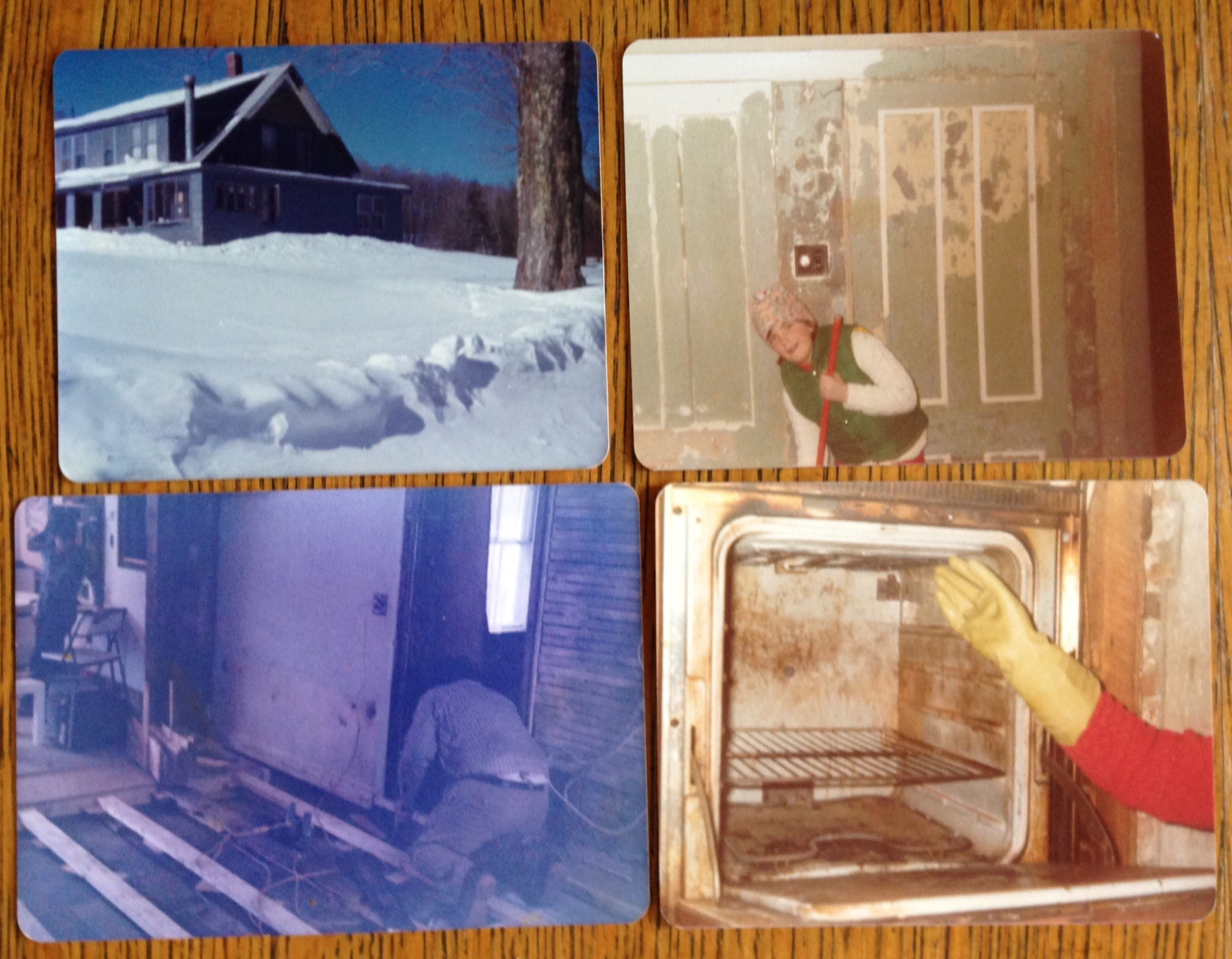
Before CFI photos

I had no idea that my threat to reveal my parents’ inn-keeping stories would get such an enthusiastic response. Given that it did, I decided to strike while the iron is still hot. I’ve been telling my own stories about the inn since I was nine years old. This post includes some of my memories from those first few days in March of 1978, when we first moved into the inn. Next time, I’ll follow up with recollections from that same period, from my parents, innkeepers Ruth and Bill.

Last time, you were left with the image of me crying in the car, not wanting to come to grips with the reality that, after all, I wasn’t moving to the Snow Mansion on the hill as I’d been fantasizing I would. Instead, our new home was a decrepit and, frankly, filthy, old farmhouse that was several years removed from its glory days as a vibrant and beautiful working farm. That is was at the gloomy end of a long winter when we took possession didn’t help matters, since the property seemed even more barren in the ice and snow.

My father lured me out of the car and into our new life by promising me that it would be like camping. And, in the beginning, it really was.

Since the inn was not going to be livable until the garbage was removed and it was properly disinfected, the six of us — our family of five and my dad’s sister, who was co-owner of the soon-to-be Combes Family Inn — took up residence in three of the motel rooms that the previous owner had built as outside units, separate from the main house. These had been the previous owner’s main source of income, particularly during ski season. Our family project was to turn the main farmhouse itself into a beautiful inn, filled with guest bedrooms and common rooms, in addition to upgrading the motel rooms.

My parents moved into room number three, while my brothers, Billy and Wayne, shared room number two.  My beloved Aunt Nancy and I shared room number one, which was closest to the main house. I adored my Aunt Nancy. Before she lived with us at the inn in Vermont, it was always the highlight of my summer to spend time with her. Over the years, she had taught me how to make beds with hospital corners, how to cook scrambled eggs with cheese and how to play various card games, “rummy 500” being my favorite.

This arrangement lasted for the two weeks it took all of us to clean out the farmhouse. Day one after the move, brother Billy was already loving the new adventure, because mom gave him a crisp twenty dollar bill to clean out a particularly nasty cupboard. He still recalls this story fondly. I, on the other hand, don’t remember about the cleaning phase—I’m sure I’ve put all that nasty business out of my mind! However, I have two strong recollections about those first few days.

One is of my first day joining the fourth grade at Ludlow Elementary School. Kim Benson, who became one of my best friends all through school and is still my friend today, asked me where I was from. When I answered “New Hampshire,” she declared “You are not a flatlander.” As that first day wore on, Kim introduced me to each classmate with the same odd introduction: “This is Sharon, she’s not a flatlander….” I could tell by the reaction of the other kids that this was a very good thing to not be a ‘flatlander’, although I had no idea what it meant. It was so exciting, in fact, that when I got off the school bus that first afternoon, I announced to my parents, “Mom, Dad, guess what? I’m not a flatlander!”  

My other memory of that period was my recognition that Dad was right, it really was like camping. My Aunt Nancy told me stories at night in our motel room before we went to sleep, which reminded me of being around a camp fire. And, since we weren’t yet able to use the kitchen inside, there were many nights that we heated up dinners camp-style, on a little hot plate, and ate them in the motel rooms.

So it was that despite my initial reluctance to step out of that car and into our new life, all of my memories about the start of the incredible adventure called the Combes Family Inn are fond and happy.

Old Stories through New Eyes

Standard

A few weeks ago, my brother sent me a very interesting New York Times opinion piece that’s on topic with the “Dry Year” thread of this blog. In it, poet John Skoyles reveals how he had spent much of his graduate school years drinking heavily, and had engaged in risky behaviors as a result. In fact, he wrote a memoir about it called “A Moveable Famine” without realizing that his own alcohol abuse was a theme in the book. It wasn’t until he reflected back on his story after reconnecting with an old girlfriend that he acknowledged his alcoholism. Although I considered reading the memoir, I’m hoping he’ll write another one that looks back on that time with new eyes.

In the same email in which he alerted me to Skoyles’ article, my brother also suggested that I consider adding a new thread or two to my blog, in order to keep people interested and entertained. He felt I needed to branch out from my too-narrow focus on not drinking, dieting and running. I couldn’t agree with him more, so, as a result, I’m introducing a new thread related to the memoir section of my blog.

My two brothers and I grew up in a busy inn, in a Vermont ski-resort town. Although hard to believe given that they’re now both in their 70’s, my parents still run the very bustling Combes Family Inn. Through the years, my mom has threatened now and then to write a book filled with stories from her and Dad’s 36 years as innkeepers. Since they’ve recently begun formulating their retirement plans and even picked a tentative date for closing the doors on their business, I decided it’s time to help Mom document some of her favorite inn-keeping stories.

My parents, while in their mid-30’s, had a dream of becoming innkeepers, long before it became fashionable. My mom was always a great cook and my dad an exceptional handyman. When our original hometown in New Hampshire was becoming over-developed, they began looking for an inn in earnest. They looked for two years to find a suitable one in either rural New Hampshire or Vermont, where they could raise their three young children while creating a business.

My mom’s story doesn’t make sense unless you understand how vibrant and beautiful the inn and its property are today. The photos below give you a taste of what I’m talking about. There are two photos of the inn and the grounds today and four of the “before” pictures.

“I’ll tell you the very first inn-keeping story that I want people to know,” Mom said the other night, after I mentioned this new idea for a blog thread. She was addressing me, my father, my husband Bruce, and my brother Bill, who is visiting for the long July 4th weekend. “The story relates the moment when we all walked through that door, as we took possession of the house in March, 1978,” she said.

“The entrance way had piles of garbage and large, opened bags of large-animal feed. Wafting out of the first room beyond the entrance was the smell of animal feces. A quick look inside, revealed more garbage and a partially collapsed ceiling,” she related. “Our cat, Gimpy, was so skeptical about the place that he wouldn’t walk through the doorway. I’ll never forget that I turned to look at my eldest child Billy, after Gimpy walked away from the front door. Billy, who was just 11 years old at the time, shook his head and asked ‘What have you gotten us all into?’”

Little did any of us know then that 36 years later the inn would be still be in business. Although I have heard the story a million times, I have no recollection of the cat’s disgust or my brother’s reaction, because, in a similar reaction as my cat, I ran back to the car and refused to get out again. I just sat in the car and cried. When my parents came back to force me out, I kept screaming “I want to go to the Snow Mansion!”

I was referring to one of the handful of other inns my parents had looked at before finally selecting the ramshackle farmhouse.  What I called the “Snow Mansion” was really the Snowvillage Inn, a resort near Conway, New Hampshire that had a large pond, tennis courts, and rolling fields. It’s still around today. This is what it looks like now. When we left our home in Merrimack, New Hampshire, in my mind, the Snow Mansion was the type of place we were moving to.  In fact, it was with considerable pride on my last day in elementary school that I told everyone I was moving to the Snow Mansion.

What my nine-year-old self and my cat Gimpy couldn’t conceive of was the potential that my parents had seen in the place. According to my mother, as she reflected back on why they risked uprooting their three young children and moving to start a new life in a house that could truthfully be described as “a dump”: “It was a place we could put our own mark on and start our new business slowly. We loved the area. It was near a small town with a village center with a growing ski resort, and it had a local school for you kids. And, on top of all that, the house itself had more than 50 acres and was on a country back road with a great view.”

Once each month, I’m going to interview my mom and share her stories. Some of them are absolutely hysterical.