
Next school-year, I’ll be teaching a handful of high school marketing classes for the very first time—but here in the blog, I’ll be focusing on the first semester of the first-year course: Intro to Marketing.
As I think about how to open that class, one idea keeps rising to the top: what if we start with personal branding?
Instead of beginning with textbook terms or the traditional marketing mix, I’m exploring the idea of starting with something more personal and reflective. My plan is to guide students through a multi-day project where they build their own personal brand. It’s designed to help them connect with marketing through their own identity, strengths, and style.
Due to our early school year with a partial week before Labor Day, I’m developing this mini unit in a three-day format. I’m still refining the structure, and I’d love input from other educators, marketers, or anyone who works with students.

Why Personal Branding?
Marketing is about value, differentiation, and storytelling. Helping students define their personal brand gives them a framework to understand all three. It encourages self-awareness, reflection, and the ability to communicate what makes them unique—skills they’ll use in everything from job interviews to presentations to future campaigns.
The first unit in the course is called “Marketing is All Around Us”—so what better place to start than with the us? Beginning with personal branding allows students to immediately see marketing as something connected to their everyday lives. It also helps me get to know my students as individuals: what motivates them, what they care about, and what kinds of brands, causes, or voices they gravitate toward. It’s a foundation for building a strong learning community.
The Project
Here’s what I’m envisioning for the first three days of Intro to Marketing:
- Day 1: Students explore the concept of branding by identifying three favorite companies and three public figures they admire. They also begin reflecting on personal strengths and interests.
- Day 2: Students write a personal tagline and draft a one-sentence mission statement based on their reflections. We’ll use brand examples to guide them.
- Day 3: Students finalize their personal brand posters using tools like Canva, Google Slides, or PowerPoint—or they can use the template I created. Posters include their tagline, mission, visual style, and personal values. We’ll wrap up with a gallery walk or group discussion.
I Tried It Myself
To test the idea, I created my own version. I picked well-known brands that I use often (like Target and Asics) and figures I admire, including Christiane Amanpour and Rafael Nadal. [I removed copyrighted images for this blog post.] My tagline is “Learning Through Living. Teaching Through Doing.” and my mission is to translate real-world experience into meaningful, relatable lessons that help students grow as marketers and as people.
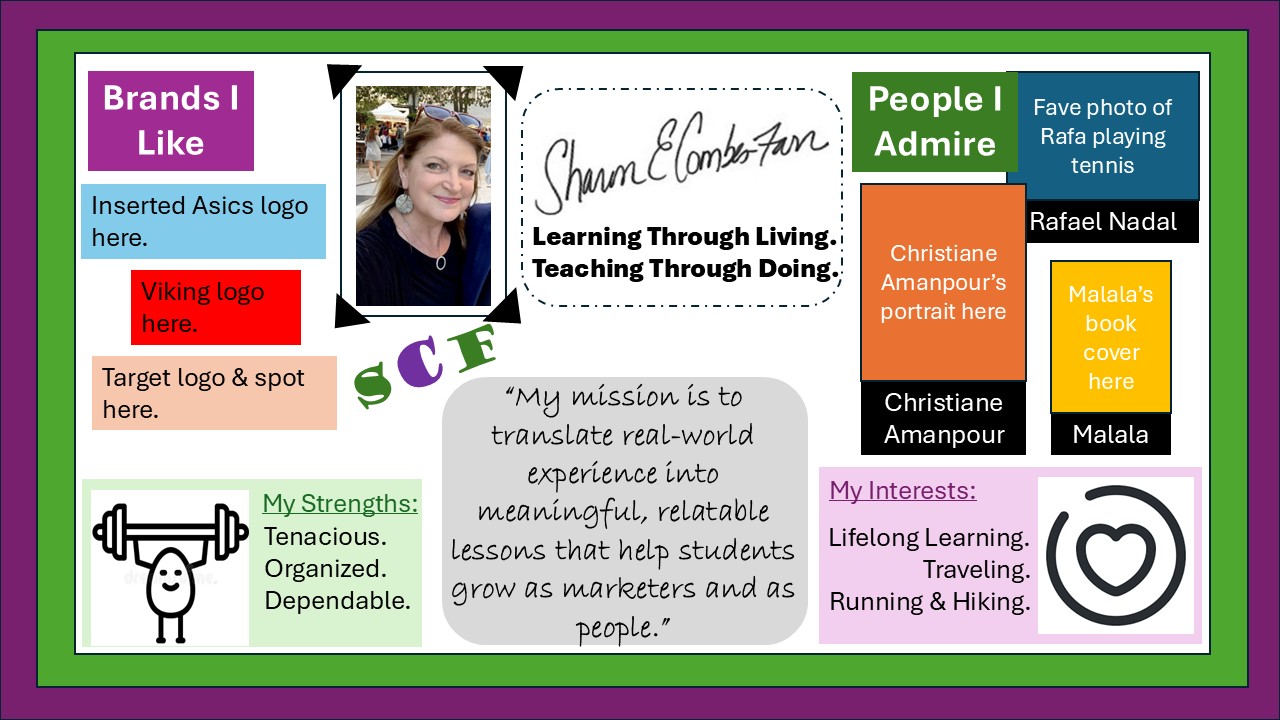
It pushed me in great ways—especially creatively. Trying to design a logo and thinking visually reminded me how easy it is to feel stretched in a new domain. That’s a big part of my philosophy: I’m a lead learner. I expect to grow alongside my students.
What Students Might Learn (and What I Hope to Learn About Them)
I’m hoping this project can uncover strengths and interests early—beyond what traditional introductions offer. It could build confidence, spark creative energy, and surface key marketing principles like segmentation, positioning, storytelling, and brand identity.
But I know I’m still early in shaping this. I’d love to hear from others who’ve tried something similar—or have suggestions to take it further.
What Do You Think?
Have you used personal branding projects with students? Or done something similar in a workplace or training environment?
I’d love to hear your feedback, ideas, or favorite resources that could enrich this unit.
Please follow my blog and share it with others who might have insights to offer.


 Detours & Destinations